Book Review
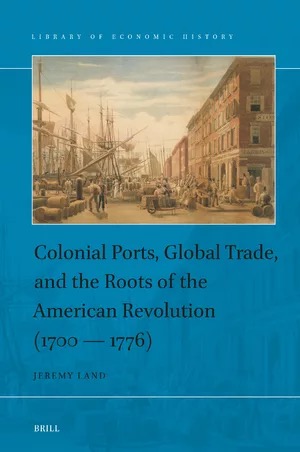
Land, Jeremy. Colonial Ports, Global Trade, and the Roots of the American Revolution (1700 – 1776). Library of Economic History, vol. 18. Leiden; Boston: Brill, 2023.
Bilateral commercial relationships in which colonies ship raw materials on vessels financed by the parent state and, in turn, the metropole exports manufactured goods to overseas settlements is the presumed operating model in a colonialist empire. In his new book, Colonial Ports, Global Trade, and the Roots of the American Revolution, Jeremy Land argues that this standard colonial exchange model does not adequately describe the trade relationships between eighteenth-century Britain and its North American colonies. The Atlantic World economic historian believes North American merchants engaged in more complex and diverse trading relationships in and beyond the British Atlantic world. He concludes that the Americans fought a war not only for political autonomy but to “win access to global commodities and markets” (182).
The post-doctoral scholar at the University of Gothenburg outlines his arguments in an introduction and delves into supporting details in six chapters rich in accompanying economic data, each with summary conclusions. Land starts by describing an integrated trading complex among the cities of Boston, New York, and Philadelphia. These three cities shared supply chain hinterlands and forelands, competing for North American coastal and metropole trade. Inventive merchants established ways to promote local economic development and “overcome the disadvantages of being on the edge” of the British Empire. Due to a lack of specie, innovative merchants engaged in private and public communications using “clever accounting methods and a mixture of payment methods….to overcome shortages of currency and lack of financial support from the metropole (69). The resulting commercial networks flourished, aided by resisting local and metropole policies, which limited or taxed free trade.
As a result of the burgeoning North American economies, coastal and metropole trade greatly expanded, especially in the Boston, New York, and Philadelphia ports. With their newfound purchasing power, Americans imported luxury goods, clothing, and raw materials. Land provides extensive import/export tables delineating merchandise and foodstuff quantities and values. The three most significant import products are molasses, rum, and sugar, demonstrating the importance of the Caribbean trade. Additionally, Boston, New York, and Philadelphia ports received over eighty percent of the nearly five million pounds of tea legally imported from Britain. The American taste for tea was prodigious, with illegal imports totaling three times the East Indian company tea (82). In addition to products within the British Empire, demand for products in other trade networks engendered Americans to disobey the Navigation Acts, seeking direct trade outside the empire.
While Atlantic trade steadily increased, inter-colonial trade was worth more than British commerce. Over half the ships’ entrances and clearance were from and to other American ports (118). Driving this coastal trade were foodstuffs, including dried fish, flour, and bread. Tobacco and rum exports were also important, especially to the West Indies. These exports helped to finance imports of British luxury items.
Americans were not satisfied with limiting their commerce to the British Empire. American merchants heavily engaged in other trans-oceanic trade. Land provides evidence that “trans-imperial trade likely exceeded direct trade (especially in the export sector) between the region and Britain” (121). While prohibited, British authorities could not enforce the Navigation Acts with only five customs offices in North America. Land estimates that “at least seventy-five percent of all commodities consumed and purchased through the Atlantic were likely smuggled into their final destinations” (127). Spanish data corroborates this estimate, with over seventy-five percent of ships entering Bilbao sailing directly from New England ports. Many British merchants believed the Americans were “overstepping their place in the British Empire” with their trans-imperial trade, creating another impetus for rebellion and independence (150).
Due to limited resources and long coastlines, ineffective customs enforcement allowed the Boston, New York, and Philadelphia port complex to become increasingly a trading powerhouse, further emboldening American merchants to confront British officials. Parliament passed the Sugar, Stamp, and Townsend Acts in response to raising import duties and other taxes. Only the Sugar Act materially generated tax revenues. The inability to collect duties created increasing friction between increasingly wealthy American merchants and metropolitan politicians.
Land believes that commercial and trade tensions were a significant factor in the outbreak of armed hostilities and the war for independence. Americans resisted British mercantilist policies and sought better and more profitable commercial opportunities, including those outside the British Empire. As a result, access to global markets became a clear ambition for the rebellion. As evidence, Land notes that the newly freed Americans quickly expanded East Asian trade and that Sweden opened Boston and Philadelphia consulates in 1783.
One area that Land could have further developed was the trans-Atlantic slave trade and its importance to North American commerce. He cites the existence of the triangle trade, and the importation of enslaved people was an essential component of trade with the Spanish and Portuguese Empires. Despite extensive economic data on other trade, Land does not estimate the number and commercial value of the American slaving ventures. Assisting readers in determining the impact of slavery on commerce would help better describe the importance of slavery to the development of the American economy.
Despite not fully addressing the slavery issue, Land’s work successfully challenges the standard colonial/metropole trading model. He unequivocally demonstrates that inter-coastal and trans-imperial markets were commercially more important than trade with Britain. Further, London did not finance most trade, and American ships, except in South Carolina and Georgia, carried the predominant percentage of American commerce. He argues that America outgrew the colonial trade restrictions, leading to the armed rebellion and American independence. Whether or not you agree with his arguments, I recommend that readers approach his well-reasoned work with an open mind and thoroughly digest the extensive tables and data sprinkled throughout the monograph and the appendices.
Another view on Land’s book
Grant Kleiser. Review of Land, Jeremy. Colonial Ports, Global Trade, and the Roots of the American Revolution (1700-1776). H-Early-America, H-Net Reviews. February, 2024.
https://www.h-net.org/reviews/showrev.php?id=60322
Discover more from Researching the American Revolution
Subscribe to get the latest posts sent to your email.
