
With a growing number of books on Revolutionary Era women, five “must-read” books form an essential knowledge baseline for scholars and casual readers. These volumes provide a fundamental understanding of women’s vital roles and contributions. I recommend readers new to Revolutionary Women’s studies prioritize reading these books before venturing into the many other excellent monographs. The selected volumes encompass diaries, primary source compendiums, and interpretive secondary sources.
Diaries and Memoirs

Drinker, Elizabeth Sandwith, and Elaine Forman Crane. The Diary of Elizabeth Drinker: The Life Cycle of an Eighteenth-Century Woman. Boston: Northeastern University Press, 1994.
Between 1758 and 1807, Elizabeth Drinker, a practicing Quaker, recounts her Revolutionary Era experiences in Philadelphia. She pens a contemporaneous diary recounting the threats and violence carried out against the neutral Quakers for not joining the Rebel cause. The sections on the 1777-8 British occupation of Philadelphia are fascinating as they describe the conflict’s complexities. Drinker’s diary is an excellent source for understanding the unique women’s troubles during the war and the late eighteenth century.
A copy of Elizabeth Drinker’s diary is available on the Internet Archive website.
Primary Sources Compendiums

Berkin, Carol, and Leslie Horowitz, eds. Women’s Voices, Women’s Lives: Documents in Early American History. Boston: Northeastern University Press, 1998.
This volume contains edited primary source documents depicting women’s lives during the colonial period through the Early Republic. Subjects covered include sex and reproduction, marriage and family, women’s work, religion, politics, and the legal system. After the Revolution, the concept of “Republican Motherhood,” which defined a set of female civic duties, emerged. Mothers were expected to inculcate virtues and values that supported and reinforced the republic in their children and families. It was the first step towards weakening the notion of female inferiority and started the rise in participation in political and civic affairs. The essays conclude with a view on female education. Beginning in the early nineteenth century, women became more and more educated, which was the initial step on a long path to gender-based equality that continues.
Interpretive Secondary Sources

Ellet, Elizabeth. F. The Women of the American Revolution. Nashville, TN: American History Imprints, 2004.
Ellet started her literary career as a published poet, then became the first historian to write about women in the American Revolution. She penned a two-volume set of short biographies of over one hundred women associated with the American Revolution, originally published in 1849. Due to the initial publishing success, she wrote a third volume depicting the roles and contributions of almost fifty additional women. While many nineteenth-century histories are too hagiographic and unreliable, Ellet’s bio compendium represents solid scholarship. Reflecting her more rigorous assessments, she separates supportable histories from apocryphal anecdotes. Her three volumes are good initial sources for overviews of prominent and lesser-known women’s lives. The third volume is available at the Internet Archives.
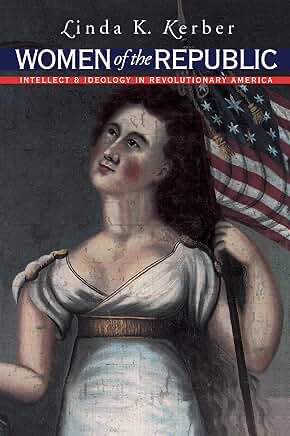
Kerber, Linda K. Women of the Republic: Intellect and Ideology in Revolutionary America. Chapel Hill, NC: Univ. of North Carolina Press, 2000.
Revolutionary America looked to major Enlightenment philosophers for intellectual support for its independence and systems of government. Kerber starts her analysis of women in the Revolution by pointing out that the European Enlightenment thinkers lacked a female voice. This lack of a role in politics and intellectual discourse continued in Revolutionary America.
Disputing the oversight, Kerber argues that women assisted in the revolt from Britain by organizing boycotts, provisioning, nursing, and providing other support to the Continental Army. Kerber points out that women made significant sacrifices but received little credit from contemporaries and historians.
Inheritance and the concept of coverture played a significant role in the lives of Revolutionary women. Men often married much wealthier men, including George Washington and James Madison. Once married, the coverture laws conferred the ownership and control of the wife’s assets to the husband. After the war, many wives of loyalists petitioned the new American governments for the return of their “Widows” third for their husbands’ property, which had been confiscated, turning the coverture laws in their favor. Many of the war’s events were harmful to women. After the war, divorce became more available to redress marriage issues. In addition, the seeds for more extensive educational opportunities were sown. Kerber concludes with the concept of a “Republican Mother” who initiated women into the political sphere, albeit slowly and with considerable difficulty.

Mayer, Holly A., ed. Women Waging War in the American Revolution. Charlottesville: University of Virginia Press, 2022.
Holly Mayer assembled an all-star set of thirteen authors to write essays on women’s active participation and contributions during the American Revolution. Her highly qualified contributors include independent researchers, public historians, military historians, and academics. The essays’ subjects span from Rebel to Loyalist, free to unfree, and indigenous to settlers to provide a comprehensive look at the place and activities of women in Revolutionary Era America. Readers gain an understanding of the impact women exerted on the significant events, as well as hints at further societal changes after the Revolution. With four years of US Army experience, Mayer brings a practical view to military history encompassing all aspects of soldiers’ lives, not just their time in combat. Mayer builds upon her thesis in a previous book, Belonging to the Army: Camp Followers and Community during the American Revolution (University of South Carolina Press, 1999), that the significant women civilian adjuncts actively engendered successful military campaigns and battles.
Additionally, women provided critical contributions outside the military. The beginning portion of her book’s title, “Women Waging War,” demonstrates that women’s contributions were vital for the Revolutionaries’ success, militarily by aiding despite the hazards of active army life and civilly professing and supporting rebellion against Crown control.
These five books will provide a solid foundation for understanding women and the American Revolution. However, many other high-quality books could be included on this list. For a list and description of many more books on Revolutionary women, click here.
Do you have a suggestion for adding and deleting book(s)?
Discover more from Researching the American Revolution
Subscribe to get the latest posts sent to your email.
