
Lender, Mark Edward. Fort Ticonderoga, the Last Campaigns: The War in the North, 1777-1783. Yardley, Pa.: Westholme, 2022.
Book Review
Strategically located on a Lake Champlain peninsula in upper New York State, Fort Ticonderoga is prominently secure in American memory as the commanding “Gibraltar of North America.” Curiously, while the strategic stone fortress regularly appears in French and Indian War and Revolutionary War books, a monograph has not been devoted to the fort’s history in almost half a century. Noted Revolutionary Era historian Mark Edward Lender fills this gap with a scholarly and eminently readable new volume. In a classy gesture, Lender honors Edward Pierce Hamilton, author of the last Fort Ticonderoga monograph, Fort Ticonderoga, Key to a Continent, published January 1, 1964, with the first citation.
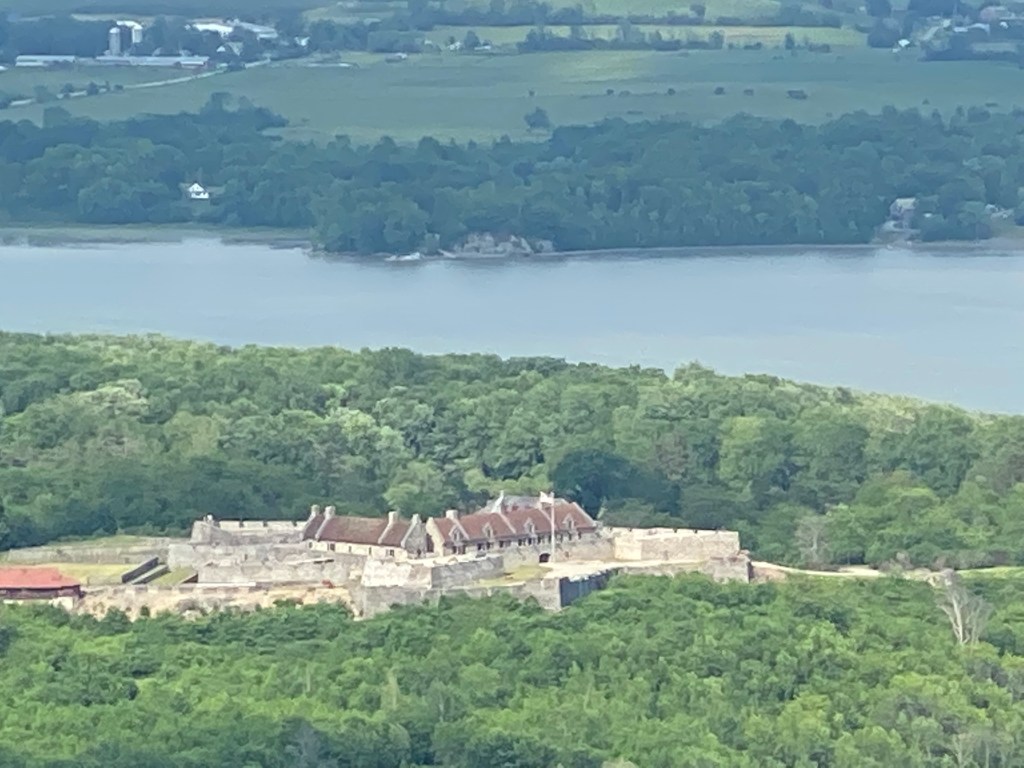
Writing a “biography of a place,” the Kean University Professor Emeritus opens with a background of the fort’s history and geography, noting the fortress’s defenses were less vaunted than its reputation. Geographic weaknesses include nearby hills that could host cannons to bombard the fort, and its siting offers better protection from southern than northern attacks. Additionally, defenders had to devote large numbers of troops to effectively guard multiple attack vectors and ferry supplies from distant places to supply the massive fortress. Determined and well-resourced attackers could and did exploit these weaknesses.
The meat of Lender’s work starts in 1777 when an invading British army from Canada under the command of Gen. John Burgoyne forced a disorganized American withdrawal due to the garrison’s inadequate manpower and inability to fortify the high ground. The aggressive Burgoyne continued advancing southward towards Albany, leaving a small garrison at Fort Ticonderoga to guard its supply lines to Canada. As with previous occupants, the undersized British soldiers guarding the Ticonderoga area were open to conquest. The Americans perceived this weakness and launched a multi-prong attack.
The book highlights one of these attack vectors led by militia Col. John Brown, which led to a highly successful raid on the Ticonderoga peninsula. Oft overlooked or tagged as a mere Benedict Arnold antagonist; Brown was an “early and committed revolutionary” with a “first-rate service record” (120-21). Brown’s “nearly flawless mission” on the Ticonderoga peninsula captured three hundred enemy soldiers and released over one hundred American prisoners of war. The foray garnered seventeen gunboats, two hundred bateaux, and two hundred muskets and ammunition. It was an impressive haul with few Rebel casualties (128). Potentially, if the supporting attack force aimed at Mount Independence, directly across Lake Champlain, under militia Brig. Gen. Jonathan Warner succeeded similarly; Fort Ticonderoga would have also fallen to the Americans. While the British maintained both fortresses, the Rebels cut Burgoyne’s supply lines and retreat path. This doomed Burgoyne’s attempt to sever New England from the rest of the colonies and led to his surrender at Saratoga. With no reason to remain, British forces at Ticonderoga abandoned the fort and retreated to Canada.
After the 1777 Saratoga campaign, no military force garrisoned Fort Ticonderoga other than occasional brief visits. The area devolved into a contested no-man’s land until the war’s end in 1783. Occasional British raiders would occupy the fort, raising invasion concerns among nearby Vermont residents and Rebel forces in the Hudson Valley. One of the most interesting uses of Fort Ticonderoga during this period was to facilitate the Haldimand Negotiations between the British Governor of Canada and the fledgling Vermont polity to renew its Crown allegiance. While not intended as a definitive account of these murky, complex negotiations, the author highlights the role of the Lake Champlain fort in facilitating Vermonter-British communications.
Lender writes with a witty, engaging style. He intersperses wry comments, some of which might evoke a belly laugh. Six maps and seventeen illustrations facilitate the professor’s engaging narrative. While supported by extensive scholarly research, the book is readable by a broad audience. It is particularly appropriate for those planning a visit to the Lake Champlain region.
On your next visit, don’t miss the view from Mt. Defiance. Gazing from the hilltop, you will understand why the “Gibraltar of North America” had an Achilles heel.
Discover more from Researching the American Revolution
Subscribe to get the latest posts sent to your email.
