Book Review
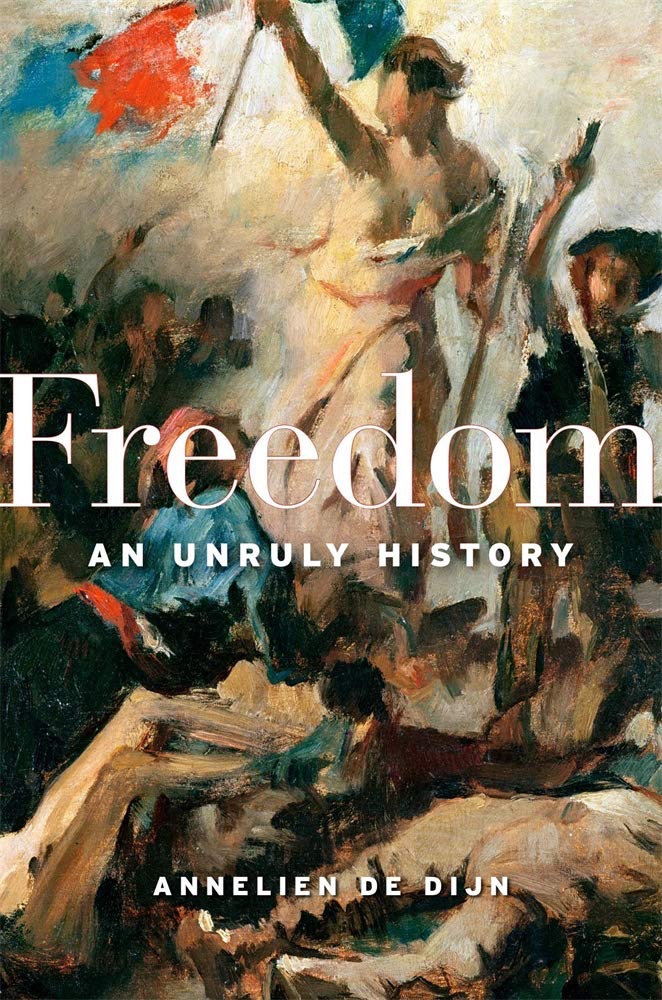
Dijn, Annelien de. Freedom: An Unruly History. First Harvard University paperback edition. Cambridge, Massachusetts London, England: Harvard University Press, 2022.
Readers and scholars of the American Revolutionary Era may fall into the trap of exclusively focusing on the eight years of the War for Independence. This lack of preceding and posterior context can lead to overlooking keen insights into the founding times and missing factors linking to longer-term trends. Reading sweeping intellectual histories such as Annelien de Dijn’s Freedom: An Unruly History is an opportunity to overcome this tendency. Her monograph provides broad perspectives, generates additional perspectives into the founding system of government, and elicits thoughtful insights relevant to current political issues.
While the Utrecht University professor’s book only touches on the American Revolution, she demonstrates that Greek and Roman notions of freedom heavily influenced the founding generation. De Dijn posits a fascinating thesis that Greco-Roman political thinkers believed freedom was the legal opposite of slavery, which permitted citizens to select their governments democratically. This vision of democracy was intellectually kept alive by various political thinkers during the Middle Ages until adopted by American, French, and other revolutionaries in the late eighteenth century. In turn, the Atlantic revolutions influenced succeeding generations. The Modern Political History professor argues that post-revolutionary elites became threatened by majority rule and started an intellectual counter-revolution, changing the definition of freedom from self-government to individual rights and the lack of government control over their actions. She sets up a dialectic tension with two competing definitions of freedom: “freedom of government” and “freedom from government.” Dijn asserts that this conflict continues in our political debates today. Counter-intuitively, she believes that “contemporary enthusiasts of freedom far more resemble democracy’s opponents than its architects” (5).
There is considerable to unpack in her far-ranging analysis of the history of Western political philosophy. Starting with the Greeks and Romans, the concept of freedom referred to the right of citizens, at least some propertied males, to select their governmental leaders. The liberty cap symbolized this freedom, which ancient Romans bestowed upon emancipated enslaved people, denoting their free status. After the fall of Rome, a group of European Renaissance humanist thinkers such as Francesco Petrarch, Leonardo Bruni, and the more famous Niccolò Machiavelli kept alive the dream of democratic self-government.
The rebelling thirteen British North American colonies justified their actions based upon the ancients and humanists’ definition of freedom as the democratic self-government. The First Continental Congress stated in 1774 that the foundation of “all free government is a right in the people to participate in their legislative council” (2). De Dijn notes that the American Rebels adopted the image of a liberty cap to signify their emancipation from British tyranny.
However, with the success of the American, French, and other Atlantic revolutions, powerful elite constituents launched a counter-revolution constraining democratic suffrage and emphasizing personal liberty. Examples of counterrevolutionaries in the Early American Republic include Federalist politicians and, later, conservative Whigs. During the Gilded Age, political scholars such as William Graham Sumner, an influential Yale professor, “vehemently rejected the idea that freedom was to be equated with democratic self-government” (5). De Dijn argued that theorists such as political economist Frederich Hayek continued to popularize the notion that government had to be limited for citizens to be free. In her view, much of the mistrust of government today emanates from the opinions of the counterrevolutionaries that people need protection from injurious government actions. While a controversial example, readers should not reflexively reject her view that the Statue of Liberty is a counterrevolutionary, antidemocratic symbol. It is well worth understanding her arguments (309). Additionally, de Dijn adds a new form of freedom emanating from the twentieth century: the freedom of equality, which, in her view, is just as important as political and individual freedoms.
In the professor’s view, many people on the political right inappropriately hearken back to the founders’ wisdom advocating limited government and individual freedoms, whereas, in reality, the founders sought democratic self-government as the embodiment of freedom. While provocative, and whether you agree or not, de Dijn’s observations highlight the risks of using historical figures and their opinions to buttress modern-day political arguments. The founders were dealing with their principal issue – how to obtain independence and not the issues today of apportioning power and recognizing freedom in our political processes.
While there is considerable admiration for de Dijn’s scholarship, the notion of a dialectic tension between freedom of government and freedom from government remains unpersuasive. It is not clear why citizens can’t enjoy the benefits of both. People can freely participate in the election of their government leaders and expect protection from public and private trespass on their guaranteed rights. A better political environment would be unfettered, universal suffrage supported by individual rights and the rule of law. The current situation starkly demonstrates the need for both. The recent and pending election of authoritarian leaders illustrates the need to have unequivocal rights as the only way to avoid devolving into autocratic chaos. Perhaps, despite pages of arguments to the contrary, the Utrecht professor comes to the same conclusion. She concludes in her last sentence, “For the founders of our modern democracies, freedom, democracy, and equality were not in tension but were inherently intertwined” (345).
Whether you agree or not, I strongly recommend Freedom: An Unruly History to those interested in the Revolutionary Era to understand better the ancient and renaissance thinkers who influenced the rebelling Americans. General readers will benefit from a tour de force of scholars opining on the concept of freedom. All will come away with a better understanding of freedom and democracy and be better able to participate in critical contemporary politics and elections. With a better grasp of freedom in democratic societies, perhaps a sequel will substitute “well-mannered” for “unruly.”
Discover more from Researching the American Revolution
Subscribe to get the latest posts sent to your email.
