Book Review
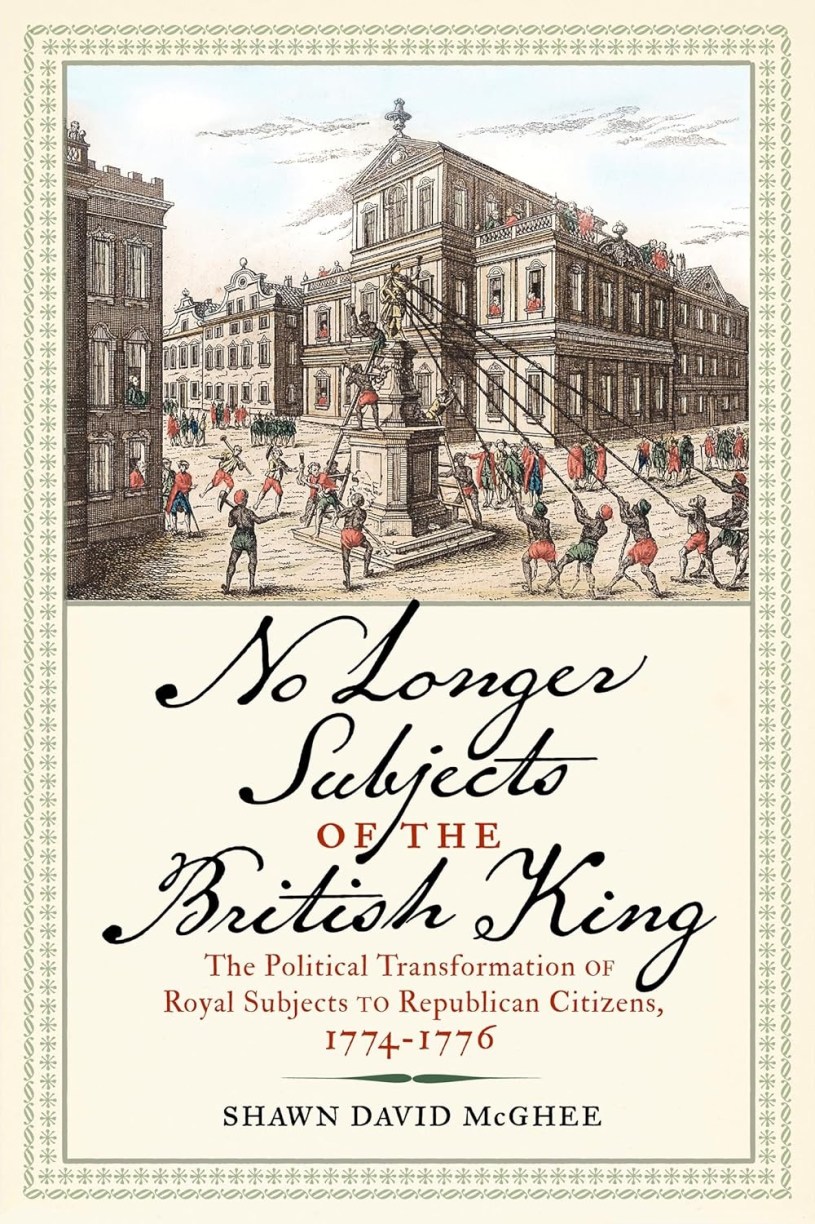
McGhee, Shawn David. No Longer Subjects of the British King: The Political Transformation of Royal Subjects to Republican Citizens, 1774-1776. Yardley, PA: Westholme Publishing, 2024.
How, when, and why did people in thirteen British North American colonies convert from Royal subjects to republican citizens in the late eighteenth century? Encountering a Thomas Jefferson quip that the transformation from subject to citizen was as easy as “throwing off and putting on a new set of clothes” inspired Shawn David McGhee, then a doctoral student, to investigate these three questions (viii). Based on the results of his dissertation and considerable post-doctoral research, which included a comprehensive review of primary sources such as letters, diaries, and official documents, as well as secondary sources from leading historians, McGhee provides answers in his new book No Longer Subjects of the British King.
McGhee argues that the Spring 1774 British Coercive Acts were an imperial overreach, sparking the First Continental Congress to enact a trade-prohibiting program, the Continental Association. The five Coercive Acts (or, to the Americans, the Intolerable Acts) closed Boston’s Port, asserted direct Crown control over the Massachusetts Government, specified criminal trials in Admiralty courts for certain economic crimes, permitted the Quartering of British soldiers on private unoccupied property, and the Quebec Act, which legally kept non-Canadian colonists out of the valuable Ohio Valley. To force parliamentary repeal of these actions, the First Continental Congress established a fourteen-article Continental Association, which requested all colonists boycott British goods and prohibited selling American-made products in British markets. The nonimportation and nonexportation provisions directly responded to punitive measures imposed by the British government, aiming to force a repeal of the Coercive Acts by hurting British merchants economically. The colonial association recommended each locality empower a Committee of Inspection and Observation to enforce non-consumption and trade sanctions. Colonialist compliance with the sometimes complex trade rules was remarkably high, becoming one of the first Congressional actions uniting the thirteen previously independent colonies.
McGhee lays out his arguments in five easy-to-follow chapters, starting each with a clear contention and summarizing his conclusions at the end. He begins with a chapter asserting that grassroots opposition to Parliament’s Coercive Acts galvanized anti-British sentiments and cemented local support for nonimportation and nonexportation trading restrictions. The second chapter describes the widespread popular support for the First Continental Congress and the development of trust and respect among the delegates. In chapter three, McGhee argues that three political factions emerged: the radicals, including Samuel Adams and Richard Henry Lee; moderates, such as John Dickinson and John Jay; and imperial traditionalists, such as Joseph Galloway and James Duane. Early indications that radicals would prevail are Congress’s selection of Carpenters’ Hall as its meeting site, its choice of the radical Charles Thomson as secretary, and its support of the anti-Coercive Acts Suffolk Resolves. In the next chapter, McGhee offers a novel argument that Congress sought to cloak the draconian trade restrictions in displays of public virtues, such as prohibiting entertainment forms such as theaters and horse racing and public displays of wealth, including mourning gloves and imported clothes. Lastly, the author asserts that the vigilance of Committees of Inspection and Observation in conjunction with newspapers helped enforce the trade restrictions, assisting in transforming the revolutionaries into citizens of a republic.
One of the book’s strengths is contrasting other historians’ work and contextualizing them with McGhee’s thesis. An example is the most recent work of the late Georg-August University of Göttingen, professor emeritus Hermann Wellenreuther, who also assigns considerable influence to the colonial Committees of Inspection and Observation. Another perspective is Jerrilyn Greene Marston’s King and Congress, which emphasizes that political legitimacy transferred from the King and Parliament to the Continental Congress after the Coercive Acts.[i] This transfer led to the Continental Congress assuming legislative and executive governmental functions from the British monarch and Parliament. McGhee offers a more public opinion and direct action role than Marston’s view. Similarly, historian Pauline Maier emphasized public shaming of loyalists and Committees of Inspection and Observation “trials” to determine guilt and punishment for those not adhering to the trade boycotts.[ii]
On the other hand, McGhee appears not to have consulted Mary Beth Norton’s 1774 – The Long Year of the Revolution, which covers the Continental Association period in detail. Norton adds context to women’s role in the trade boycotts, which would have enhanced the author’s work.[iii] While McGhee adds fascinating details of the varying Revolutionary zeal in the most prominent Georgia parishes, Norton provides similar evidence from many colonies and regions, emphasizing people who remained loyal to the British Crown. Of course, book reviewers always fancy more substantiation, but readers will appreciate the author’s conciseness and sprightly laid-out arguments.
In any event, Shawn McGee cogently demonstrates that Jefferson’s metaphor of changing clothes drastically underestimated the complex transition from subject to citizen. Importantly, the author emphasizes that it always appears easier to accomplish major transformations when viewed in the rearview mirror. While there are a few instances of technical jargon typically found in Ph.D. dissertations, general, American Revolution enthusiasts and scholarly book lovers will enjoy No Longer Subjects of the British King. All readers will relish the book’s well-elucidated, easy-to-follow arguments, evidence, and conclusions.
From a publishing industry perspective, a trade press’s high-quality publication of No Longer a Subject of the British King also portends future market share losses by academic presses that traditionally have published dissertations. McGhee and Westholme Press demonstrate that the old saw that dissertations don’t sell to the general public no longer applies.
[i] Jerrilyn Greene Marston, King and Congress: The Transfer of Political Legitimacy, 1774-1776 (Princeton, NJ: Princeton university press, 1987), 3–4.
[ii] Pauline Maier, From Resistance to Revolution: Colonial Radicals and the Development of American Opposition to Britain, 1765-1776 (New York: Norton, 1991), 281–82.
[iii] Mary Beth Norton, 1774: The Long Year of Revolution, First edition (New York: Alfred A. Knopf, 2020), 280.
Discover more from Researching the American Revolution
Subscribe to get the latest posts sent to your email.

Another well done review!
Sent from my iPhone
<
div dir=”ltr”>
<
blockquote type=”cite”>
LikeLike