
A Selective Continental Congress Historiographic Review
Burnett, Edmund Cody. The Continental Congress: A Definitive History of the Continental Congress from Its Inception in 1774 to March 1789. New York: Macmillan, 1941.
Jensen, Merrill. The Articles of Confederation: An Interpretation of the Social-Constitutional History of the American Revolution 1774 – 1781. Reprint with new forward. Madison: University of Wisconsin Press, 1976.
Henderson, H. James. Party Politics in the Continental Congress. Bicentennial of the American Revolution. New York: McGraw-Hill, 1974.
Rakove, Jack N. The Beginnings of National Politics: An Interpretive History of the Continental Congress. Baltimore: Johns Hopkins University Press, 1982.
Marston, Jerrilyn Greene. King and Congress: The Transfer of Political Legitimacy, 1774-1776. Princeton, NJ: Princeton University Press, 1987.
Jillson, Calvin C., Wilson, Rick K. Congressional Dynamics: Structure, Coordination, and Choice in the First American Congress, 1774-1789. United States: Stanford University Press, 1994.
McGhee, Shawn David. No Longer Subjects of the British King: The Political Transformation of Royal Subjects to Republican Citizens, 1774-1776. Yardley, PA: Westholme Publishing, 2024.
Well-researched history books with novel insights based on innovative analytic techniques retain relevance for general readers and scholars, standing the test of time. Six histories of the First and Second Continental Congresses written in the mid-to-late twentieth century fit this definition and are highly relevant today. After this rich spurt of research, scholars have produced only one book on the Continental Congress in the twenty-first century. Why is there a relative dearth of new Continental Congress scholarship while other Revolutionary research areas are booming? Did the twentieth-century historians so completely mine available sources that there is nothing new to discover? Or did other issues become more relevant to today’s audiences? Analyzing these seven histories will help illuminate answers to these questions.
While each offers a unique interpretative view, historians writing on the Continental Congress’s activities and delegates argue that readers should evaluate Congress’s accomplishments and failures in the context of the Revolutionary Era, and comparisons with today’s Congress are faint and fraught with issues. All but one of the historians disagree with the widespread view that the Continental Congress was a failed institution. Three of the eminent historians argue that the Continental Congress successfully prosecuted the war and enacted important post-war legislation despite severe funding and other restrictions. Merrill Jensen best captured the group’s sentiment, “Many delegates to the Continental Congress on 10 May 1775 were slow sailors, but they were not dull,” rifting off a John Adams quote stating that the fasted boats had to wait for the slowest and most dull. The delegates created the Congress they wished, including its dependence upon the states for funds and resources. Starting from a common assessment of Congress’s challenges and successes, the historians’ views diverge regarding the underlying politics, institutional structure, and decision-making. The selected historians agree that changing delegate views on the need for national power led to the 1787 Constitutional Convention and a new governmental system.

Commencing with the 1941 publication of The Continental Congress, a definitive history of the Continental Congress from its inception in 1774 to March 1789 by Edmund Cody Burnett, historians recount and assess the Continental Congresses’ decisions, actions, and accomplishments. Burnett’s comprehensive chronological narrative sets the stage for the following historians, delivering over seven hundred pages reinforcing his definitive history promise. The former Carnegie Institution historian argued that the congressional delegates were men of vision who kept alive the prospect of a national government despite widespread calls for the dissolution of power to the states. The foresighted delegates knew they had implemented a weak, unsustainable national government under the Articles of Confederation. However, the Articles of Confederation kept alive the prospect of a more perfect union, which occurred at the 1787 Constitutional Convention (ix).
Burnett explains away his monograph’s lack of footnotes and a bibliography by offering that readers will more closely follow his arguments and narrative without interruption. As a substitute, Burnett discloses that his scholarship relies on three primary sources: Letters of the Members, Journals of Congress, and the Writings of George Washington. While Burnett righty asserts that there are limited primary sources, later historians will expand their number.

Concurrent to Burnett’s monograph, Merrill Jensen published The Articles of Confederation, an interpretation of the history of the American Revolution 1774-1781. Jensen’s monograph commanded eight printings over thirty-six years, demonstrating lasting staying power, ending in 1976. While the body of each printing remained the same, the author added a preface addressing comments and criticisms from book reviewers and other historians in each new edition. Reading the prefaces as a group is an excellent historiographical view of Jensen’s rebuttals of contrary arguments from leftist, consensus-advocating, and nationalist-leaning historians. A former University of Wisconsin professor, Jensen’s thesis is that the American Revolution was more than a struggle between Great Britain and America; it was a social and political struggle between the privileged elite and those with less economic and political power, which started before the rebellion and remained contested in the Early Republic (6-7). The social, political, and economic discontent influenced the debate over the nature and purpose of the central government of the new United States.
Further, the congressional delegates debated the extent of democracy within the new political system. Jensen believes that two political forces clashed: a party of radicalism emerged from the cities and the rural areas, and a party of conservative merchants, planters, and other elites. The more radical delegates sought to enshrine democratic processes, while more conservatives wanted to limit popular control, avoiding “mad” democracy. The conservatives forced the development of a national government (14), albeit a weak confederation. The fundamental societal forces in America remained unchanged by the rebellion and continued to drive the Early Republic political debates. As a result of continued political and economic strife, such as Shay’s Rebellion, conservatism reemerged after the war, leading to limits on democracy (12).
While Jensen employs radical and conservative terms, he cautions that their use often leads to confusion. He argues that while the revolution can be interpreted as “an internal revolution carried on by the masses of the people against the local aristocracy, it is not without recognition of the fact that there were aristocratic revolutionists and proletarian loyalists; that the majority of the people were more or less indifferent to what was taking place; and that British policy after 1763 drove many conservatives into a war for independence (14). Despite Jensen’s admonition, overusing broad terms is rife among succeeding historians and society at large.

Following Jenson’s work, H. James Henderson assessed the Continental Congress’s fifteen-year existence in his book Party Politics in the Continental Congress. The former Oklahoma State University professor addresses two commonly held views of America’s first national government. First, while the Continental Congress experienced divisiveness, most historians posit that party-led politics only emerged with the new Federal Government in the 1790s. Second, numerous historians have concluded that the Continental Congress was a failed institution and, as such, had to be replaced by a bicameral legislature and independent executive and judicial branches in the 1787 Constitution.
Professor Henderson assembled a detailed database of 1,069 votes taken by 186 delegates between 1777, when roll call votes were first recorded, and 1786. He employed a cluster block analysis to identify groupings of like-minded delegates based on their voting patterns. The data analytic results are reproduced in twenty-eight tables, identifying voting blocs named for a predominant regional or ideological view. For example, Henderson named an Eastern bloc for the faction dominated by New England delegates but boasted membership from other regions.
Three different party structures emerged during the Continental Congress’s operation. Until 1779, an Eastern or Northern party dominated the Southern Party and a radical Middle State faction. In the later stages of the war (1780-83), Middle State Centrists supported by Nationalists Northerners and Southerners formed a majority. Finally, after 1784, the Southern Party ruled over the Northern Party. Henderson concludes that the political alignments during the Confederation period germinated the national parties formed in the first decades of the Early Republic. In his view, the Federalists and Democratic-Republicans did not appear out of whole cloth in the 1790s but owed their existence to the factional battles of the Confederation period.
Popular histories generally give the Continental Congress low marks, with some historians concluding it was ineffective and collapsed. As evidence, they cite an inability to adequately finance the war, poor military command decisions, and overly divisive sectional and factional politics. While Professor Henderson acknowledges these weaknesses, he advocates a more balanced view of Congress’s performance. He argues, “Within the span of a dozen years, Congress produced the Declaration of Independence, the Articles of Confederation, the alliance with France, the Treaty of Paris, which ended the war, the basis of the (Northwest Ordinance) territorial system (page 430). No other American legislature produced five seminal accomplishments within such a short period. Henderson concludes that regional disputes such as the John Jay and Spanish negotiations over Mississippi River navigation rights and the Shay’s Rebellion forced Americans to implement a more robust national government.
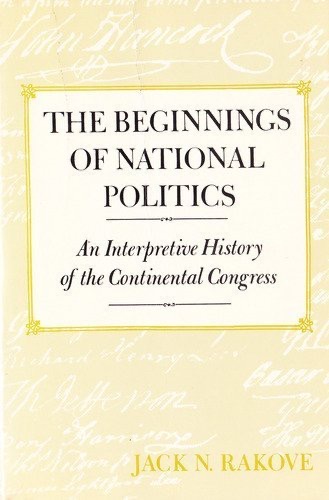
In the next decade, political historian Jack Rakove asserted a novel interpretation of congressional debates in the volume The Beginnings of National Politics: An Interpretive History of the Continental Congress, based upon his Ph.D. dissertation. Taking issue with Henderson’s data analysis, Rakove believes there are limits to roll call voting analysis. He notes that not all votes had recorded roll calls and that two delegates, Elbridge Gerry and Thomas Burke, requested most roll call votes, which might introduce bias (248). Additionally, many delegates served short terms and frequently were absent, thereby inhibiting the development of ideological parties. Rakove believes there were too many shifting delegates to have firm voting blocs. Given the factors hindering the growth of party factions, Rakove warns that, looking back, the present bitter partisan battles can overly influence our views of the delegates’ actions in the founding era.
Rakove offers an alternative analytic framework in which delegates voted based on their views on limited available alternatives, assumptions about the requirements of resistance, and their sensitivity to preserving Congress’s authority. He assesses that these factors drove major congressional decisions not based on party factions. Further, at various times, there were limited courses of action. Rakove does not believe in using radicals and conservatives as descriptors. “Novel issues, intractable problems, unattractive options, partial solutions: these were the usual determinants of Revolutionary policymaking (xvi). Lastly, Rakove makes an excellent point: “…few delegates consciously saw themselves competing for power or struggling to control the Revolution (xvii). Returning home or participating in local politics was more important to the delegates than creating political parties to influence legislation in the Continental Congresses.
While Rakove makes several good points, Henderson’s roll call analysis is an interesting analytic framework that readers should not discount. Just as Jensen argues that politics did not emerge out of whole cloth after the war, political parties had to have some antecedents in the Confederation period. Like-minded politicians have long allied to along ideological lines. While Rakove and Henderson debate factional alignments, at least seven reviewers disagreed with Rakove’s work. In a particularly critical review, the former University of Houston Professor James Kirby Martin argues that Rakove overstates congressional successes. The military historian criticizes Rakove for not recognizing Congress’s paralysis, posing the suggestive question, “Why did so many men avoid serving in the Continental Congress?” Martin also believes that nationalism emanated primarily from army officers and was missing in Congress. While Martin concludes that The Beginnings of National Politics: An Interpretive History of the Continental Congress “leaves a great deal to be desired,” he does admit several strong points, including the analysis of the different Articles of Confederation drafts, the discussion of the Arthur Lee/Silas Deane controversy, and the depiction of North Carolina’s delegate Thomas Burke.[i] Another critic, Gerald W. Gawalt, contends that Rakove neglects Congress’s military oversight responsibilities (except funding), omits the Continental Congress’s final two years, and downplays the delegates’ vast uncertainty. Wildly uncharitable, Gawalt, a former American history specialist at the Library of Congress, advises scholars to keep Edmund Burnett’s The Continental Congress as their primary resource.[ii] While Martin and Gawalt have valid critiques, they overstate their overall conclusions. The Beginnings of National Politics: An Interpretive History of the Continental Congress has stood the test of time and is an excellent starting point for those seeking to understand the Continental Congress’s history.
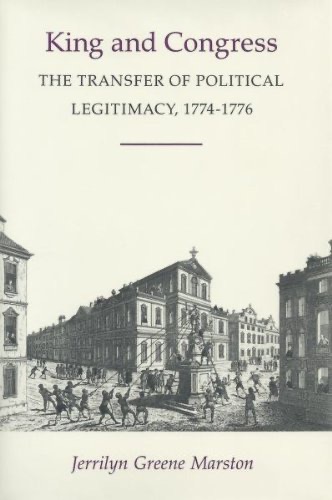
Almost a decade later, Jerrilyn Greene Marston offered, in her book King and Congress: The Transfer of Political Legitimacy, 1774-1776, a new interpretation of the first three years of the Continental Congress, also based upon her 1975 doctoral thesis and richly supported by over one hundred and twenty-five pages of citation and discursive footnotes. The jointly trained lawyer-historian argues that the revolutionaries transferred the British monarch’s role to the Continental Congress, leaving Parliamentary and current colonial legislative authorities in the state governments. As evidence, she points to an enhanced executive role but weak legislative role, creating an “idealized British monarchical model from the past.” Essentially, the Continental Congress was a national executive power that assumed the King’s leadership role in the military and foreign affairs. Marston concludes that Americans would not create a new continental political structure but, in the words of delegate William Hooper, would adopt the British constitution “purged of its impurities” and thus would “build an empire upon the ruins of Great Britain” (9).
Marston’s monograph generated at least ten positive and negative book reviews in academic journals, demonstrating that her work was novel, captivating, and thought-provoking. Peter Charles Hoffer’s review is an example of an upbeat review offering that “Marston’s case strikes me as convincing.”[iii] On the other hand, Rakove offers a biting assessment of her book in a Law and History Review article despite arguing that Marston’s work supports his thesis. He argues that Marston’s analysis is defective for two reasons. First, she errs in concluding that the Continental Congress replaced the British crown. As evidence, Rakove cites the British King adjudicated inter-colonial disputes while the Continental Congress could only recommend a settlement. However, Hoffer believes that Marston adequately addressed Congress’s inability to compel its decisions as the states peacefully concluded disputes.[iv] Second, Rakove believes that Marston inappropriately limited her timeframe to 1774-1776, neglecting subsequent changes to Congress’s governance. In the fall of 1777, delegates modified the Articles of Confederation drafts, indicating that the Congress’s executive powers were incomplete at the end of Marston’s analysis.[v] While Rakove criticizes for not considering future events, another reviewer, John A. Schutz, believes that Marston should have included events before 1774 in her analysis. He criticizes Marston for not considering the decline of British monarchical power in North America before the First Continental Congress. While historians regularly criticize others for not including prior and post events, Marston’s overall characterization of the Continental Congress as an executive body with many of the King’s powers, such as defense, national security, and diplomacy, survive these critiques.

In their book, Congressional Dynamics: Structure, Coordination, and Choice in the First American Congress, 1774-1789, Calvin Jillson and Rick K. Wilson assert “That American expectations regarding the proper functions of a legitimate central government were formed under the British monarchy” (9). The Revolutionaries wishes to maintain domestic power within the colonial legislatures, replacing the Crown’s military and diplomacy responsibilities with the Continental Congress. As a result, to preserve state autonomy and limit national power, state legislatures elected congressional delegates to one-year terms, limited to serving no more than three years in six; each state had one vote, Congress could not regulate commerce or enact taxes and could recommend, but not compel the states (3). Jillson and Wilson characterize the Congressional delegates as ambassadors who consult with each other to develop recommendations and report back to their respective state (colonial) legislatures for voting guidance (2).
Rooted in political science and economics, Jillson and Wilson argue that historians have overly focused on exogenous factors, such as social, economic, or political, in interpreting the Continental Congress’s actions and accomplishments. On the contrary, the political science duo argues that endogenous issues, such as institutional practices, norms, and structures, are just as important. The authors believe that three “choices made by delegates about institutional design contributed to institutional stalemate, obstruction, and inconsistency” (7).
First, Congress did not assign powers to leaders to accomplish shared interests. As proof, the authors cite that Congress created a figurehead presidency, failed to delegate powers to standing committees, established over three thousand ad hoc committees with results frequently modified by Congress, and did not make committee assignments based upon substantive experience or developing expertise. Congress failed to set up rules and processes to distribute the workload better. As a result, members became overworked and sought to leave for home as soon as possible.
Second, Congress had difficulty taking collective action. For example, Congress could not compel the states to pay requisitions, create leadership positions to implement collection actions, or effectively leverage delegates’ time commitments. As a result of the inability to take collective actions, Jillson and Wilson are skeptical of Jensen and Henderson’s view that shared ideologies and regional interests held stable delegate factions together.
Third, congressional institutions significantly inhibited collective decision-making due to the inability to accomplish shared interests and collective actions. The political scientists employed a multidimensional scaling (MDS) framework to identify visual patterns of cooperation and opposition, creating their arguments. The MDS approach elicited insights into coordinating shared interests, collection action, and collective decision-making. For example, besides the feckless War and Finance Secretaries, Congress did not create institutions to promote effective decision-making. As a result, delegates and states learned to hold out rather than compromise. Jillson and Wilson conclude that Congress became an “institution-free mechanism” (298).
Eugene R. Sheridan, a Thomas Jefferson scholar, offers an insightful reflection that might sharpen the political scientists’ analysis. He observes that the “Pressures of war with Great Britain ameliorated Congress’s institutional weaknesses before 1783, and the resurgence of localism after the removal of the British military threat aggravated them thereafter.”[vi] With only the passage of the Northwest Ordinance as an accomplishment, the post-war Continental Congress did not accomplish much other than to keep the states in confederation during its final six years, which supports Sheridan’s observation.

In the monograph No Longer Subjects of the British King: The Political Transformation of Royal Subjects to Republican Citizens, 1774-1776, Shaun David McGhee returns to the First Continental Congress, covering a similar timeframe as Marston but with a different emphasis. In the only book on the Continental Congress written in the twenty-first century, McGhee argues that the Spring 1774 British Coercive Acts were an imperial overreach, sparking the First Continental Congress to enact a trade-prohibiting program, the Continental Association. He assesses that in Congress, “better-organized radicals outmaneuvered both moderates and imperial traditionalists” to recommend trade sanctions to local communities (131). While Marston emphasizes that political legitimacy, including legislative and executive governmental functions, transferred from the King and Parliament to the Continental Congress after the Coercive Acts, McGhee offers a more public opinion and direct-action role than Marston’s view.
While the First Continental Congress established a fourteen-article Continental Association to force parliamentary repeal of the Coercive Acts, McGhee asserts that local Committees of Inspections assumed governmental authorities to enforce the non-consumption and trade sanctions. McGhee assesses that colonialist compliance with the sometimes-complex trade rules was remarkably high, which united the thirteen previously independent colonies. He notes that the colonists united to sacrifice for the common good, with local identities, liberties, and traditions remaining intact (135).
Each of these seven historians helps to understand the Continental Congresses better. Burnett provides a comprehensive narrative that continues to be a research source. Jensen reminds us that the rebellion only solved some of America’s political and social problems. Henderson, Jillson, and Wilson demonstrate that data analytics is a valuable historical tool for identifying political party antecedents in the Revolutionary Era. Marston and McGhee describe Congress’s assumption of national power from the British Crown. Jenson chronicles the development of the first American government. Finally, Rakove demonstrates that Congressional delegates can only pursue ideology so far in the face of existential issues with limited alternatives.
I encourage readers of the Revolutionary Era to read or re-read these books to understand the emergence of party politics better and obtain a more balanced view of the Continental Congress’s performance. Additionally, the selected authors will dissuade readers from comparing the Continental Congress with today’s Congress. The Continental Congress coordinated external military and diplomatic functions with limited internal executive powers and did not legislate as modern Congresses. The true purpose was to unite people to accomplish a common objective: independence.
However, recent scholarship fails to recognize this purposely limited objective. Historians continue to criticize Congress as feckless and inept, especially scholars of the Continental Army and state governments. Additionally, Revolutionary Era scholarship has appropriately moved toward more microhistories depicting underrepresented groups. While this trend has yielded fascinating new works, one cannot correctly interpret the era without understanding the national politics of the period. As a result, there is a need for an updated and more balanced assessment of the congressional period 1774-1789.
[i] James Kirby Martin, “Book Review of The Beginnings of National Politics: An Interpretive History of the Continental Congress by Jack Rakove,” The American Historical Review 85, no. 4 (1980): 580, https://doi.org/10.2307/1869053.
[ii] Gerard W. Gawalt, “Book Review of The Beginnings of National Politics: An Interpretive History of the Continental Congress by Jack Rakove,” The New England Quarterly 53, no. 3 (1980): 403, https://doi.org/10.2307/365134.
[iii] Peter Charles Hoffer, “Will the Real Continental Congress Please Stand Up? Review of King and Congress 1774-1776, By Jerrilyn Greene Marston,” Reviews in American History 16, no. 3 (1988): 360, https://doi.org/10.2307/2702265.
[iv] Hoffer, 359.
[v] Jack N. Rakove, “Book Review of King and Congress: The Transfer of Political Legitimacy, 1774-1776 by Jerrilyn Greene Marston,” Law and History Review 9, no. 1 (1991): 188, https://doi.org/10.2307/743671.
[vi] Eugene R. Sheridan, “Book Review of Congressional Dynamics: Structure, Coordination, and Choice in the First American Congress, 1774-1789 by Calvin Jillson and Rick K. Wilson,” The American Historical Review 101, no. 3 (1996): 908, https://doi.org/10.2307/2169562.

Discover more from Researching the American Revolution
Subscribe to get the latest posts sent to your email.
