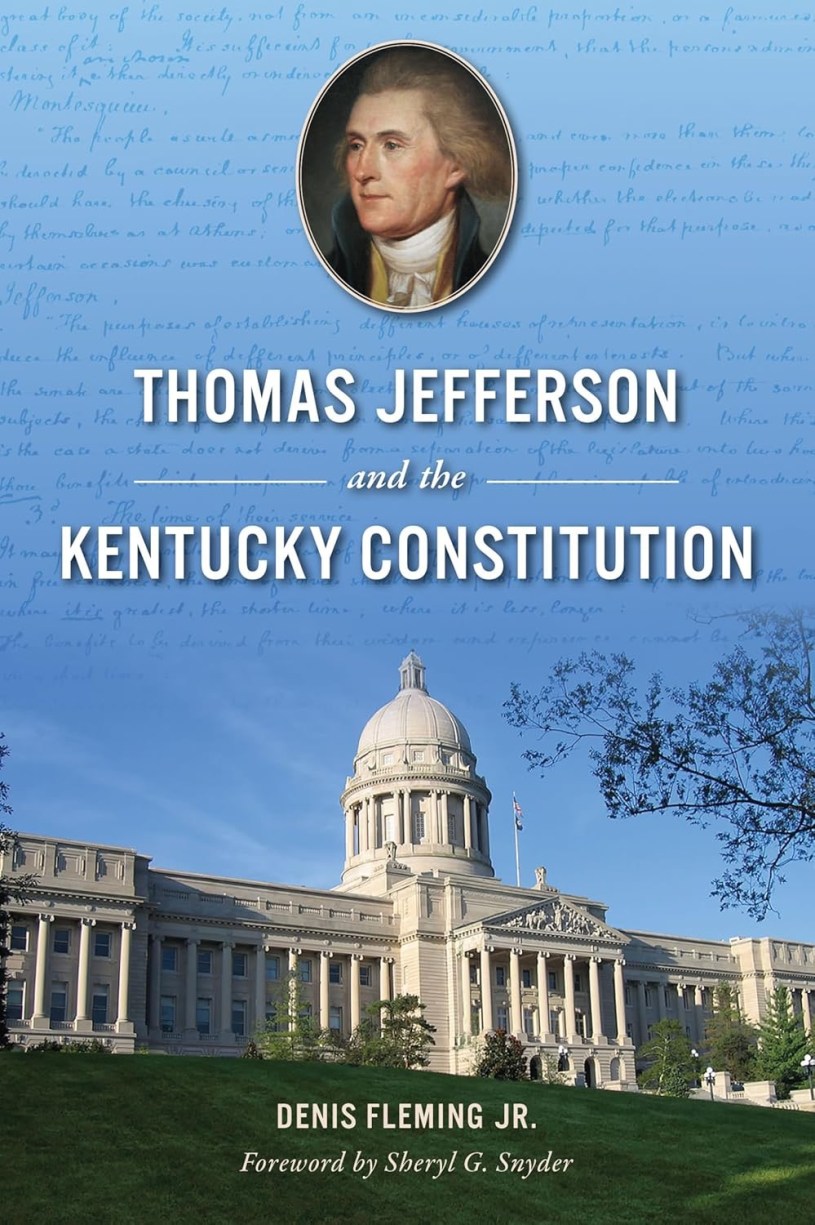
Fleming, Denis, and Sheryl G. Snyder. Thomas Jefferson and the Kentucky Constitution. Charleston: The History Press, 2025.
Book Review
Based on recent archival research, lawyer and constitutional scholar Denis Fleming asserts that Thomas Jefferson significantly influenced the first Kentucky Constitution. Many historians and observers have overlooked this connection, which Fleming discovered in the correspondence of George Nicholas. A prominent Kentucky politician and former Virginian, Nicholas spearheaded the drafting of Kentucky’s original 1792 constitution. Although the framers of the US Constitution did not incorporate Jefferson’s clear separation of powers clause, the Monticello planter’s impact is evident in the Bluegrass State’s robust separation of powers clause. The first article of the fifteenth state’s constitution delineates three branches of government.
“The powers of government shall be divided into three distinct departments, each of them to be confided to a separate body of magistracy, to wit: those which are legislative to one, those which are executive to another, and those which are judiciary to another.”
The George Nicholas Papers at the University of Chicago include a one-page memo discussing the separation of powers. This document references page 195 of Jefferson’s Notes on the State of Virginia, which outlines a similar division of executive, legislative, and judicial powers. In addition to the long-standing personal interactions among Jefferson, Nicholas, and other Virginians who relocated to Kentucky, Nicholas’s memo and reference strengthen the link to Jefferson.
The collaborations between Jefferson and Kentucky persisted throughout the last decade of the eighteenth century and into the presidency of the Monticello planter. Fleming details Jefferson’s authorship of the Kentucky Resolves, which asserted the states’ powers to nullify federal laws. Written in 1798 to counter President John Adams’ overly restrictive Alien and Sedition Acts, Jefferson provided Kentuckian John Breckenridge with a resolution that rejected the harmful federal restrictions on free speech and political participation. Jefferson’s authorship remained a secret; as Adams’ vice president, he could have faced charges of treason or sedition if his involvement had become public. The Kentucky legislature adopted Jefferson’s declaration but softened its most extreme provisions. Jefferson sought the passage of the resolves in other states, but only Virginia complied, ending the constitutional crisis.
While Jefferson sought to limit Federal power in response to the Alien and Sedition Acts, he later turned to Kentuckians for support in expanding Federal authority during his presidency. John Breckenridge provided Jefferson with legal advice and guided the Louisiana Purchase—a significant expansion of executive power—through Congress to facilitate the land acquisition. Subsequently, Jefferson nominated Breckenridge as his Attorney General. Their partnership ended abruptly due to Breckenridge’s illness and untimely death.
Interestingly, Fleming served in various Kentucky legal roles, including as the General Counsel for the Governor. Drawing from this experience, he discusses the ongoing impact of the separation of powers provisions within Kentucky’s Constitution and recounts the persistent disputes among the state’s three branches of government. He notes that, over the years, Kentucky’s Supreme Court has referenced Jefferson’s separation of powers clause. The seasoned government lawyer emphasizes how Jefferson’s ideas have shaped perspectives on contemporary issues such as civil rights and religious matters.
As contemporary politicians and the public debate far-reaching changes to the separation of federal legislative, judicial, and executive powers and prerogatives, Thomas Jefferson and the Kentucky Constitution is a timely book. Contemplating Jefferson’s suggestions enriches current discourse and provides an excellent reason to read Denis Fleming’s new book.
Discover more from Researching the American Revolution
Subscribe to get the latest posts sent to your email.
