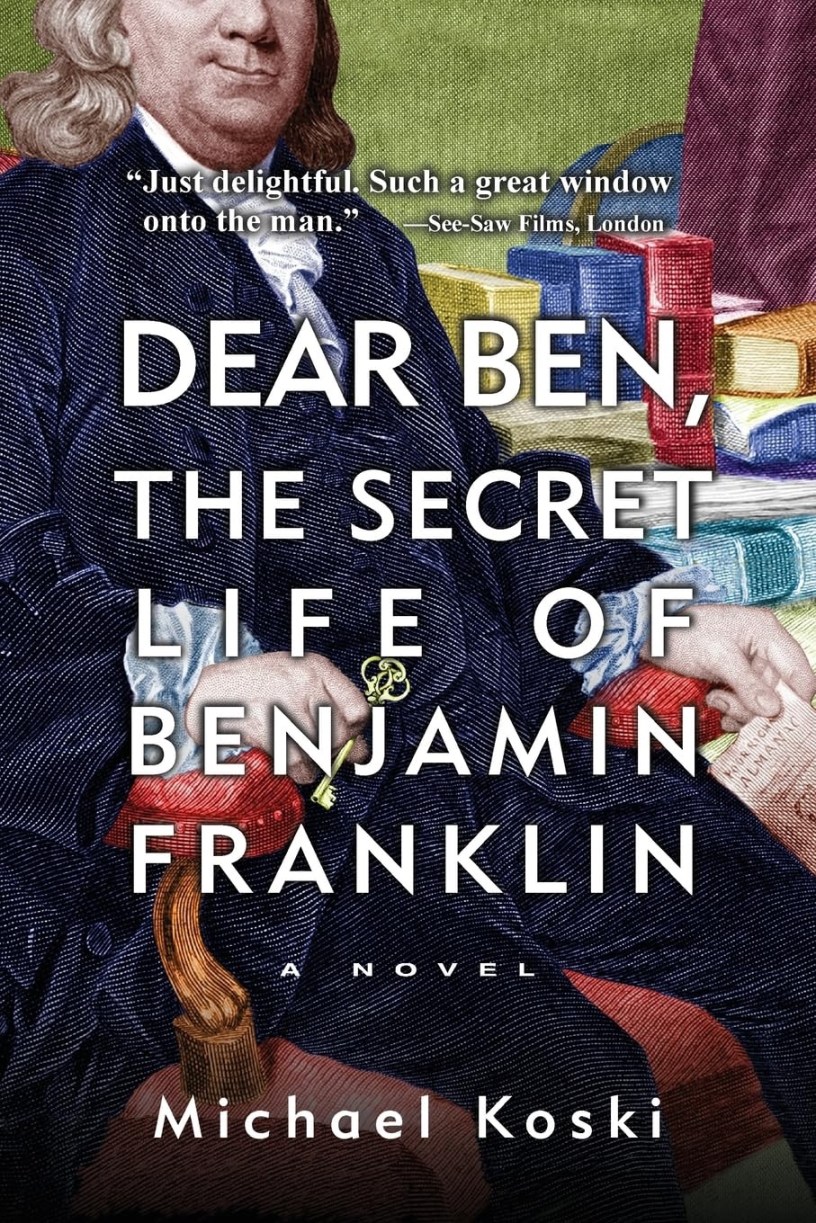
Koski, Michael. Dear Ben, The Secret Life of Benjamin Franklin. Meadville, PA: Fulton Books, 2024.
Book Review
Benjamin Franklin is one of the best-documented American founders, having left an autobiography, thousands of letters, and an extensive collection of personal papers. Despite this vast trove, much remains unknown about his feelings, motivations, and inner thoughts. For instance, why did Franklin have troubled family relationships? Was it easier for him to bond socially while finding it more challenging to connect intimately? Did Franklin ever discover true love? Michael Koski explores these and other personal questions in a new novel. The first-time author provides a broad outline of Franklin’s life, interspersed with historical fiction that recounts his innermost self.
A residential interior designer by day, the author organizes his narrative using the clever literary device of a dying Franklin sharing his life story and innermost thoughts with his trusted enslaved valet, Bobby. The account periodically returns to the last few days of Franklin’s life and explores how he deals with unresolved personal issues. Knowledgeable readers will recognize the broad outline of Franklin’s life as the author delves into the inventor’s family, social, and political relationships. What is less known, and likely not part of the official historical record, are the personal and professional motivations behind Franklin’s behaviors.
Through the eyes of a novelist, Koski provides compelling insights into Franklin’s personality, relationships, and emotions. The novelist portrays Franklin’s bond with his London landlord’s daughter as more fatherly and affectionate than his relationship with Sally, his only daughter. The ghost of Madame Brillon, an unrequited passionate interest in Paris, haunts Franklin at his death, implying that she was his true love and that he never remained loyal to any of his romantic interests. Finally, while never close, Sally and their son William clash over Franklin’s inheritance. Although fictional, Koski’s depiction of the inner Franklin is plausible, resonating with historians and general audiences.
An unexpected aspect of Koski’s narrative is the close personal relationship between Franklin and Bobby. Bobby listens to and responds to Franklin’s reminiscences, providing physical and emotional support during the renowned scientist’s final days. Just before he dies, a grateful and repentant Franklin emancipates Bobby by giving him his legal release, a horse, and money to escape west to Ohio. Bobby’s successful flight is met with dismay by Sally, who views this as a significant loss of economic value. However, the story does not end there. After losing his prized gun to an Indian, Bobby arrives safely at his cousin’s farm in Ohio. Yet, freedom is not what Bobby expected; slave catchers and white racism make his life miserable.
After ten years, Bobby’s situation did not improve, so he decided to return to the East. At that time, Sally Bache and her husband lived on a farm in the Delaware Valley. The couple warmly welcomed Bobby to stay with them. When Bobby tried to pick up the couple’s laundry, Sally took the basket, saying she could carry her own wash. This demonstrated that the Baches had transformed their view of Bobby, regarding him as a free and equal individual. Bobby felt relieved to be back with the family, feeling safe and secure. Koski’s depiction of the challenges faced by formerly enslaved people illustrated that more than freedom was necessary for a secure and happy life.
Writing historical fiction presents one of the greatest challenges in crafting narratives about history. Authors must grasp their historical context, appreciate their subjects’ most private perspectives, and create engaging and believable dialogue. Koski excels in all these areas. Rather than being a mere rehash of Franklin’s well-known life, readers will encounter a broader message encompassing challenging family relationships, racism, and the real issues transitioning from enslavement to freedom.
Discover more from Researching the American Revolution
Subscribe to get the latest posts sent to your email.
