Book Review
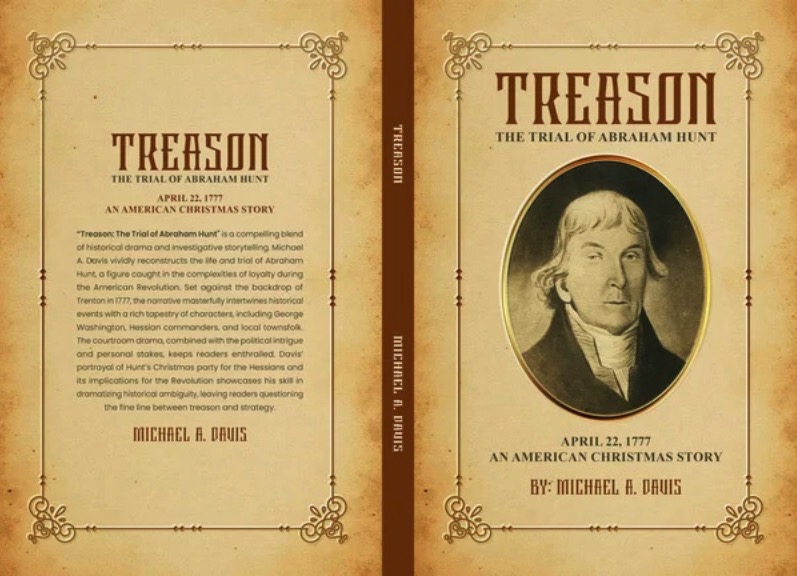
Davis, Michael A. Treason: The Trial of Abraham Hunt. Denver, CO: Independently Published, 2025.
Typically, history books describe people of the Revolutionary Era as either Patriots or Loyalists, based on which side they fought for or supported. However, loyalties were more flexible than a simple yes-or-no choice. The shifting fortunes of war, roaming armies, and heavily contested regions led to numerous people changing their allegiances multiple times. Due to the uncertainty and dangers to their families and livelihoods, others tried to stay neutral. As a result, it was often difficult to discern the complex and shifting loyalties from the historical record. This was especially true when individuals faced the risk of losing crops or commercial goods. Regardless of political affiliations, nobody wanted their food supplies or stores taken by foraging armies.
Historical fiction can be a valuable genre for understanding how loyalties developed and broke apart during the eight-year American Revolution. Michael A. Davis achieves this through his fictional account of the trial of Abraham Hunt, a wealthy and influential merchant from Trenton, New Jersey. Initially, Hunt clearly supported the Patriot cause by serving as a Lieutenant Colonel in the local militia and assisting the Continental Army with supplies and logistics. Later, when the British take control of Trenton, Hunt receives protection for his home and business from General William Howe and swears an oath of loyalty to the British Crown. On Christmas Night 1776, Hunt hosts a holiday celebration at his house, feting the occupying Hessians. Notably, Colonel Rahl, the senior German commander, stays late to play cards and drink. Historians suggest this late-night carousing left the Hessians unprepared to defend themselves after General George Washington boldly crossed the Delaware River to attack and capture most of the town’s garrison the next day.
Later, after the Patriots push the British out of the region, Hunt is put on trial for treasonous aid to the enemy and for failing to renounce his oath of loyalty to the British when given the chance. In 1994, Davis located Hunt’s incriminating loyalty oath in the possession of an antique documents dealer. This discovery led the author to a decades-long investigation of Hunt’s allegiances, and the loyalty oath is Exhibit One in the recreated trial.
The book’s highlight is the retired criminal defense attorney’s recounting of the tribunal’s proceedings. Davis creates a riveting courtroom drama by introducing an out-of-town newspaper reporter who navigates the local politics among competing lawyers and community leaders to shape the trial’s outcome. Throughout the proceedings, Abraham Hunt unsuccessfully attempts to testify and share his side of the story, suggesting that there is more to his account than appears on the surface.
Like many others in Revolutionary America, all signs suggest that Hunt’s loyalties are more complicated than just Loyalist or Rebel. Did he sign the British oath to protect his family and business even though he was a passionate Rebel? Was he a Patriot double agent? What did George Washington know about his loyalties? Did Hunt’s neighbors trust him?
For answers and the outcome of the trial, you can purchase a copy of Davis’s novella at http://www.abrahamhunttreason.com.
Enjoy the story and reflect on the meaning and cost of loyalty, especially during dangerous and uncertain times.
Discover more from Researching the American Revolution
Subscribe to get the latest posts sent to your email.
