
McCandless, Peter. Remarkable Charlestonians in the American Revolution. Forewords by Elizabeth Chew and William Bentinck-Smith. History Press, 2025.
Book Review
An emerging focus in American Revolution scholarship is understanding how people chose to remain loyal or rebel against the British Crown and why many switched sides during the eight-year war. Peter McCandless, in his new book, explores the loyalty decisions of a diverse group of Charleston residents during the American War for Independence. He describes the complex political and military situation in South Carolina’s capital as “chaotic, turbulent, and fascinating” (p. 15), where the people were forced to make life-threatening decisions about loyalty. As a result, some prospered while others faced economic disasters and displacement from their homes, and two of these allegiance choices resulted in premature death.
The Distinguished Professor Emeritus from the College of Charleston structures his third book as fourteen micro-biographies of individuals and families. Except for a Royal Governor and a preacher, McCandless’s subjects were generally successful as planters (five individuals), in business (four), or as medical practitioners (three). Included in the group were two women: Sarah Izard, the wife of the Royal Governor, and Louisa Wells, who left a remarkable diary. There are three men of African descent. The Whigs (i.e., Rebels or Patriots) executed Thomas Jeremiah, a free Black harbor pilot and operator of a successful fishing business, for his perceived support of the Loyalists. Both Scipio Handley, a free Black fisherman, and Boston King, an escaped enslaved plantation worker, sided with the British. Each eventually emigrated to Britain and Sierra Leone, respectively. The most politically prominent among McCandless’s subjects were Arthur Middleton, William Henry Dayton, and David Ramsay, who served in the Continental Congress.

The biographical accounts are about equally divided between Whigs and Loyalists. McCandless recounts that four of the individuals changed their loyalties during the rebellion. Wealthy slave trader and planter Henry Laurens did not resist the 1765 Stamp Tax. As a result, an anti-tax mob invaded his home. Later, Laurens twisted the nose of the Royal Customs Collector, much to the delight of the Stamp Tax protestors. Laurens became an ardent revolutionary but detested extra-legal mob actions such as physical intimidation and tar and feathering. Likewise, wealthy planter William Henry Dayton initially supported Parliament’s right to levy the Stamp Tax. After Crown officials nixed a lucrative western land deal, he became another latecomer to the Whig position, albeit more radical than Laurens.
Taking a different turn, Alexander Garden, a physician and naturalist, remained neutral until 1780 but declared allegiance to the Crown when the British Army captured Charleston in 1780. Also emblematic of fluctuating military conditions, John Wells, son of a newspaper printer, exhibited flexible loyalty by fighting for the Whigs in the early years of the war and eventually returning to England as a Loyalist. Demonstrating the virulence of the Whig/Loyalist divide, none of the Loyalists in McCandless’s study remained in Charleston after the 1783 Treaty of Paris.
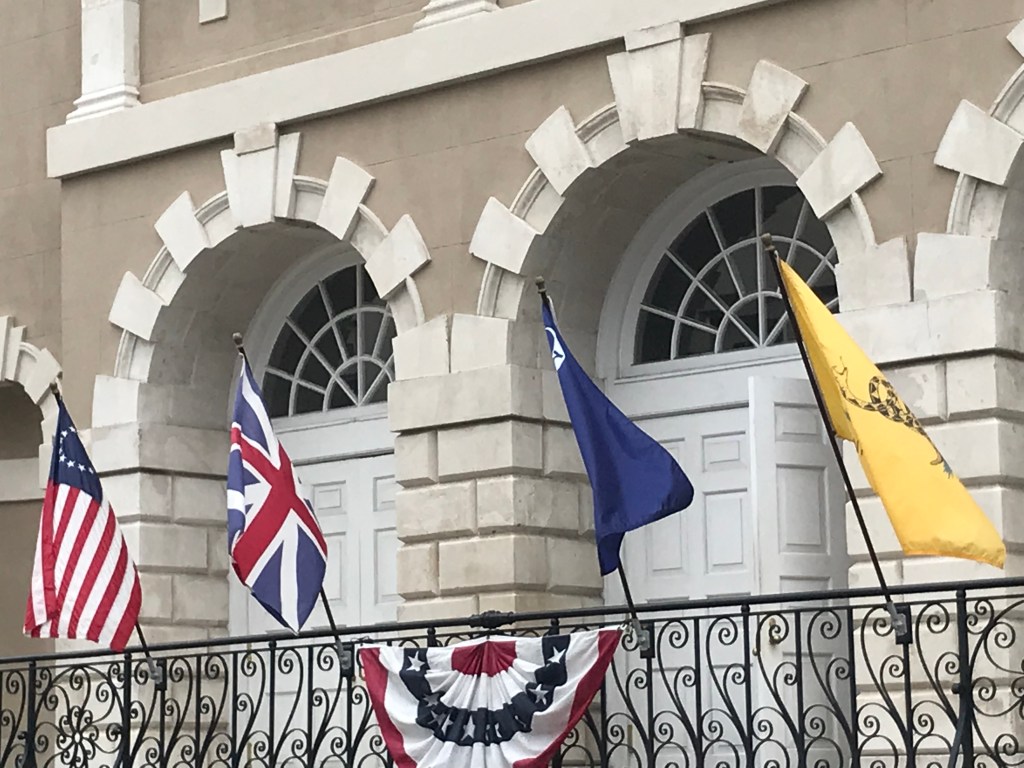
In the brief bio of Christopher Gadsden, designer of the now-famous “don’t tread on me” flag, the author makes two notable observations. First, Gadsden was a key instigator of the first Charleston “tea party,” which predated the most famous one in Boston by one week. The Charleston Whigs forced the tea shipment into the bottom floor of the Exchange (today’s Old Exchange and Provost Dungeon Building), where it was to be housed until Parliament ended the despised tax. Later, a second and third “tea party” prevented the tea shipments from being sold in Charleston.
Second, McCandless describes a general loathing of people of Scottish descent by Gadsden and other Low Country elites, which the author terms “Scottophobia.” Gadsden displayed open hostility towards Scots, especially Highlander soldiers sent by the British to quell the Cherokee uprising before the Revolution. The author argues that colonialists distrusted the last Royal Governor, William Campbell, due to his Scottish heritage. Many Whigs believed that Campbell and other prominent Scots with Royal appointments sought to replace traditional British liberties with an authoritarian regime in the American colonies. However, McCandless dismisses the Scottish conspiracy theories as baseless. Alternatively, he postulates that competition for trade and governmental offices contributed to the anti-Scot biases.
The author examines the enduring debate over the impact of the Somerset court decision, which emancipated enslaved workers residing in England. Judge William Murray, Lord Mansfield, another Scot, ruled in the Somerset case that slavery was illegal in Britain. Consequently, McCandless and other well-known historians argue that White Americans fought for independence to protect legal slavery, while enslaved workers backed the British efforts to suppress the rebellion to gain their freedom. Other prominent historians, such as Sean Wilentz, disagree, noting that the Somerset case had little influence on the desire for independence among White Americans or on African American support for the British cause. McCandless’s contribution to the debate would have been more substantial if one or more of his free or enslaved subjects had mentioned the Somerset decision as a motivating factor in their loyalty choices.
At times, McCandless can be too judgmental and overly focused, as demonstrated by three examples. First, the author concludes that Arthur Middleton’s “actions and his life violated the principles of liberty and equality he espoused in signing the Declaration of Independence (p. 28).” While this is certainly true from a presentist perspective, contemporaries did not adversely judge Middleton as violating his principles, as most other signers were “guilty” of the same modern-day defined hypocrisy.
Second, the southern-focused author asserts that the Rebels’ failure to capture the port city of Savannah from the British was their worst defeat of the war up to that point in 1779. While there is no dispute that the failed assault was a combined American and French disaster, it does not compare in scale and impact to the monumental loss of New York City to the British in 1776, including the loss of over four thousand soldiers.
Finally, the author’s negative portrayal of “a revolution proclaiming lofty ideals it failed to achieve” would have been improved by acknowledging some key achievements (pp. 129-30). For example, on the positive side, the Whigs replaced a monarchy with a republic. Additionally, British-appointed leaders were replaced by elected officials, and although not universal, suffrage became more inclusive than during the colonial period. Clearly, from the beginning, the American state was not perfect, but the founders created a foundation that later generations could build upon.
From a broader perspective, recounting the War for Independence through the perspectives of its participants—rather than just providing a straightforward timeline—makes McCandless’s book a valuable addition to the historical record of Revolutionary Era Charleston. Readers will benefit from the author’s efforts to dispel myths and explore the complexities and uncomfortable truths of history. The author makes a strong case that people had to make life-changing decisions in uncertain times. As a result, loyalties were often confused and shifting, and oversimplified stories are not the best way to understand the American Revolution.

Discover more from Researching the American Revolution
Subscribe to get the latest posts sent to your email.
