Book Review
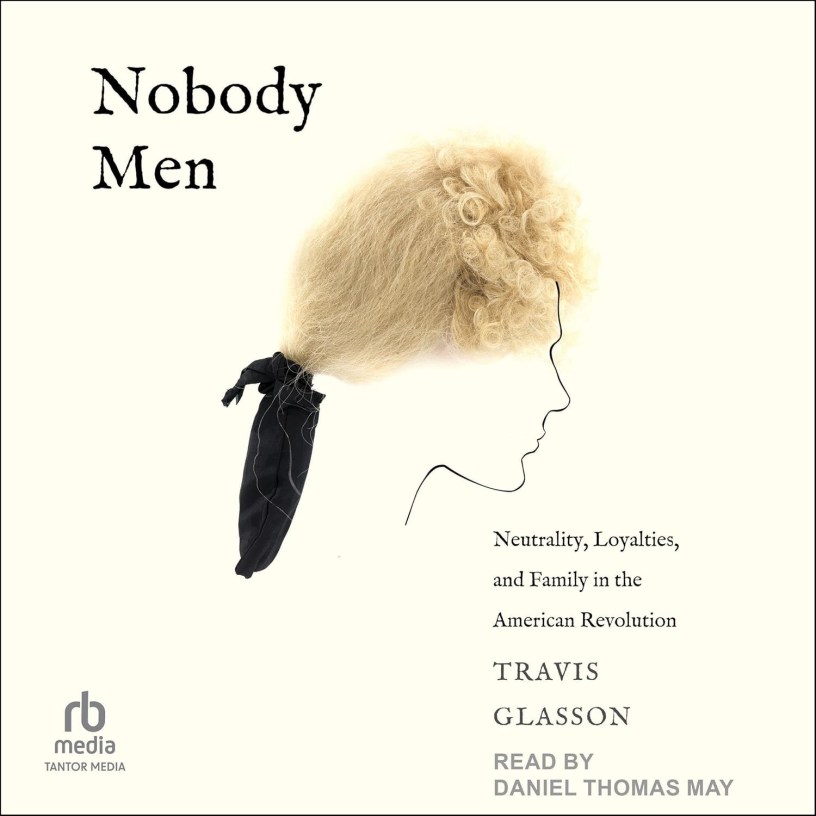
Glasson, Travis. Nobody Men: Neutrality, Loyalties, and Family in the American Revolution. Yale University Press, 2025.
In recent years, Revolutionary Era historians have greatly increased our understanding of the people who remained loyal to the British Crown and the patriots who aided the rebellion. Little has been written about the people who remained neutral, unwilling to fight for either side. In his second book, Travis Glasson contributes to the limited research of those who exhibited ambiguous, changing, or lukewarm loyalties in the conflict. The Temple University professor calls this middle group “nobody men,” a characterization borrowed from a 1779 letter published in a Philadelphia paper.
Glasson estimates that “nobodies” accounted for two-fifths to three-fifths of the total wartime population. While these estimates are higher than typical, Glasson asserts that revolutions are often successful with as little as 5% of the population actively rebelling. He posits that in most revolutions, there is a core of militant partisans who employ violent tactics to achieve regime change. He challenges the viewpoint that only Patriots and Loyalists were the principal players in the Revolutionary Era. He asserts that “nobody men” were notable participants impacting the outcome of the rebellion. While important, they did not always act the same way, were motivated by a variety of reasons, and sometimes switched loyalties in response to changing local conditions.
Glasson tells the story of nobody men through the experiences of the extended Cruger family, anchored in New York City with family members spread throughout the Atlantic world. The family patriarch and matriarch were John Cruger, Sr., a Danish immigrant, and Marya Cuyler. In the early eighteenth century, the couple had five daughters and three sons. At the outset of the Revolutionary War, John’s second son, Henry Cruger, Sr., operated a large trading network in the ports of Bristol, England; Jamaica; Curacao; and Africa, with his sons and partners. John’s third son, John Cruger, Jr., was more interested in politics. He served as the mayor of New York City and as a member of the New York State Assembly. In 1765, represented New York in the Stamp Act Congress. The family’s commercial and political ties supported one another despite long-term geographic separation.
At the outset of the American War of Independence, the Cruger family loyalties were unclear. John Cruger, Jr., is the prototypical “nobody man.” He originally sided with the Patriots but refused to serve in the First Continental Congress and, at the outbreak of the hostilities, retired to his country estate in Kinderhook, New York. John, Jr. stayed out of the conflict despite being on the Rebels’ list of disaffected people whose property was to be confiscated and who were to be expelled from the state. Peter Van Schaak, who married into the Cruger family, lived in Kinderhook while remaining neutral. Both men remained on their estates unmolested. Unfortunately, staying out of the conflict did not always lead to surviving the conflict. Van Schaak sent his wife, Elizabeth, to live in British-occupied New York City for safety, where she died from disease in 1778. Likewise, another sibling, Mary Cruger, succumbed to disease in the city along with her husband.
Another category of “nobody men” were pro-British with American sympathies, such as Henry Cruger, Jr., Henry Sr.’s second son, who lived in Bristol, England, and served as a pro-peace member of the British Parliament. Other family members chose to remain staunchly loyal. John Harris Cruger, the first son of Henry Cruger, Sr., joined the British Army and distinguished himself in battle, ending the war as a Lieutenant Colonel. On the other hand, another Henry Cruger, Sr.’s son, looked after the family’s business in the Caribbean and aided the Patriots. The Cruger family’s mixed loyalties contrast with those of other powerful New York families who chose sides. Most prominently, the Livingston family became ardent Patriots, while the rival Delancey family remained Loyalists. During the conflict, the Cruger family did not fracture despite threats from both sides.
The dispersed family members resumed commercial ties and familial affections after the cessation of hostilities. Peter Van Schaack restarted legal work with the help of his friend, future Supreme Court Chief Justice John Jay. Henry Cruger Jr.’s loyalties and citizenship after the war were more complicated. He was born in the American colonies, elected to the House of Commons as an English citizen, and, in the 1790s, returned to New York to serve in the New York Senate as an American. He earned the distinction of being the only British Member of Parliament elected to the New York State Senate. As a combatant on the losing side, John Harris Cruger’s affiliation was never in doubt. He evacuated with the British Army, never to return to America, but retained friendly family connections.
Glasson’s work demonstrates that loyalties did not follow the simple dualistic patterns of rebels and loyalists. Some family members were welcomed back into society while others remained British subjects. In this regard, the American War of Independence was a civil war. The professor’s research demonstrates that the old saw that civil wars break apart families does not always apply. Despite Cruger family members making different loyalty choices, their familial ties remarkably endured.
As demonstrated by Henry Cruger, Jr., and Peter Van Schaak, some “nobody men” reintegrated into society and contributed to building the new nation. Beyond the Cruger family, Gleasson’s assessment of the importance of the neutral population would have been enhanced with more support from the historical record on the impact of the neutrals. Readers may ponder several questions. Was the Cruger family representative of the neutral population? Were others equally successful in avoiding taking sides and reintegrating after the war? Did the family’s wealth and social status engender their acceptance in American society? Hopefully, Glasson’s innovative concept of “nobody men” will engender further research into a field he calls “neutralist studies” or “nobodyism.” As demonstrated by the Cruger family, overlooked, complex, and non-traditional stories can be the most interesting.
Discover more from Researching the American Revolution
Subscribe to get the latest posts sent to your email.
