Book Review
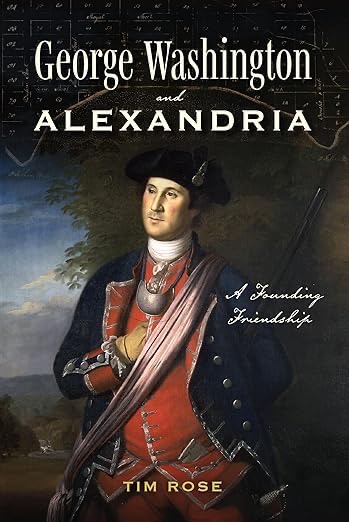
Rose, Tim. George Washington and Alexandria: A Founding Friendship. Charleston, SC: The History Press, 2026.
Mount Vernon is so closely related to George Washington that people overlook his extensive connections to the nearby town of Alexandria, Virginia. In his first book, public historian Tim Rose explores Washington’s deep civic, commercial, military, medical, and religious connections to the thriving port city. The owner of a historic walking tour company asserts that Washington’s hometown provided him with critical developmental experiences, cogent advisors, and loyal followers. Throughout Washington’s life, he appointed Alexandrians to key governmental and military positions, including on his command staff during the war and to prominent positions in his presidential administrations.
In 1748, Washington’s older half-brother, Lawrence, and Lord Fairfax, the largest regional landowner, petitioned the Virginia legislature to establish a town north of Mount Vernon on the Potomac River. Successful, Alexandria was founded as a port for the storage and shipment of tobacco. George, just 17 years old, drafted an early town survey. Later, George purchased lots in Alexandria and built a house which he both occupied and rented.
Even as a young man, Washington became active in the growing town’s civic affairs. Townspeople selected Washington as a town trustee before Alexandria became a city. Later, the town and the surrounding county elected Washington to serve in the colony’s House of Burgesses. A supporter of education, Washington worked with his friends to establish the Alexandria Academy to educate children, including the poor and orphaned. Washington also joined the local Freemason chapter, which continues to operate today. His largest civic contribution was chairing the committee that drafted a document opposing Britain’s Coercive Acts, which shut down the Massachusetts government and closed the port of Boston. The 1774 Fairfax Resolves were among the most radical in denouncing the British response to the Boston Tea Party and placed Washington firmly on the Patriot side.
Alexandria was also a place where Washington developed extensive commercial relationships. Early on, Washington developed business and personal relationships with merchants William Ramsay and John Carlyle. Exhibiting a high level of trust, Washington extended and received trade credit from these merchants. After transitioning from tobacco to wheat and other grains, John Fitzgerald and George Gilpen sold Washington’s crops. Robert Hanson Harrison helped Washington with legal matters. These trusting relationships led to important roles for these latter three individuals during the War for Independence.
Washington also experienced Alexandria as a strategic military staging point. In 1755, British General Edward Braddock established Alexandria as his headquarters for the expedition to expel the French from the Ohio country during the French and Indian War. Likewise, Washington, a Lieutenant Colonel in the Virginia Regiment, also made his headquarters in his hometown. A few years later, in preparation for the rebellion, Colonel Washington led the Fairfax County Independent Company and wore the unit’s uniform to the Second Continental Congress. After his selection as Commander in Chief of the Continental Army, Washington named several Alexandrians to his command staff. Fitzgerald, Harrison, and his brother-in-law, George Johnson, Jr., served as military aides. John Fitzgerald proved extremely valuable to Washington as he ferreted out the dangerous Conway Cabal and helped restore order on the Monmouth battlefield.
The Alexandrian medical community also supported Washington militarily and personally. Dr. James Craik was probably Washington’s closest friend and confidant. He was a fellow member of the Virginia Regiment and served in the Continental Army in several capacities. Another Alexandrian, Dr. William Rumney, treated his stepdaughter’s epilepsy. Dr. William Brown, who also served in the Continental Army, was one of Washington’s tenants and close friends. Dr. Brown and Washington collaborated to raise funds and operate the Alexandria school. One of the author’s most incisive observations is Washington’s deft use of medical advice from the Alexandria medical community to care for the Patriot army.
While Washington was a member of two other churches, he was active in Alexandria’s Christ Church. Parishioners elected him to the vestry. He purchased a pew (number 5) to fund the church. Demonstrating his open-mindedness and friendship, Washington supported John Fitzgerald’s efforts to build a Catholic church in the city, a notable gesture given the widespread anti-Catholic sentiment in Revolutionary America.
After independence, Washington remained active in the city. He was a leading proponent and investor in the Potomac Company, which sought to develop a canal to facilitate westward navigation. Mayor Dennis Ramsay, William’s son, was the first public official to recognize Washington’s election as president. As the first president, Washington ensured the city’s continued prominence by establishing it as the cornerstone of the new Federal District of Columbia. President Washington appointed Alexandria resident Charles Lee as the third Attorney General, the fifth-longest-serving Attorney General in history. When Washington died in 1799, many people from Alexandria attended the funeral services at Mt. Vernon.
The author makes a convincing case that Alexandria had a significant impact on Washington, and that Washington had a significant impact on Alexandria. One of the book’s best features is pictures of plaques commemorating people and events associated with Washington and the town’s history. Remarkably, many of the buildings Washington experienced can be seen in the town today. Another strength is that the author provides just enough background to allow those without extensive knowledge of Washington’s life to follow the narrative. Other readers might wonder, aside from Washington’s surrender at Fort Necessity during the French and Indian War, whether the author paints too rosy a picture of Washington’s association with Alexandria. As with other aspects of Washington’s (or anyone’s) life, there were failures, missteps, or misdeeds. That notwithstanding, it is remarkable that Washington was able to leverage his Alexandria network so effectively as commander in chief and as president.
While many of Washington’s Alexandrian friends are lesser recognized, one Alexandrian’s words reverberate through the centuries. Resident Light Horse Harry Lee delivered the iconic Washington eulogy, “First in war, first in peace and first in the hearts of his countrymen.” To understand how Washington achieved such lofty acclaim, one must delve into his hometown roots.
Discover more from Researching the American Revolution
Subscribe to get the latest posts sent to your email.
