Book Review
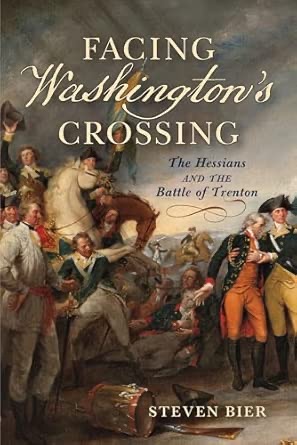
Bier, Steven. Facing Washington’s Crossing: The Hessians And The Battle Of Trenton. Yardley, PA: Westholme Publishing, 2025.
Typically, the story of Hessian mercenaries hired by King George III to fight in the American Revolution begins with their landing on Staten Island in the summer of 1776. However, public historian Steven Bier demonstrates that this simplistic story is wrong on two counts. The Hessians were not mercenaries but soldiers who served the Hessen-Kassel state and did not operate as private citizens seeking personal profit. Secondly, German culture, social norms, and the communities from which they were recruited and trained are critical to understanding the soldiers’ participation in the conflict.
He devotes the first third of the book to describing the German principality of Hessen-Kassel and its society, political leadership, and military practices, which produced three regiments sent to America. On their fifteenth birthday, every male was registered with the army and subject to conscription when required. Families knew that their sons could be drafted and trained to fight in distant wars. For almost a century, the Hessen-Kassel Landgrave (a land count sovereign over a territory) periodically rented the principality’s army to foreign powers. While the soldiers received pay and were promised captured booty, the Landgrave disproportionally benefited. The author asserts that the rental of the Landgrave’s army was the most profitable enterprise in the principality (page 21).
Although Voltaire and the Enlightenment inspired the current Landgrave, Friedrich II continued the practice of renting soldiers when the British sought soldiers to put down the American rebellion. Economics was a major motivator. The principality had not recovered from the devastation of the Seven Years’ War, just a few years prior. Friedrich II wanted to be a benevolent, enlightened ruler, but he also believed in the absolutism and militarism of Frederick the Great (page 27). Much of the information about Friedrich II comes from a German-language biography that Bier impressively cites, demonstrating that even American historians need to be fluent in foreign languages.[i] Most readers will find the underreported background on Hessen-Kassel and its monarch new and fascinating.
The first-time author focuses on the three regiments from the German principality of Hessen-Kassel, which opposed George Washington’s 26 December attack on Trenton, NJ. He describes the soldiers’ civilian lives, families, the drafting process, and the formation and training of military units capable of expeditionary deployments. Bier tells the story through the experiences recounted in the diaries of three soldiers: 17-year-old Johannes Reuber, a private in Colonel Rall’s Grenadier Regiment; 44-year-old Lieutenant Andreas Wiederhold of the Fusilier Regiment Knyphausen; and 34-year-old Lieutenant Jakob Piel of the Fusilier Regiment Von Lossberg. Bier supplements his narrative with several other soldiers’ diaries.
The extensive use of primary-source diaries is one of the book’s strengths. Hearing the Hessian voices unvarnished adds realism, transforming nameless, faceless soldiers into relatable people, and provides interesting details on battles and people. Additionally, the author obtained access to several unpublished diaries from historian Bruce Burgoyne, the noted translator of numerous Hessian diaries. However, accepting all information in the diaries as accurate can lead to misinterpretations. Bier notes in the Reuber diary that the five Rall Regiment battle flags surrendered at Trenton were recaptured at the Battle of Stono Ferry in South Carolina (page 260). This assertion is not corroborated by other sources, as there is no record of Hessian flags recaptured at Stono Ferry. A vexillologist-historian reports that two of the flags were in Philadelphia until they were stolen in the twentieth century, and that one fragment is held in the First Troop Philadelphia City Cavalry Museum collection.[ii]
Initially, the three Hessen-Kassel regiments experienced remarkable success in the 1776 New York campaign. Their first clash with the Rebels occurred in the lopsided Battle of Brooklyn. Later, the Hessen-Kassel soldiers assisted in the British victories in the Bronx and Westchester. Despite 330 casualties, the high point of Hessen-Kassel’s military contributions was the assault on Fort Washington, capturing 2800 American Rebels. British observers lauded their performance, “The Hessians behaved with incomparable Steadiness and Spirit” (page 155). Unbeknownst to the men from Hessen-Kassel, this would be the last combat compliment that they would receive during the American War for Independence.
After securing Manhattan Island, the Hessen-Kassel regiments aided the British in sweeping the beleaguered Continental Army from New Jersey. As the fall turned cold, the British commander, General William Howe, ordered the Hessians into winter quarters. Howe assigned the Hessen-Kassel regiments to garrison Trenton, New Jersey, the most exposed location of any of the British or Hessian forces. Colonel Johann Rall served as the overall commander.
Other strengths of Bier’s book include its depiction of the harsh winter’s impact on the Hessian soldiers and the controversies surrounding Rall’s defensive strategy. The Germans had inadequate winter clothing and deteriorating footwear, leading to suffering like that of the Continental Army. The Hessians were also on continual alert as Patriot forces raided the Germans’ defenses and ambushed patrols. The high state of alarm changed Rall’s decision-making on securing the garrison from attack. Rall’s superior ordered, and some of his subordinates recommended that he build redoubts to defend against a Rebel attack. Rather than a static defense, Rall ordered active patrols and a line of pickets to ferret out any threats before they reached the town. The colonel thought the Americans’ offensive capabilities were limited to raiding outlying posts, and the depleted Rebels could not mount a concerted attack. Rall’s decision not to build defensive fortifications, especially at the high ground at the northern entrance to the town, proved fatal.
When Washington’s army arrived the day after Christmas, it had a commanding advantage with 18 cannons compared to the 6 used by the garrison. Bier states that not only was this the biggest difference in firepower in any Revolutionary War battle, but also that Rall had incorrectly placed his cannons, rendering the Hessian guns ineffective. With no fortifications, limited artillery support, and the Rebels occupying the high ground, the battle quickly turned into a rout. Over 950 Hessians were killed or captured, while the American side suffered only a few casualties (page 257). Colonel Rall was among the fallen. The Hessen-Kassel soldiers were shocked by the Americans’ fearlessness (page 249).
Diarists Reber, Wiederhold, and Piel, along with the other soldiers captured at Trenton, continued in the British service after a prisoner exchange a few years later. None of their duties had as much importance as their defense of Trenton. The three diarists returned to their homeland after the war. Lieutenant Wiederhold was especially bitter. His diary notes an intense hatred of Americans, their concept of liberty, and the idea of a new nation (page 261).
The Trenton defeat was humiliating for the Landgrave, and he demanded satisfaction. General William von Knyphausen conducted a series of court-martials over three years. In the court’s final verdict, Colonel Rall, along with one other officer who died in the battle, was held fully responsible for the defeat. The court cleared all the living officers, including the Jagers, artillerymen, and the pickets who did not fight and fled the battlefield. Bier claims it was a kangaroo court that covered up for their fellow soldiers. Frederick II died two years after the Treaty of Paris, leaving his son, the new Landgrave, a treasury full of gold. Leasing soldiers was a highly profitable business.
Readers will enjoy learning about Hessen-Kassel’s history and its practice of renting soldiers to serve in foreign wars. The author’s extensive use of primary sources helps personalize the soldiers as individuals, including their motivations and aspirations. While not impacting the author’s thesis, Revolutionary War scholars will note several factual discrepancies.[iii] However, all readers will enjoy the author’s telling the story of the 1776 campaign from the point of view of the Hessians. This innovative approach humanizes the Hessen-Kassel soldiers, thereby enriching our understanding of their participation as British auxiliaries in the American Revolution.
[i] Both, Wolf von and Vogel, Hans. Landgraf Friedrich II. Deutscher Kunstverlag, 1973.
[ii] Hill, Stephen W. Hessian Flags in the American War for Independence, 1776-1783. https://www.scribd.com/document/562863218/Hessian-Flags.
[iii] For example, Washington wore his Fairfax Independent Company, not his French and Indian War uniform, to the Second Continental Congress (page 97). For background on Washington’s attire at the Second Continental Congress see, Reframing George Washington’s Clothing at the Second Continental Congress, Journal of the American Revolution. https://allthingsliberty.com/2022/12/reframing-george-washingtons-clothing-at-the-second-continental-congress/#:~:text=Dressed%20in%20defiance%2C%20Col.,preparation%20for%20potential%20civil%20conflict. George Mason to Geroge Washington, Founders Online. https://founders.archives.gov/documents/Washington/02-10-02-0113.
Additionally, the author refers to William Alexander, Lord Stirling, as William Stirling, an inappropriate contraction of his name (page 111). Contemporaries called him either William Alexander or Lord Stirling. For background on William Alexander and his title of Lord Stirling see, Blue Mountain Valley and the Rise of Lord Stirling. Journal of the American Revolution. https://allthingsliberty.com/2020/05/blue-mountain-valley-and-the-rise-of-lord-stirling/.
Discover more from Researching the American Revolution
Subscribe to get the latest posts sent to your email.
