Book Review
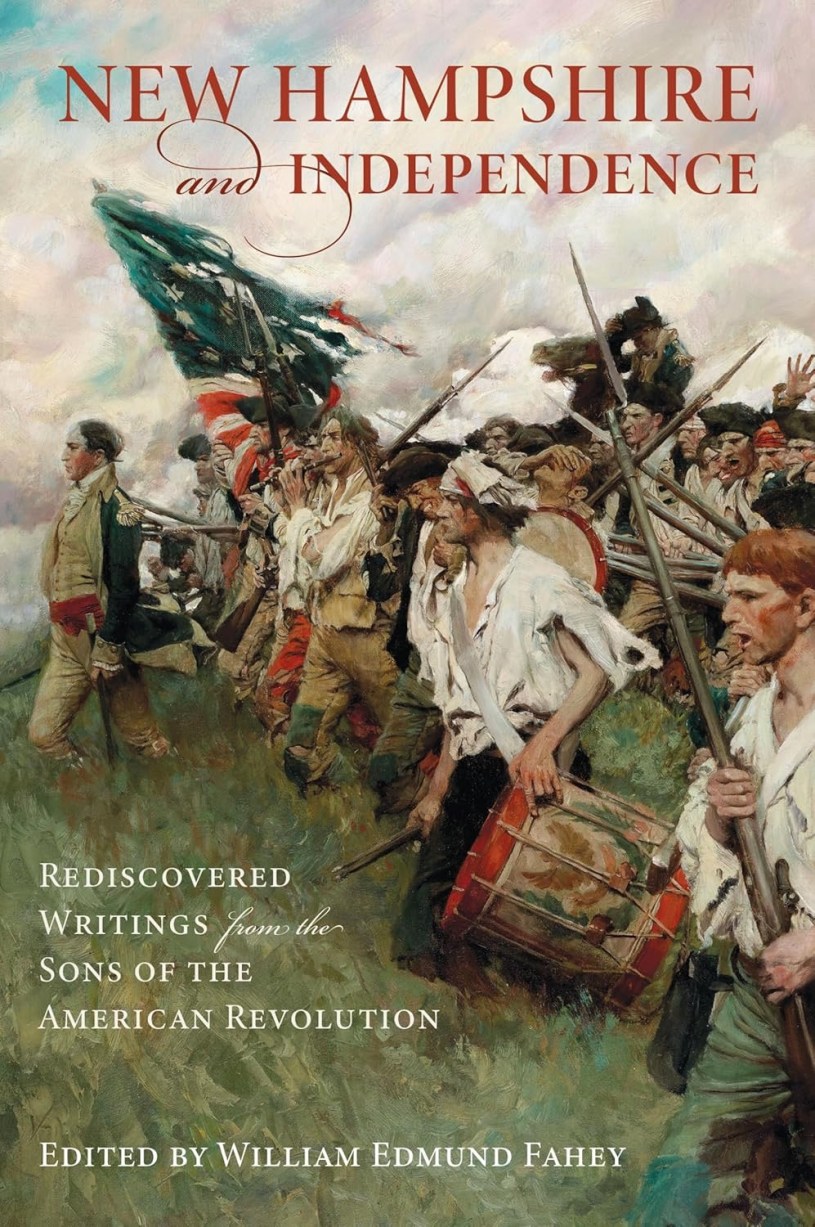
Fahey, William Edmund, ed. New Hampshire and Independence: Rediscovered Writings from the Sons of the American Revolution. With Jeff Thomas and Richard Baynes. History Press, 2026.
People may ask, “Why read about New Hampshire during the American Revolution, as no battles or major events took place in the state?” In his new book, Thomas More College President William Fahey demonstrates that New Hampshire residents were instrumental to the Patriots’ success in the rebellion. Remarkably, two-thirds of the state’s men served in the Continental Army or as active-duty militia (page 38). While noting less-than-stellar performances at the Battles of the Cedars, Quebec, and Hubbardton, Vermont, most New Hampshire regiments and commanders acquitted themselves with honor. They made major contributions in the Battle of Bunker Hill and key Patriot victories at Trenton, Bennington, Saratoga, and Yorktown.
As importantly, New Hampshire’s people were remarkably similar in mind regarding their desire to take up arms to break away from the British Empire. Unlike most states, New Hampshire did not experience the violence of a civil war. No loyalist militias pitted Americans against one another in the Granite State. The relatively few loyalists fled to British lines in Boston or quietly retired from political or military activities.
Likewise, residents coalesced around a new state government with minimal controversy. Given the overwhelming support for independence, New Hampshire citizens were the first to replace their Royal charter with a state constitution (reprinted pp. 235-38). In another bold step, they declared independence before the Continental Congress did on 4 July 1776 (reprinted pp. 239-41) and submitted the deciding ninth state ratification to adopt the U.S. Constitution in 1788. Remarkably, the state’s residents did not feel enmity towards their last Royal governor, as did other colonies. Governor John Wentworth’s portrait hangs today in the state capitol building (p. 54).
Professor Fahey, a member of eight heritage and lineage societies, chose a unique way to depict New Hampshire’s exceptionally large contributions. He selected and edited six lectures delivered at the turn of the twentieth century by presidents or prominent members of the New Hampshire Sons of the Revolution lineage organization. The first two essays provide overviews of the state’s contributions throughout the war. The remaining four delve into the details of the Siege of Boston, the Battle of Bunker Hill, the 1779 Maj. Gen. John Sullivan’s invasion of the Haudenosaunee (Iroquois) Nation, and the life of John Landon, an oft-overlooked founder.
Although the lectures were written at the turn of the twentieth century, their accounts still hold up well against modern historiography, with only a few exceptions. Notably, readers will learn about several lesser-known contributions by Granite Staters in key battles. For example, New Hampshire soldiers played a critical role in maintaining the Siege of Boston when a large group of Connecticut troops left for home. Thirty-one New Hampshire companies, each comprising 63 soldiers, stepped into the breach, with hundreds volunteering to serve in Massachusetts regiments (p. 116). At the Battle of Bunker Hill, the efforts of Col. John Stark’s and Col. James Reed’s regiments inflicted significant casualties on the threatening British flanking maneuver. The steadfastness of the New Hampshire regiments, their calmness under attack, and their covering fire during the retreat helped save many men manning the American redoubt from “annihilation” (p. 144). Another overlooked contribution is John Langdon’s personal funding of the New Hampshire militia to march to the aid of the Vermonters in stopping the 1777 British invasion from Canada. The Portsmouth merchant stated that his “property would be of no value to him” unless “we succeed in defending our firesides and our homes” (p. 206). Under the leadership of Gen. John Stark, the New Hampshire militiamen, alongside Vermonters, defeated the Hessian force at the pivotal Battle of Bennington. Langdon later served as governor and a U.S. senator.
The essay on Maj. Gen. John Sullivan’s expedition to destroy the combat power of the Haudenosaunee (Iroquois) stands the test of time less well. The author, a congregational minister and prolific writer, describes the Patriots’ scorched-earth campaign as a tactical success, sweeping the Loyalists and their native allies from central New York and eliminating the agricultural base of the British-allied Iroquois Nation. However, the essay downplays the strategic failure to secure peace on the frontier during the war. Instead of being virtually destroyed (p. 178), the displaced Iroquois and their Loyalist allies became dependent on the British and intensely embittered. The survivors launched even more frequent and violent raids in 1780 and 1781 to gather food and seek revenge. The New York and Pennsylvania frontier between the Americans and the Haudenosaunee remained a bloodily contested area until the end of the war. Additionally, some readers will be taken aback by the description of the Native Americans as “red men” (p. 158) and the starving Haudenosaunee as “sheep dying in a blizzard” (p. 178). In this instance and several others, an editor’s note would have helped modern readers put these 1900s characterizations in context.
The New Hampshire and Independence compendium of essays and information has several strengths that aid readers’ understanding of the state’s revolutionary history. The editor provides numerous interesting pictures to illustrate the essays and personalize the participants. Readers seeking to delve deeper will appreciate the book’s ending segment, “Revivifying the Past.” This section provides information on state libraries, historical sites, reenactment groups, and hereditary heritage communities. Also, Fahey provides recommendations for those interested in building Revolutionary Era book collections focusing on both general works and specific New Hampshire volumes. He concludes with a reprinting of important state founding documents. Readers will especially enjoy the final document: John Stark’s message to a 1809 gathering commemorating his victory at Bennington, Vermont. The irascible general ends by coining New Hampshire’s famous motto: “Live free or die” (251-52).
Dr. Fahey demonstrates that New Hampshirites “punched above their weight” in contributing to the success of the American Revolution. Using older descriptions from the New Hampshire Sons of Liberty files is a unique way to understand the state’s support of the rebellion and the evolution of historical interpretations over time. The early-twentieth-century essayists exhibit a strong sense of pride stemming from the accomplishments of their Granite Staters’ Revolutionary Era ancestors. Today, readers will enjoy celebrating their successes and will be inspired to work towards improving what the founding generation created.
Discover more from Researching the American Revolution
Subscribe to get the latest posts sent to your email.
