Overview
A British-born citizen, Thomas Paine arrived in the American Colonies just before the outbreak of the American War of Independence. During the dark days of 1776, when Gen. George Washington’s Army seemed to be on the brink of collapse, Paine penned his most famous book, Common Sense. He followed up with a series of Pamphlets under the title The American Crisis. His writing has been credited with instilling a renewed sense of commitment to the Revolutionary Rebels. In the 1790’s, in Revolutionary France, Paine wrote The Rights of Man. Paine’s contribution to the French Revolution is more controversial, and eventually, he fled France for Britain and America.
While Paine is credited as a gifted political writer, his views were out of step with those of the United States and French governments and with many of their citizens after the American and French Revolutions. Paine eventually returned to the United States but received a cold welcome. Many people were put off by Paine’s views on Christianity and religion. His death in 1809 went almost unnoticed. There are a few memorials to Paine in the United States. Two statues are in New Jersey (Morristown and Bordentown), and two busts are in museums on either side of the Delaware River, where Washington’s Army crossed on December 25 and 26. In addition, there’s a monument on the grounds of the Thomas Paine Association in New Rochelle, New York.
Books and Pamphlets by Thomas Paine
Common Sense, 1776
First published in January 1776, Common Sense is a manifesto for democratic government and a call of declaring American independence from Britain. It is written to be understood by people without formal education (in a vulgar style, without classical references). Paine cites the Book of Samuel in the Christian Bible and John Milton’s Paradise Lost to argue against monarchy. He provides an outline of the arguments that eventually are incorporated into the Continental Congress’s Declaration of Independence. Paine ends with a four-part argument for why a Declaration of Independence is needed. His reasoning resonates with both political leaders and the general population.
One of the most famous Paine quotes is “We have it in our power to begin the world over again.”
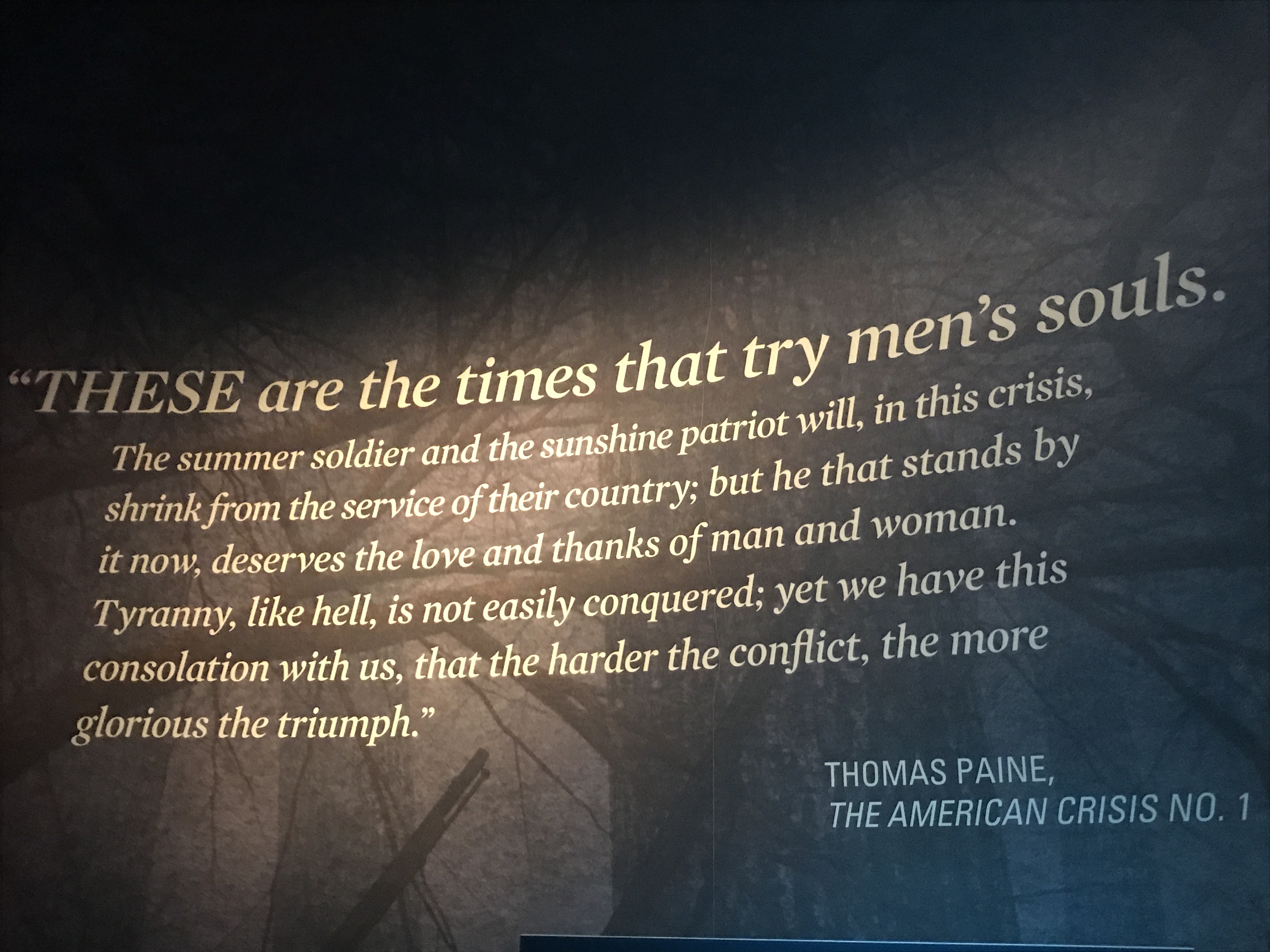
The American Crisis: Number 1. by the Author of Common Sense December 23, 1776
General George Washington had Paine’s The American Crisis read to the troops before crossing the Delaware River to attack the Hessians at Trenton. He believed that Paine’s words would inspire his army to weather the elements and fiercely attack the Hessian outpost.
The Rights of Man, 1792
Paine, Thomas. Collected Writings. The Library of America 76. New York: Library of America, 1995.
The Library of America has the best reprint of all of Paine’s works in a compact volume.
———. Common Sense. Mount Vernon, New York: The Press of A. Colish, 1976.
_______. The Rights of Man -Part Two – The Second Combining Pinciple and Practice. London: H. D. Symonds, 1972.
A six-volume collection of Thomas Pain’s writings will be published by Princeton University Press in Spring of 2026
https://press.princeton.edu/books/hardcover/9780691233420/thomas-paine-collected-writings-volume-1
Secondary Sources – Biographies
Ferling, John E. Apostles of Revolution: Jefferson, Paine, Monroe, and the Struggle against the Old Order in America and Europe. New York: Bloomsbury Publishing, 2018.

Foner, Eric, and Thomas Paine. Tom Paine and Revolutionary America. Oxford University Press paperback. London: Oxford University Press, 1977.
Thomas Paine was more involved in the American Revolution than just writing his influential pamphlet, Common Sense. Eric Foner points out that Paine influenced the first Pennsylvania state constitution. He supported the radical concept of a unicameral legislature elected annually by eligiable voters. While Pennsylvania’s legislature was more democratic than other states, Paine did not support enlarging the suffrage. In addition to constitution-making, Paine became involved in the controversies over price controls and efforts to mitigate the onerous implications of runaway continental dollar inflation. Paine supported a laissez-faire response to the inflation crisis.
While most of this book is focused on the American Revolution, Foner observes that Paine changed several of his views over time. The polemicist moved to France during the French Revolution where he argued for expanded suffrage and for price controls to better harness the revolutionary fervor of French citizens. During the terror, Paine was fortunate to not have been sent to the guillotine. Paine ends his life in New York, living on a farm he received for his American Revolutionary contributions.
Foner envelops his arguments in traditional Marxist class structures, such as lower classes, artisans, and mechanics. While class analysis might be foreign to some ears, Foner’s history is first-rate and remains relevant today.
Hawkins, David Freeman. Paine. New York: W. W. Norton, 1992.
Keane, John. Tom Paine: A Political Life. 1st ed. Boston: Little, Brown, 1995.
Nelson, Craig. Thomas Paine: Enlightenment, Revolution, and the Birth of Modern Nations. New York: Viking, 2006.
Unger, Harlow Giles. Thomas Paine and the Clarion Call for American Independence. New York: Da Capo Press, 2019.
Journal Article
Research Centers
Iona College maintains an Institute for Thomas Paine Studies as part of its academic mission. Iona is located three miles from the location of Paine’s burial. The institute employs Artificial Intelligence and Big Data to better analyze Paine’s writings and to identify writings that should be attributed to other authors.