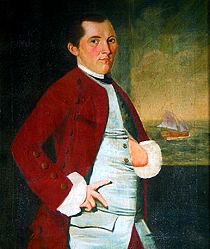
Overview
Controversies have not been resolved surrounding Silas Deane and his diplomatic and commercial activities in Europe during the American Revolution. These activities were disputed among his contemporaries and historians. Many believed that he substantially aided the Patriot cause, while most thought he was a traitor in the same vein as his friend Benedict Arnold.
A highly successful merchant before the war, the Rebel Connecticut Assembly voted to send Deane to the Continental Congress. When not re-elected, Congress’s Secret Committee selected him for a mission to France to procure arms and expertise for the needy Continental Army. Initially, Deane successfully organized numerous secret weapons and military store shipments. Later, he became entangled with fellow diplomat Arthur Lee which developed into a major dispute.
When Congress appeared to side with Lee, a disgruntled Lee returned to France to pursue a commercial business. While operating in France, Deane sent a series of private letters to friends criticizing Congress and expressing doubt as to the viability of the new nation. Unfortunately for Deane, a British warship intercepted these letters, and a Loyalist newspaper editor printed them with some alterations.
After the war, Deane moved from Paris to Britain to further his business. In London, Benedict Arnold visited Deane. This high-profile association and the intercepted wartime letters branded Deane a traitor among his contemporaries. Deane never returned to America. However, his descendants continued to advocate for Congressional restitution of monies owed to him. In 1842, President John Taylor signed a bill authorizing the payment of $37,000 (over one million today) to Deane’s granddaughter. Congress concluded, “Mr. Deane performed highly important and valuable services for the country.” Although the US Government belatedly cleared Deane’s name, many historians have not held his services in high regard with some casting aspersions as to his patriotic loyalty.
Primary Sources
The Deane Papers. Correspondence between Silas Deane, his Brothers, and their Business and Political Associates, 1771-1795 (Collections of the Connecticut Historical Society, Volume 23), Hartford: Connecticut Historical Society, 1930.
Memorial of the heirs of Silas Deane formerly political and commercial agent in Europe one of the ambassadors of the United States in France in the Revolutionary War, 1835.
Deane, Silas. Papers in the Relation to the Case of Silas Deane. Philadelphia: Printed for the Seventy-Six Society/ .K.& P.G. Collins, Printers, 1855.
Wharton, Francis, ed. Revolutionary Diplomatic Correspondence of the United States. First. 6 vols. Washington, DC: Government Printing Office, 1889.
Secondary Sources
Van Vlack, Milton C. Silas Deane: Revolutionary War Diplomat and Politician. Jefferson, NC: McFarland & Company, Inc., 2013.
Van Vlack’s book is the most recent Silas Deane biography. It is a good starting place for those interested in an overview of Deane’s life and a description of the Deane/Arthur Lee controversy. However, the book suffers from several deficiencies, which Liz Covart ably illustrates in her book review.
Carleton, Marsha W. Silas Deane 1737-1789. Hartford, CT: National Society of Colonial Dames, 1971.
Clark, George L. Silas Deane A Connecticut Leader in the American Revolution. New York: G. P. Putnam Sons, 1913.
Silas Deane Historic Sites
The house that Silas Deane built in Wethersfield, Connecticut, is part of a house museum complex open to visitors.
