By Reny Mariane Bake, Economics & Geopolitical Analyst, Guatemala City, LinkedIn Profile http://linkedin.com/in/reny-mariane-bake-8260467.
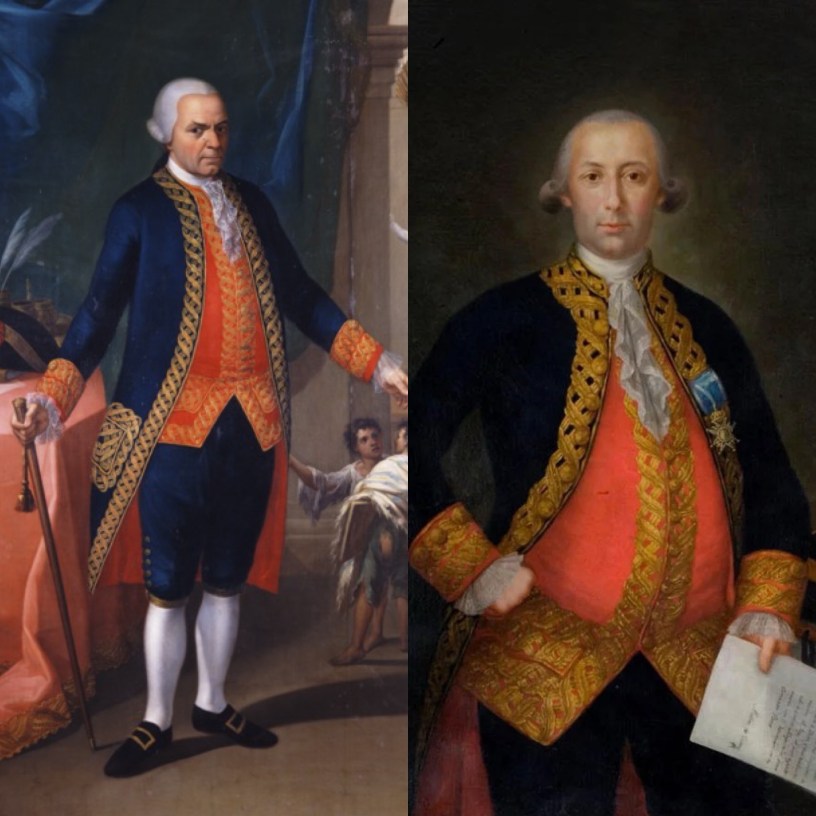
There is a portrait hanging in the U.S. Senate on a wall of the Foreign Relations Committee room[i]. It is the portrait of Bernardo de Galvez, the Spanish hero of the American Revolution and one of the seven people[ii] declared “honorary citizens” in that country. Bernardo’s statue is located in front of the U.S. State Department in Washington, D.C., near the National Mall, where the most iconic monuments of that country are located. His story is well-known in the United States.

Bernardo de Gálvez y Madrid ( Juy 23, 1746, Macharaviaya, Málaga, Spain – November 30, 1786, Tacubaya, Mexico) Portrait attributed to Maella[iii]
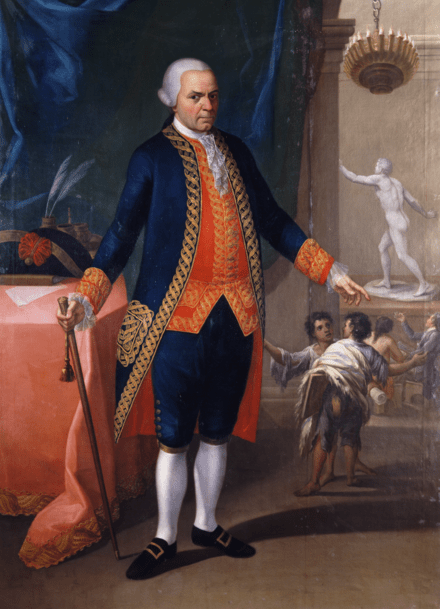
Matias de Gálvez y Gallardo. ( July 29, 1717, Macharaviaya, Málaga, Spain – November 3, 1784, Mexico city, México) Portrait at Museo Nacional del Virreinato, Mexico.
In contrast, the story of Bernardo de Gálvez’s father, Matías de Gálvez y Gallardo, is almost unknown. He also fought against the British between 1779 and 1782 in the territory known today as Central America. These battles were fought against the British as Captain General of the then Kingdom of Guatemala (then part of the Spanish Empire and today Guatemala, Belize, El Salvador, Honduras, Nicaragua, Costa Rica, and the Mexican state of Chiapas).
In 1776, Matias de Galvez was a career military officer in Tenerife, Spain. That year, in America, on July 4, 1776, after years of unconformity, revolts, and some battles against the British, the inhabitants of the then Thirteen British colonies in America -which today we know as the United States- declared their independence from Britain and prepared for war against that empire.
They were a group of colonists of different origins and religious beliefs, poorly equipped, fighting against England, the most powerful nation at the time, with enormous financial resources and a regular army. Those “colonists” would be known in history as “the American patriots.”
These American patriots were fed up with England imposing more taxes on them and having no representation in the British Parliament. So, they declared themselves independent. They had a dream of freedom but little money, few weapons, and little or no military training; they wanted to govern themselves and elect their authorities themselves. That, at that time in history, was a novel idea globally.
They could not even be considered a regular army by the standards of the time. George Washington, who would be their commanding general, had not commanded anything larger than a regiment[iv] before that. During 1776 and 1777, the so-called “continental army” lacked arms, ammunition, food, and shelter. That would be accentuated during the winter between 1777 and 1778 at Valley Forge, Philadelphia. There, General George Washington and his troops suffered from a lack of food, shelter, and disease and an inclement winter. There, with the help of Baron Von Steuben, who had recently arrived from Europe, the troops would be trained to become an army that could better face the British army.
At the beginning of the war, the British established a commercial-naval blockade of their “former American colonies”. Soon, the Dutch merchants managed to smuggle arms and ammunition to the continental army, which helped them evade the blockade to sell their products in Europe, thus enabling them to finance the war.
Later, France and Spain would become involved in seeking to weaken the British Empire and would send economic support, as well as arms and ammunition, to the American patriots. However, military reinforcements were not initially received from any power of the time. In particular, volunteers came from France and other European countries to join the American cause. On a military level, it was almost a David versus Goliath struggle. The future of the nascent United States was uncertain, and it was not clear whether they would succeed in defeating the British.
In April 1779, France and Spain renewed the so-called “Family Pact” – an agreement between the two powers against Great Britain – and as a result, the Anglo-Spanish War of 1779-1783 broke out. The new belligerents opened a second front of war for the British. The direct entry of France and Spain in the war against England would change the balance of military power and provide military reinforcements for the American patriots. In the case of Spain, Bernardo de Galvez and his troops would fight in the then-called West Florida, which today are the U.S. states of Louisiana, Mississippi, Alabama, and Florida.
While that was happening in North America, in 1778, Matías de Gálvez, Bernardo’s father, had arrived in the Kingdom of Guatemala -now Central America- as Inspector General of the Troops and Militias. In the XVIII century, that region was a flourishing part of the Spanish empire and suffered from periodic attacks on its coasts by the British and pirates.
From the beginning, Matias’s main concern was to improve the defenses of the territory since there was a growing fear of a direct war between Spain and England. Then, he took care of military matters and organized the military corps of several regional cities.
Almost simultaneously, the “Family Pact” was renewed in Europe; in April 1779, Matias de Galvez was named governor of the Kingdom of Guatemala and captain-general. He then took charge of the political and administrative part of the Kingdom. A few years before, earthquakes had destroyed the capital of the Kingdom of Guatemala, and the city had been moved. Matías continued with the construction of the new town.
In the Kingdom, there were three forts. These were: San Felipe del Golfo Dulce -today in Guatemala- the Inmaculada Concepción del Río San Juan -today in Nicaragua- and the fort of San Fernando de Omoa -today in Honduras- recently finished in 1775. The last one was the most important fort on the Atlantic coast of Central America to protect the exit of silver exports from the mines in the region and the towns on the nearby coast.
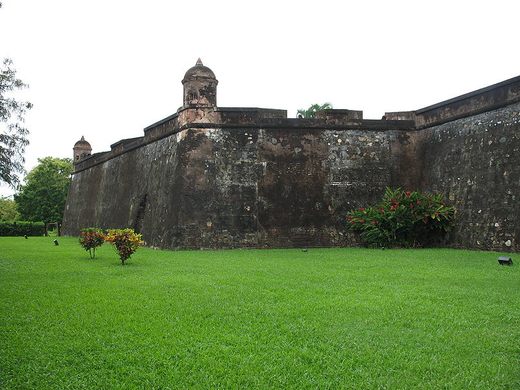
Fort of San Fernando de Omoa. Honduras.Picture taken from https://es.wikipedia.org/wiki/Batalla_de_San_Fernando_de_Omoa. March 15, 2022.
In October 1779[v], the English attacked and seized the San Fernando de Omoa fort. Then, Matías de Gálvez y Gallardo organized troops to rescue the fort. These troops were called to fight soldiers stationed in towns that today are in Guatemala, El Salvador, Honduras, and Nicaragua. According to the historian Luis Alfonso Ortega Aparicio about that battle: “The Royal Army of His Catholic Majesty in the Kingdom of Guatemala was formed by mulattos, mestizos and Spaniards.” (Aparicio and Ortega, 2017)
Once the troops were gathered, Matias de Galvez marched to fight the English and recover the fort. The fort was in an area known to be unhealthy, plagued by mosquitoes and diseases. Gálvez’s troops were more acclimatized, and that would help them. The British were already weakened by the weather and diseases when Matias de Gálvez approached the fort. It was immediately vacated by the English, who were already embarking on the high seas when Gálvez ordered to inspect the castle without English opposition” (Aparicio and Ortega, 2017).
In the following years, Matias de Galvez also recovered the other forts and the islands of Roatan. For his victories against the British, he was promoted to lieutenant general of the Spanish Army and later appointed Viceroy of New Spain -today Mexico- in 1783. He died there in 1784 and was succeeded by his son, Bernardo de Gálvez y Madrid.
Matias and Bernardo de Gálvez, father and son of Spanish origin, fought against the British during the American Revolution; these fights took place both in the territory that today is the United States and in what today is Central America.
Millions of people have migrated from that region to the United States in recent decades, representing approximately 2% of the population in that country. Will any of them descend from the troops of Matias de Galvez, who fought against the British during the American Revolution? Who knows, but in 2026, the United States will celebrate the 250th anniversary of the Declaration of Independence, and remembering those ties that unite Central America with the United States should be part of those celebrations.
Currently, when we are discussing the relationship between Central America and the United States, we tend to talk about issues such as illegal migration, drug trafficking, gangs, or insecurity. When we talk about the shared past, it seems that this past has only existed since the 20th century.
Our common roots are older and go back to the American Revolution. The United States and Central America are not only united by geography, trade, or migration; we are united, in some way, by a common history since the very origins of the United States. In some way, we are united by the story of Bernardo de Gálvez and his father, Matias.
Bibliography
Aparicio y Ortega (5 de diciembre 2017). Historia y Genealogía de la familia Sáenz de Tejada. Guatemala.
Pereda, C.(29 de marzo 2014). Estados Unidos le debe un homenaje a Bernardo de Gálvez. EL PAIS. Recuperado de https://elpais.com/cultura/2014/03/29/actualidad/1396124066_794294.html. Consulta del 15 de marzo de 2022
N.I. (1700). Matias de Gálvez (óleo sobre tela). Museo nacional del Virreinato. México. https://mexicana.cultura.gob.mx/es/repositorio/detalle?id=_suri:MNV:TransObject:5bce8af67a8a02074f834444. Consulta del 15 de marzo de 2022
Roig-Franzia, M. (30 de octubre 2014). A picture of persistence in honoring a Spanish hero of the Revolutionary War. Washington Post. https://www.washingtonpost.com/lifestyle/style/a-picture-of-persistence-in-honoring-a-spanish-hero-of-the-revolutionary-war/2014/10/30/d59cf296-5b95-11e4-b812-38518ae74c67_story.html
Garcia Calero, J. (09 de diciembre 2014). Estados Unidos concede a Bernardo de Gálvez la ciudadanía honorífica. ABC. https://www.abc.es/cultura/20141205/abci-eeuu-galvez-ciudadano-honorario-201412051309.html
J.G.C. (21 de enero 2014). Bernardo de Gálvez ya no está solo. ABC. https://www.abc.es/cultura/toros/20140120/abci-bernardo-galvez-esta-solo-201401202134.html
Footnotes
[i] https://www.usatoday.com/story/news/world/2014/12/09/congress-honors-wishes-of-continental-congress-with-galvez-portrait/20149797/
[ii] The other six are: Sir Winston Churchill, Raoul Wallemberg, William Penn, Hannah Callowhill Penn, The Marquis of Lafayette y Kazimierz Pulanski.
[iii] Picture taken from Pereda, C.(29 de marzo 2014). Estados Unidos le debe un homenaje a Bernardo de Gálvez. EL PAIS. Recuperado de https://elpais.com/cultura/2014/03/29/actualidad/1396124066_794294.html. Consulta del 15 de marzo de 2022
[iv] McCullough, D. “John Adams”. Simon & Schuster. Estados Unidos. 2001. Página 27.
[v] Anglo Spanish War 1779 -1783.
Discover more from Researching the American Revolution
Subscribe to get the latest posts sent to your email.

El ejército que Matías de Gálvez formó para desocupar el fuerte de Omoa, lo aglutinó durante su tránsito por los pueblos que estaban en el camino que conducía desde la nueva población de Guatemala hasta ese fuerte, y no luchó en contra de los soldados que estaban en esos pueblos, todo lo contrario, se unieron a él para defender ese fuerte del ataque que sufrió por parte de los ingleses.
LikeLiked by 1 person