Book Review
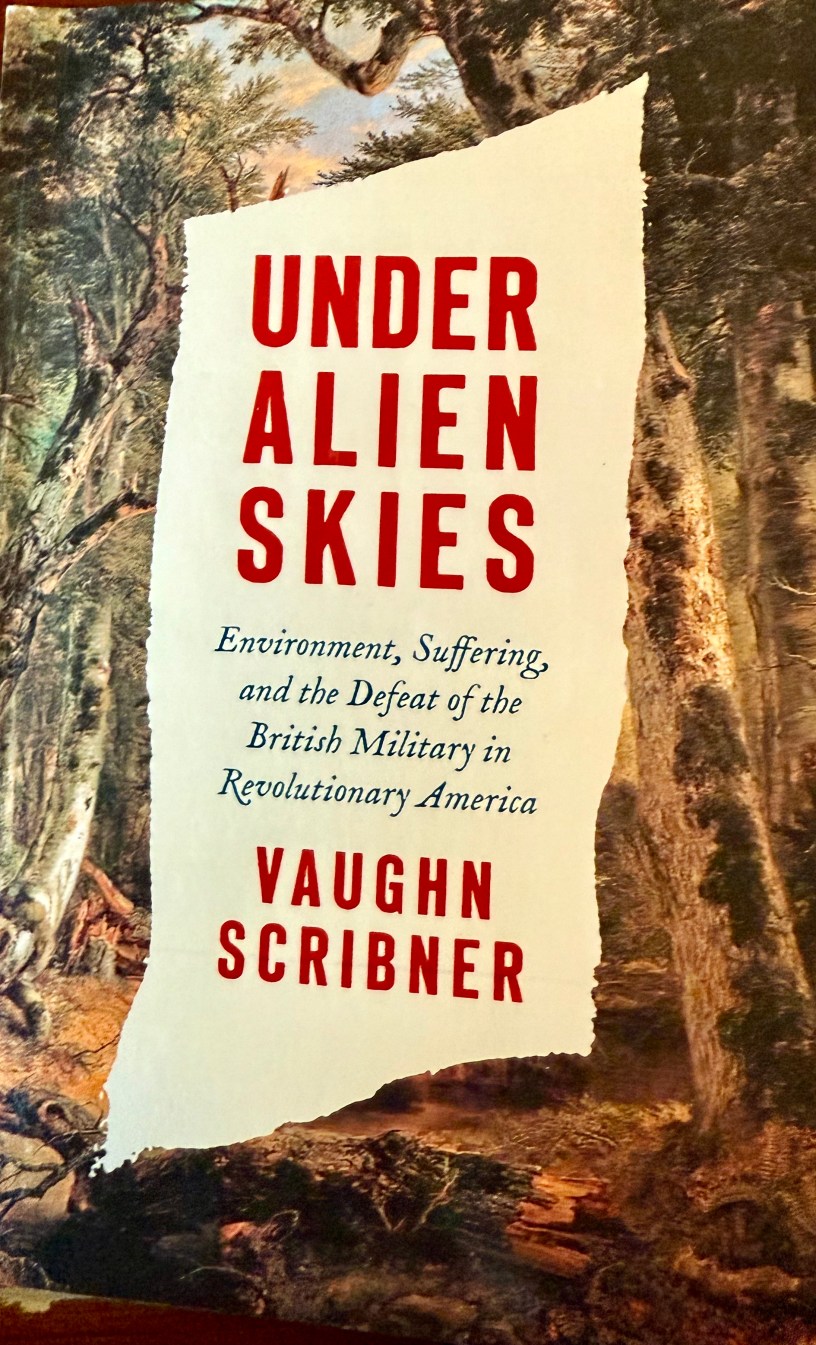
Scribner, Vaughn. Under Alien Skies: Environment, Suffering, and the Defeat of the British Military in Revolutionary America. 1st ed. Chapel Hill: University of North Carolina Press, 2024.
Soldiers’ lives are often more affected by their travails between battles than in actual combat, especially in foreign regions. Vaughn Scribner, a University of Central Arkansas history professor, demonstrates that the overseas and hostile North American environment caused the invading British and Hessian forces substantial emotional and physical trauma during the American War of Independence. Professor Scribner asserts that his work is the first full-length monograph to chronicle the environmental history of the American Revolution from a British perspective.
Professor Scribner starts his third book with the combatants’ horrifying crossing of the Atlantic Ocean under cramped, harsh, and dangerous conditions. This was their first sailing experience for most soldiers, and many dreaded a return voyage. Once on land, the Royal forces faced unfamiliar and daunting swamps, mountains, and waterways. The warriors complained that they felt helpless and endured mental and physical hardships due to this unaccustomed terrain. The soldiers and camp followers also encountered previously unencountered venomous snakes, dangerous wild mammals, and poisonous plants.
Adding to their discomfort, the climate was either too hot or too cold, with furious storms or parched droughts. The professor posits a fascinating four-region climate account: the frigid north, middle colonies, Torrid south, and coastal Atlantic. Within and between regions, the environmental historian points out that the Hessian and British uniforms were too heavy or too light for many times of the year. As a result, soldiers regularly died from exposure or heat prostration.
In one of the most interesting and innovative chapters, Scribner describes soldiers’ emotional distresses, including depression and suicide. Mental health is a vastly under-reported eighteenth-century issue, which makes Scribner’s book valuable for this insightful and relevant chapter alone. To complete the round trip, the author concludes with a chapter on the less well-chronicled return voyage to Europe. He notes that the impact of the North American environment and stresses did not end after returning home, with soldiers feeling the adverse environmental effects for years or dying young.
There is a lot to learn from Scribner’s work. He avoids the sophomoric thinking of soldiers as mere chess pieces to be moved around the battlefield. Climate, geography, and human stresses sapped morale and combat strength. Marching between battles and camps could be as deadly as combat. The author also dispels a myth that the British were snug in warm and comfortable Philadelphia and New York City while the Rebels suffered food and fuel deprivations in Valley Forge. Both sides endured great hardships.
While Scribner’s environmental assessment is unique and compelling, several unanswered questions arise. At the outbreak of the revolution, the British Army had several thousand troops stationed in North America. Over the years, these troops gained local knowledge and an excellent understanding of the climate and geography. Outside of Boston and New York, the garrison troops adapted to the local environments and generally had good relationships with the residents. One measure of their contentment is the prodigious number of children born to wives of the 26th Regiment of Foot in New Jersey.
Another question is whether the British and Hessian experiences differed greatly from the Americans. Most Continental Army soldiers had been at most 75 miles from their hometowns. As they traveled north or south, they would have encountered unfamiliar terrain, flora, and fauna with inadequate uniforms like the British and Hessians. The Rebels also lost more people to diseases than fighting, as did the invaders.
Lastly, I would have liked to see more “so what” conclusions. While there appear to be more Hessian stories in the book, it would have been interesting to know if the environment negatively affected the Hessians or the British more. Indeed, language difficulties inhibited Hessian acculturation. Other interesting questions are whether the officers or enlisted men suffered more and whether American-born recruits in the British Army impacted the Crown forces’ environmental adaption. Scribner is a prolific writer, so perhaps these additional questions will be answered in future works.
The author’s extensive primary source research benefits inquisitive readers. The hundreds of vignettes and their sources are helpful to anyone interested in revolutionary diaries and memoirs. I particularly like the emphasis on newspaper accounts, as they are contemporaneously written and less subject to later modification or selective preservation. Finally, environmental history is an excellent addition to understanding the Revolutionary Era war beyond battles and combat.
Discover more from Researching the American Revolution
Subscribe to get the latest posts sent to your email.

Thanks, Gene. Very interesting review of a very interesting topic. The environment in war is becoming a popular subject, with a number of recent Civil War era books. I believe there is another on the revolution in progress. But $99 for a hardback? Yikes! Are they crazy? I always enjoy your reviews.
Bill
LikeLiked by 1 person
Bill, thank you for your kind words! I hear that several academic presses are promoting paperbacks and only offering hardbacks at exorbitant prices to make the paperbacks look cheaper. I interviewed one author who said he did not even own a hardback version. It is a new world for academic presses. Gene
LikeLike