Book Review
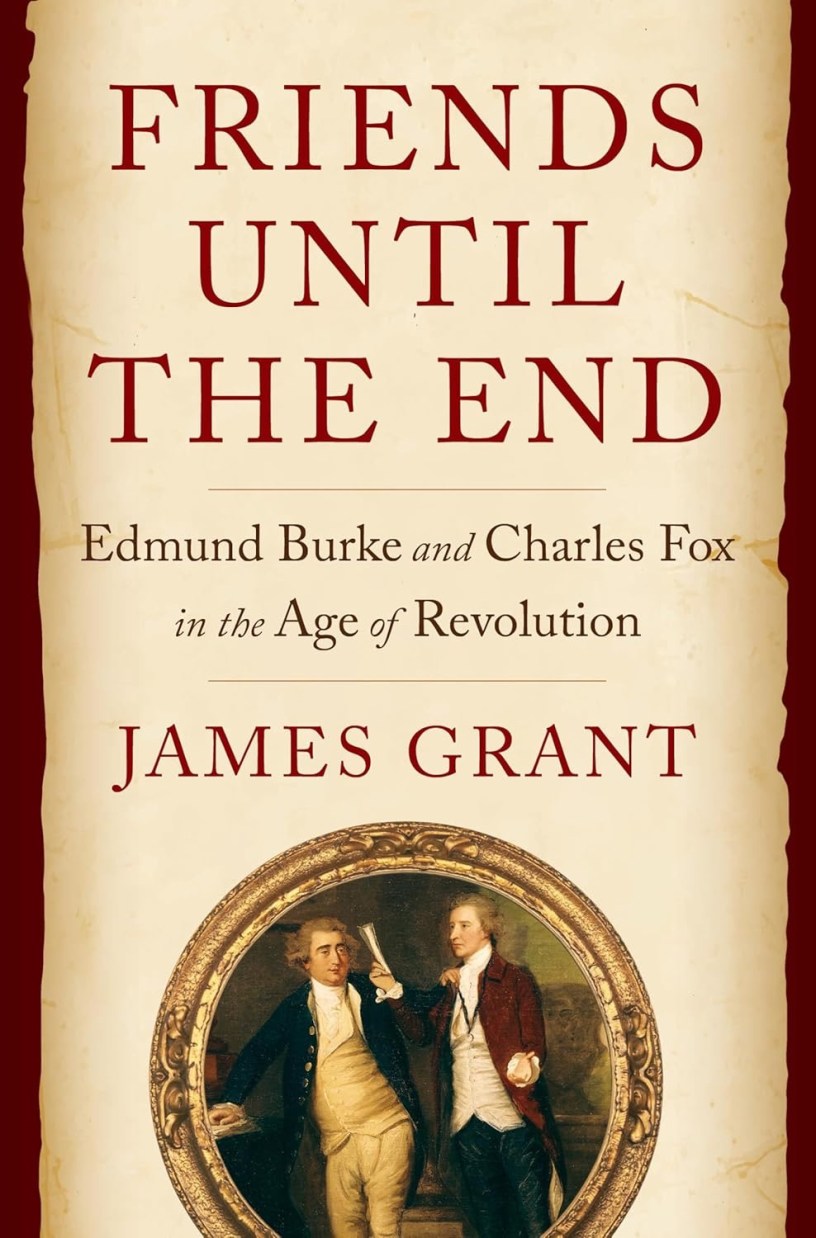
Grant, James. Friends until the End: Edmund Burke and Charles Fox in the Age of Revolution. New York, NY: W.W. Norton and Company, 2025.
Eighteenth-century British legislators faced numerous challenges, including imperial conflicts, religious unrest, disputes over slavery, and corruption in government and corporations. In his new book, experienced financial journalist James Grant explores these issues through the lives of Edmund Burke and Charles James Fox, two Members of Parliament. Burke and Fox formed an unlikely political alliance, opposing King George III’s government. Remarkably, this political duo held significant influence and achieved critical human rights milestones despite being part of the minority Whig party for most of their decades in the House of Commons.
Interwoven in the dual-biographical account are attention-grabbing features of the eighteenth-century British political system. For example, only one-third of the represented constituencies (counties, boroughs, and universities) were democratically contested. Members served terms of up to seven years with no term limits (p. 220). Electoral voting rights were limited to males with substantial land or wealth, and few boroughs had thousands of voters. Furthermore, elections could be expensive for candidates. Voters expected food, drink, and lodging in exchange for traveling to central polling places and casting favorable votes.
Although espousing similar political views, Burke and Fox came from very different families and backgrounds. Burke was born a commoner of Irish descent, rumored by political opponents to have been baptized into the Catholic faith. In contrast, Fox was the favorite son of a wealthy, politically connected English father. Likewise, their social lives were very different. Burke faithfully returned home from Parliament to his wife each night. Conversely, Fox womanized, gambled well beyond his means, and drank excessively.
Despite dissimilar family lives, Burke and Fox started their parliamentary careers with the support of political benefactors who granted them seats through undemocratic “rotten boroughs” whose owners could secure their elections. Lord Rockingham, leader of the opposition Whig party, persuaded the owner of Wendover Borough to elect Burke and Fox’s father purchased the Midhurst borough for £3000 to provide a seat for his son. Gaining legislative prominence, both men lived beyond their means, accumulating large, unsustainable debts. Fox gambled irresponsibly and excessively, while Burke bought a country estate far beyond his financial capacity. Their political benefactors—and in Fox’s case, an over-indulgent father—periodically paid off these debts, only for new ones to appear.
The author ably chronicles the rise and end of the duo’s political partnership. Initially, the duo supported numerous liberalizing Whig policies and opposed the majority Tory faction led by King George III. They both resisted military intervention to suppress the American rebellion. Fox declared in a speech to Parliament, “If we are in a dilemma of conquering or abandoning America, if we are reduced to that, I am for abandoning America.” Burke called Fox’s speech a “noble performance” (p. 180). However, their political partnership ended fourteen years later when Fox backed the French Revolutionaries, while Burke did not. This fissure abruptly ended their twenty-year political alliance and friendship.
While the close political partnership is clearly shown in the author’s story, many readers will want more details about the social side of their friendship. Did they often dine together? Did their families socialize? Did they recreate together? What non-political hobbies or interests did they share? Despite Fox’s efforts at the end, the two Whig leaders never made peace and rekindled their friendship. As a result, one might wonder if the political allies really had much of a social connection. For comparison, Thomas Jefferson and John Adams, though bitter political rivals, reconciled later in life, relying on their early days of socializing and sharing family experiences. The question of friendship overcoming political differences deserves greater attention, as it remains a significant societal issue today.

Despite similar political views for most of their careers, each left a unique political legacy. Burke is best known today as the intellectual founder of the modern conservative movement. He believed that the British Constitution was perfect and should not be altered to permit expanded suffrage, electoral reform, or increased representation. Burke details his reasons for opposing the French Revolution in his magnum opus, Reflections on the Revolution in France. Despite these conservative views, Grant argues that Burke promoted many liberalizing actions, such as supporting Irish Catholics against British penal laws, the American Colonists against the King, and the Indian people against the East India Company leader Warren Hastings. The author questions why, given these and a host of other liberalizing positions that Burke did not support, the French National Assembly, in its conflict with King Louis XVI. One has to wonder whether, although not coincident, the King paying off Burke’s debts and granting him a pension influenced his one-hundred-and-eighty-degree turn? Readers would have benefited if Grant had delved more into Burke’s reconciliation with the King.

Likewise, Fox leaves a legacy of advocating for policies that better protect the British people’s civil liberties. Fox wholeheartedly supported the French revolutionaries for their democratizing actions. As foreign minister during the Napoleonic Wars, he tried to secure peace between Britain and France. Additionally, he attacked the Atlantic slave trade and introduced a motion that led to its abolition. Fox also managed the passage of a libel law which shifted the guilt or innocence decision from the judge to a jury, providing a much fairer result. Fox was less successful in achieving religious freedoms, including Catholic emancipation, and is less remembered today.
Ultimately, Grant does a commendable job of portraying Burke’s and Fox’s political lives. American readers will particularly enjoy exploring the unique features of 18th-century British politics. Everyone will benefit from understanding how minorities can influence change despite facing stronger and more deeply rooted opposition. Additionally, Grant’s book prompts reflection on contemporary issues, such as the meaning of liberal and conservative labels, the ethical limits of party unity, and the importance of diversity in thought and ideas. Edmund Burke and Charles James Fox were not perfect, but in the face of powerful adversaries, they demonstrated courage in their convictions—an admirable trait that offers timeless lessons.
Discover more from Researching the American Revolution
Subscribe to get the latest posts sent to your email.

Gre
LikeLike
Thanks for the excellent review, as always. This one has been on my to-read pile since it came out. I’ll have to move it closer to the top of the stack.
LikeLike
Thanks, Eric. I hope things are going well. Looking forward to more of your research.
LikeLiked by 1 person