Book Review
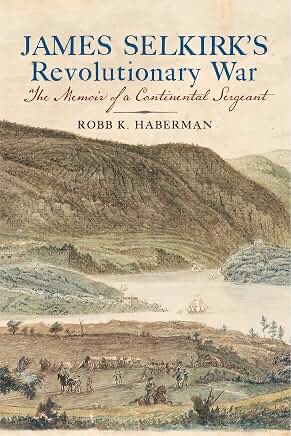
Haberman, Robb K., ed. James Selkirk’s Revolutionary War: The Memoir of a Continental Sergeant. Yardley, PA: Westholme Publishing, 2026.
Memoirs by Revolutionary War soldiers are rare. When a family offered access to a memoir by James Selkirk, their Revolutionary War ancestor, Robb K. Haberman jumped at the opportunity. The Fordham history professor produced an expertly researched and edited edition of Selkirk’s memoir, preceded by an introductory essay. Demonstrating extensive use of primary sources, Haberman consulted 10 archival and manuscript sources, including unpublished Selkirk family papers.
Selkirk’s memoir is one of three dozen surviving memoirs and one of the few diaries by an enlisted soldier that covers most of the 8-year war. It is also unique because only 42 pages were written entirely by him. Most of the remaining 200 pages were copied or summarized from David Ramsay’s History of the American Revolution, published in 1789. Late in life, Selkirk combined his personal experiences with Ramsay’s work to produce a “New and Complete History of the American Revolution,” possibly to secure much-needed financial support. Unfortunately, Selkirk died before publication, and the unfinished manuscript passed down through subsequent generations.
The memorialist was born in the Scottish Lowlands in November 1757 and emigrated to the Albany area of New York at 16, just before hostilities broke out. He worked as a tailor but enlisted in a New York regiment after turning 18. Selkirk served for 7 years and 2 months across three regiments. He participated in the 1777 Saratoga campaign, the 1778 abortive attack on Newport, Rhode Island, and served on the Yorktown siege lines in 1781.
However, readers should not expect authoritative accounts of the two major Patriot victories and one loss Selkirk experienced. Rather, the sergeant offers an exceptional on-the-ground view of soldiers’ daily lives and the basic challenges of survival. For example, early in the war, when salt was scarce, Selkirk traded his salt ration for fresh provisions from civilians (p. 121). Additionally, the New Yorker’s diary records several periods of dangerous illness, including ague, dysentery, and pleurisy.
Military life was difficult, with harsh penalties for rule infractions. Finding enough to eat was a constant challenge. During a New Jersey winter, even though Selkirk’s unit was issued raw corn, they could not eat it because the weather was so cold that the corn mill froze. The lack of food, clothing, and pay led many soldiers to commit crimes. Selkirk witnessed thieves whipped and deserters hanged or shot. He reported that even with the threat of capital punishment, desertions were rampant.
Selkirk witnessed the gruesome, intensely personal horrors of eighteenth-century combat. He visited the Oriskany Battle site several weeks after the clash. He described the carnage as “a place of great slaughter.” Whether factual or not, he observed that the dead Indians were only swollen and less mortified than the defeated New York militia. After witnessing the effects of battle, Selkirk fought in the brutal first and second battles of Freeman’s Farm. Later, a cannonball killed the person next to him, covering him in gore and injuring him with splinters.
Some of the most dangerous situations were not on the battlefield. Selkirk recounts how several soldiers died of exposure during winter travel in Rhode Island (p. 44). Even more perilous was his shipboard journey to Yorktown. His less-than-seaworthy ship ran aground, forcing him to swim to another vessel for help. During the trip, several soldiers died of sickness and exposure. Demonstrating that soldiers are often enterprising, Selkirk and some of his mates helped a privateer attempt to capture a British vessel. The attack failed, but Selkirk received one thousand dollars in Virginia money, about one dollar in specie, for his services (p. 90).
By the end of the war, Selkirk had been promoted to sergeant and received a Badge of Merit for six years of service, recognizing his leadership and competence as a soldier. His unit was discharged on June 7, 1783, a bittersweet moment for him. With no family in the United States, he worried about being alone. Camaraderie among soldiers is real. Selkirk viewed the soldiers in his company as the “children of one common parent” (p. 120).
Likewise, he felt “Ill Rewarded.” Discharged with only one week’s provisions and a promissory note, he sold the note at a steep discount to buy civilian clothes for travel back to the Albany area. Later, he received a 600-acre land grant in the Finger Lakes region, which he sold between 1784 and 1789.
Despite financial challenges, the rest of his life was happier. At age 28, he married Elizabeth Henry. Together, the couple raised eight sons and two daughters and supported their family through tailoring and farming. They lived in Bethlehem, New York, south of Albany, in a neighborhood now named after him. After the 1818 military pension act for indigent veterans passed, Selkirk qualified and soon began receiving payments. However, he died two years later, having received only $185.28.
The Selkirk family has given us an extraordinary gift by preserving James’s diary for the past 250 years. Each recovered story helps us better understand the challenges and opportunities of military life during the Revolutionary Era. Although he did not accomplish great things himself, his wartime experiences, along with those of his fellow enlisted soldiers, demonstrate the gritty, courageous, and loyal service required to prevail in the Revolution. Without the James Selkirks of the world, Americans would not have gained their independence.
Discover more from Researching the American Revolution
Subscribe to get the latest posts sent to your email.
