Book Review
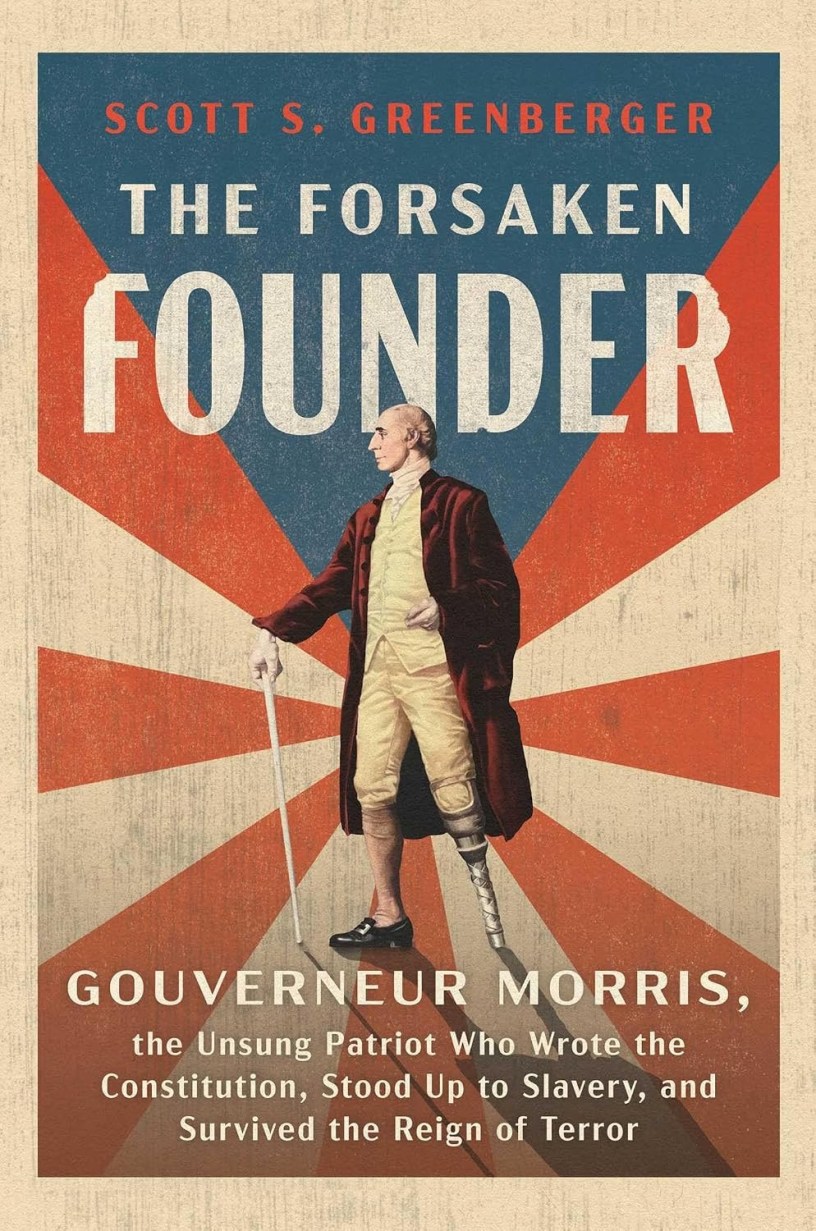
Greenberger, Scott S. The Forsaken Founder: Gouverneur Morris, the Unsung Patriot Who Wrote the Constitution, Stood Up to Slavery, and Survived the Reign of Terror. New York: 37 INK/Simon & Schuster, 2026.
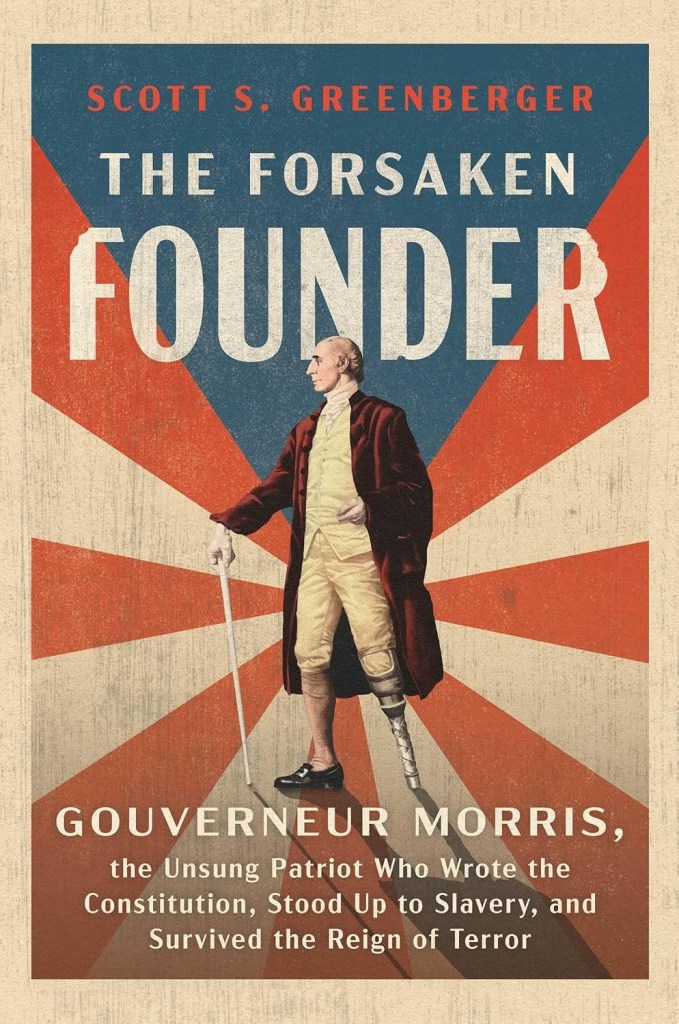
Revolutionary-era businessman, politician, and diplomat Gouverneur Morris is often reduced to an aristocratic philanderer and bon vivant. Journalist and editor Scott S. Greenberger argues that Morris’s reputation as a high-living libertine has overshadowed his important contributions to the nation’s founding. Notably, Morris took unpopular but principled stances in favor of popular sovereignty and against slavery and tyranny during the Revolutionary Era.
The author writes in an engaging style. He intersperses one- and two-sentence paragraphs to punctuate key points and keep the narrative easy to read. The book includes more than forty pages of footnotes and a comprehensive bibliography documenting Greenberger’s research. The author acknowledges earlier biographers, all of whom published their works more than twenty years ago.
The book follows the typical biographical arc, beginning with a brief history of his parents and ancestors. Three major contributions stand out.
First, Morris served on a Congressional delegation, empowered to improve the Continental Army’s fighting capacity and supply availability at Valley Forge. In this capacity, he developed a strong relationship with General George Washington. By addressing the military’s needs, the New York politician learned the importance of a national government with sufficient authority and revenue to provide for common defense and other national security requirements.
Second, as a delegate to the 1787 Federal Constitutional Convention, Morris made iconic improvements to the U.S. Constitution’s draft. He chaired the Committee of Style, which produced the final document sent to the states for ratification. Morris replaced the opening phrase of the Constitution, “We, the People of the States of… (listing the states)” with the nation-building “We, the People of the United States.” Moreover, Morris listed six broad goals for the Constitution: to form a more perfect Union, establish Justice, ensure domestic Tranquility, provide for the common defense, promote the general welfare, and secure the blessings of liberty. In addition to supporting popular sovereignty, Morris was an outspoken advocate of ending slavery but was outvoted in the final drafting.
Third, Morris made major contributions during the early years of the republic. He led the commission to survey and lay out New York’s street grid. Contrary to the common perception of his aristocratic nature, neither the east-west nor the north-south streets are named after prominent people or families. Additionally, the new street cut through several wealthy landowners’ properties, seizing valuable land for the public. Another contribution was Morris’s early support for a canal connecting the Hudson River with the Great Lakes. Although Morris did not live to see the Erie Canal open, he helped build the political consensus for its construction.
While the author highlights these major achievements, his assessment of Morris is not hagiographic. He notes that, like other founders, Morris had flaws, exhibited contradictory behavior, and failed to extend equality and freedom to all (p. 258). Most notably, Morris briefly flirted with the idea of a northern succession over slavery and the War of 1812 (p. 245). Although Morris did not organize or attend the potentially seditious Hartford Convention, which considered a northern response to the war, historians still tarnish his reputation.
While Greenberger recounts most of Morris’s contributions and failings, he overlooks or downplays several notable aspects of Morris’s life. As a New York delegate to the Second Continental Congress, Morris signed the Articles of Confederation on July 9, 1778, becoming the youngest signatory at age 26. Although he entered the Continental Congress in January 1778, after the text had largely been drafted and submitted to the states, he drafted and secured approval for a plan to secure unanimous acceptance of America’s first founding document.
Another area that deserves more attention is Morris’s views on religion and his personal religiosity. The author argues that Morris advocated religious freedom and keeping religion out of government, believing it was divisive and would distract from building popular support for the new republic. For example, Greenberger cites Morris’s successful resistance to efforts by John Jay, a fellow member of the 1777 New York Constitutional Convention, to bar Catholics from voting or owning land unless they swore an oath that a practicing Catholic could not sign in good faith (p. 46).
However, readers learn little about Morris’s personal religious beliefs, leaving unanswered several provocative questions about Morris’s faith. Did Morris inherit his father’s grudge against adherents of the Congregational faith? Did his teacher, a Swiss Huguenot, influence Morris’s religious beliefs? Did King’s College, known for religious toleration, shape Morris’s support for tolerating multiple faiths? Did Morris practice a personal faith? Another biographer concludes that Morris possessed “a deep religious conviction beneath his worldly exterior.”[i]
The author concludes by making a strong case that Americans have forsaken Gouverneur Morris as a first-rank founder. Other biographers have contributed to this neglect by characterizing him as a rake,[ii] an independent thinker,[iii] or a talented aristocrat.[iv] Alternatively, Greenberger argues that these portrayals are too simplistic and misleading. He posits that later generations regarded Morris less highly because he expressed unpopular opinions, such as ending slavery, and focused on fixing problems in his time rather than burnishing his image or writing treatises for posterity.
Perhaps the main reason people overlook Morris’s contributions is that he did not seek to advance party politics in the government structure he helped build. Although he leaned towards the Federalist Party, Morris “detested the hysteria” in both parties (p. 191). Morris believed party politics could get out of hand and harm the public’s well-being. Near the end of his life, Morris wrote, “Let us forget party, and think of our country” (p. 258). America’s best leaders have taken Morris’s advice.
[i] Max M. Mintz, Gouverneur Morris and the American Revolution, First edition (University of Oklahoma Press, 1970), 127.
[ii] Richard Brookhiser, Gentleman Revolutionary: Gouverneur Morris, the Rake Who Wrote the Constitution (Free Press, 2003).
[iii] W. H. Adams, Gouverneur Morris: An Independent Life (Yale University Press, 2014), https://books.google.com/books?id=xrsingEACAAJ.
[iv] Mintz, Gouverneur Morris and the American Revolution, vii.
Discover more from Researching the American Revolution
Subscribe to get the latest posts sent to your email.
