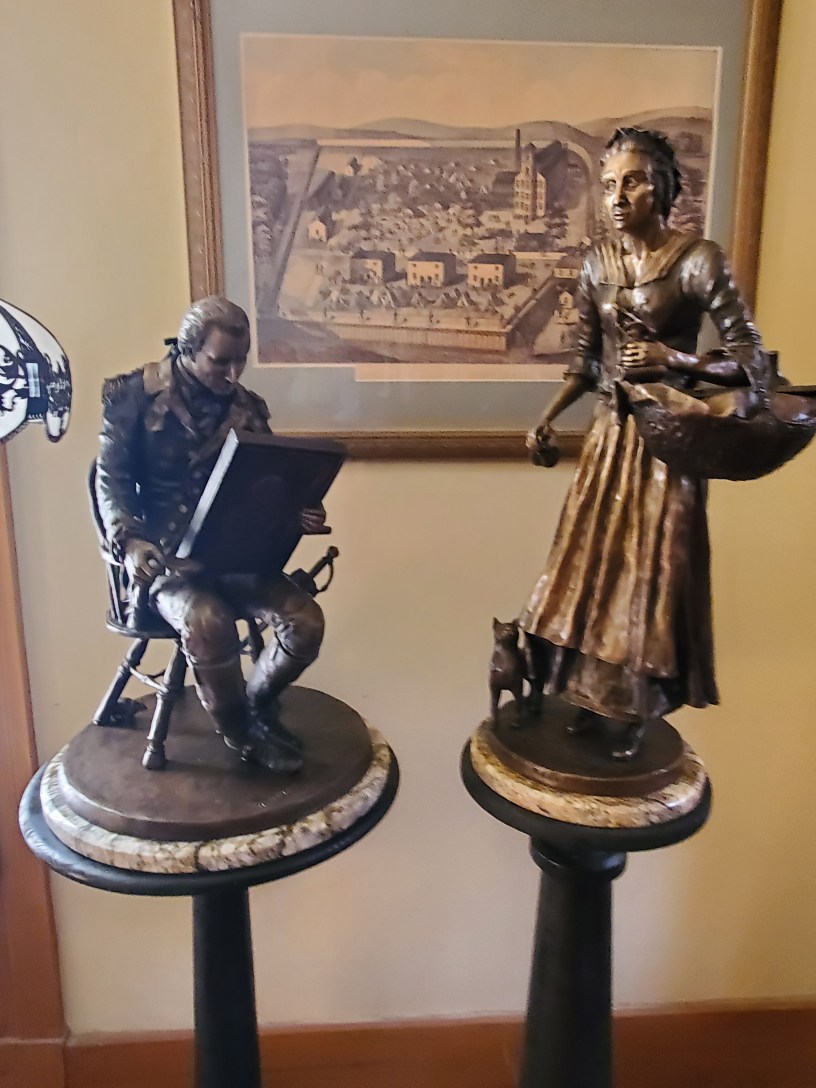
February 1781 was a dark month for Maj. Gen. Nathanael Greene, commander of the understrength Continental Army in the South. Superior British forces threatened to overtake the retreating Patriot army before they could cross the Yadkin River in North Carolina. Exhausted, hungry, and penniless, Greene stopped at a Salisbury tavern for a brief respite. What happened next inspired Chris Gilbert to sculpt figures of the general and the tavern owner as his celebratory contribution to America’s 250th anniversary.
Here is my conversation with artist and sculptor Chris Gilbert.
What is your background?
After high school, I enlisted in the US Army. During duty breaks, I visited the arts-and-crafts shop, where I first became interested in sculpture. Later, I enrolled in college, joined ROTC, and earned an officer’s commission. Upon graduation, I joined the National Guard as an engineering officer. I completed tours in many war zones, including Iraq, Afghanistan, Kuwait, Jordan, and the Horn of Africa. After leaving the Army as a Lieutenant Colonel, I served the University of North Carolina at Charlotte as a master planner. Later, I joined the Veterans Administration to oversee construction across seven health care networks.
How did you get interested in this story?
As a young boy, I was captivated by the American Revolution bicentennial celebrations. Harkening back to this experience, I wanted to honor the 250th. Living in the historic district of Salisbury, NC, and within walking distance of the Steel tavern site visited by General Greene, gave me the idea to combine my sculpting skills and an intense interest in the Revolutionary Era.
What transpired between Elizabeth Maxwell Steel and General Greene?
During the Revolutionary War, Salisbury served as a vital Patriot military hub, a supply depot, and a temporary waypoint for the retreating Continental Army in 1781. Following the Battle of Cowpens, the rebel army marched through Salisbury, pursued by the much stronger British forces. Initially, Greene planned to engage Lord Cornwallis in a major battle at Salisbury. However, he decided against it and retreated over the Yadkin River, seven miles north of Salisbury at Trading Ford.
While contemplating his options, an anxious Greene stopped at Steel’s tavern. Local legend has it that tavern owner Elizabeth Maxwell Steel aided a worn-out Greene. She provided food and shelter. Most crucially, she gave the general gold and silver coins to fund the Rebel army’s escape.
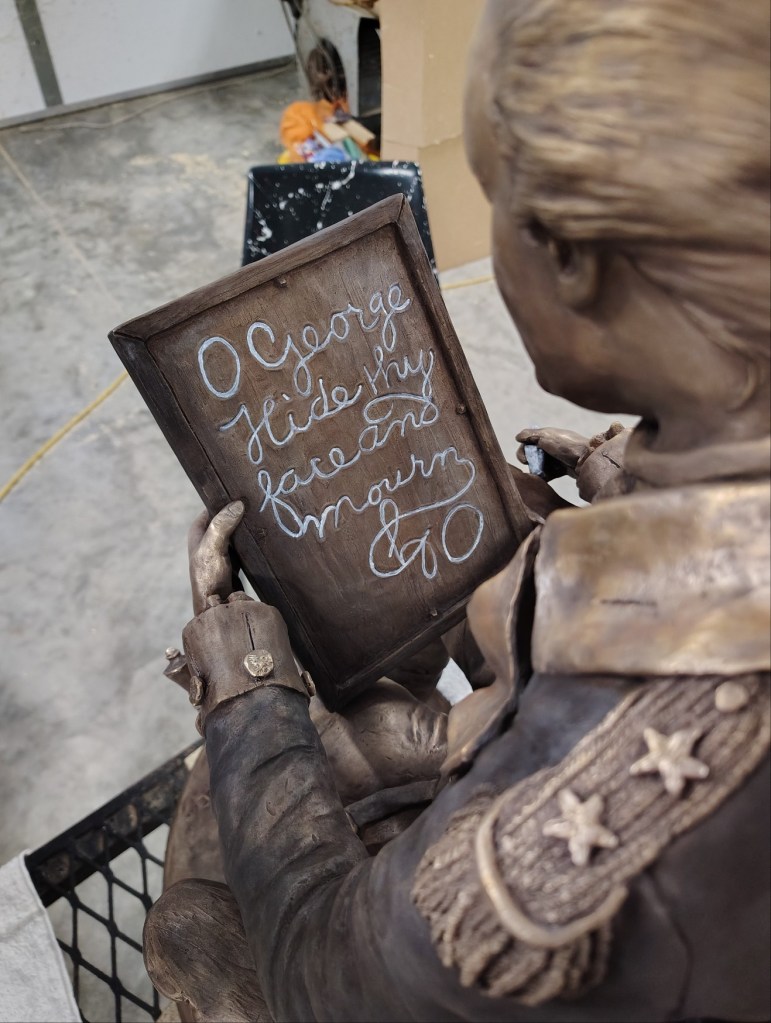
In return, the general took down a portrait of King George III from over the fireplace and wrote: “Oh, George, hide thy face and mourne” on the back. He then replaced the portrait backward, exposing the inscription. The pre-1780 mezzotint likeness of the English King with Greene’s snarky inscription hangs in the Thyatira Presbyterian Church today.
Describe your statues.
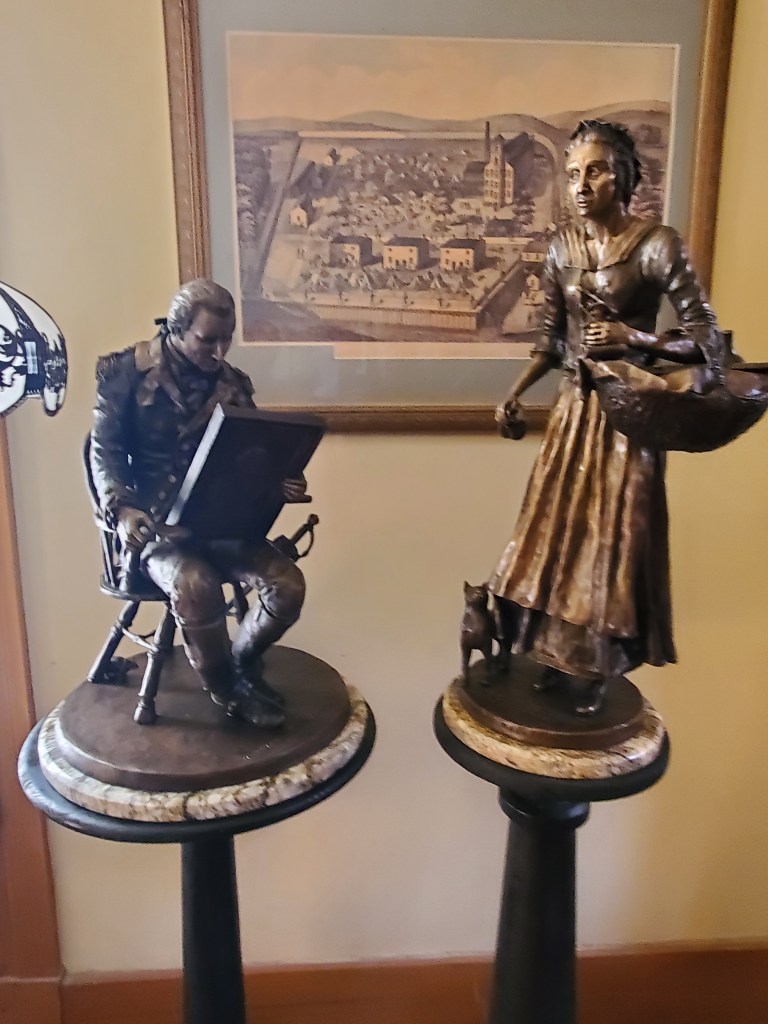
There are separate statues of Steel and Greene, each approximately one-half life-sized. They are meant to be displayed together, depicting a conversation between the two participants.
The Steel statue is entitled “Simple Gifts,” from the old Quaker song. Steel stands holding a basket, with a cat at her feet. The cat symbolizes the “cat-and-mouse” maneuvers between the British and Patriot armies in the Salisbury area. Her quote on the statue is “Take these, General. You need them, and I can do without them.”
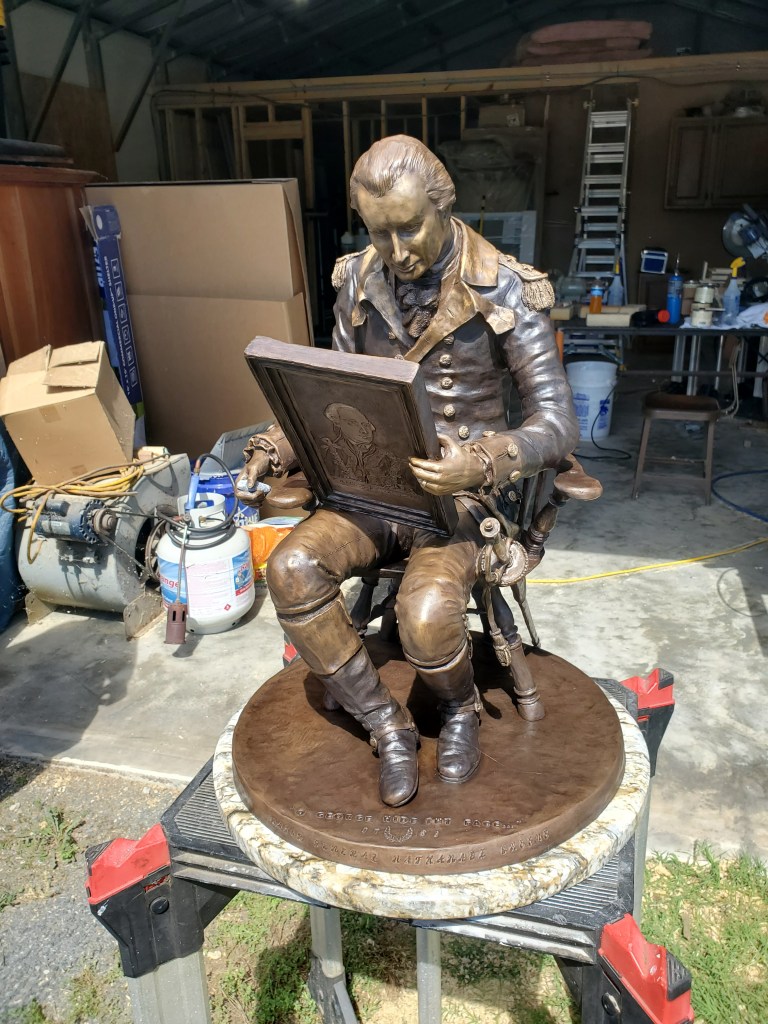
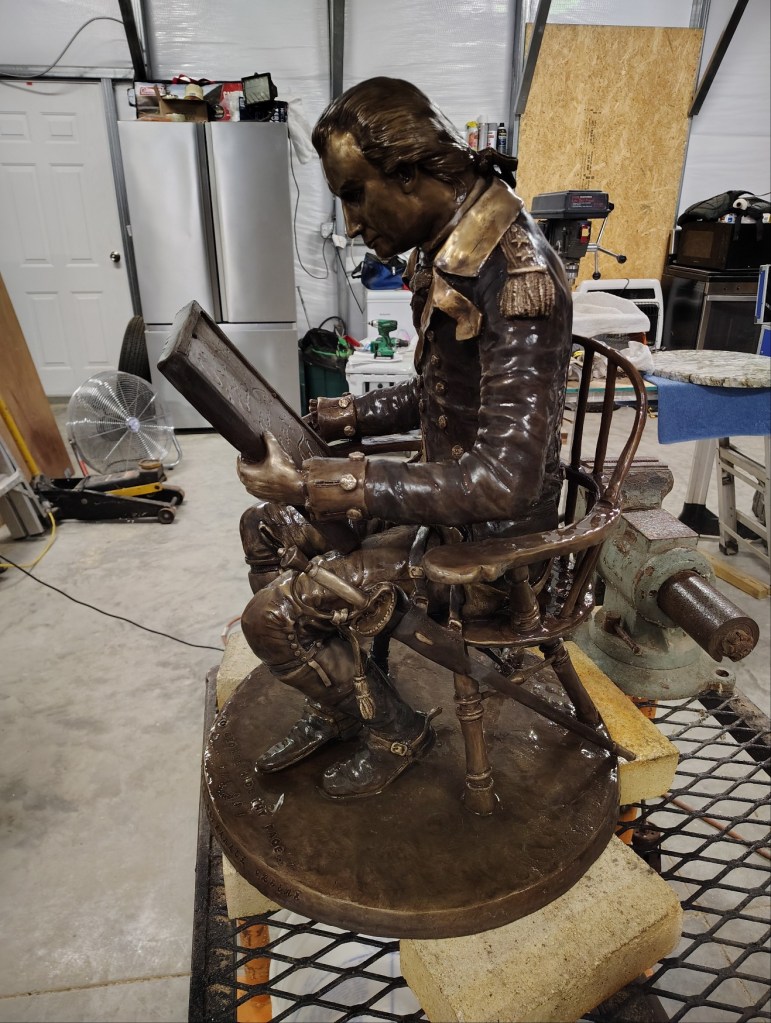
Greene’s statue is named “O, George, hide thy face.” Greene sits in a Windsor chair, inscribing the back of the King George III portrait with “O, George, hide thy face and mourne”. At his side is a sword, the original resides in the Rhode Island State house. Greene also secured 1700 arms in Rowan county vital for arming his needy troops.
What were the most challenging features?
I did not have a good model for the Steel figure. Elizabeth Steel died in 1790 without leaving a portrait or a detailed description of her likeness. I used later images of her son, John Steel, and two granddaughters. I worked hard to make her look like her granddaughters.
While there are many portraits and statues of Greene, sculpting his uniform presented special challenges. It is hard to find examples of the back of uniforms. I needed help from a reenactor to understand the general’s uniform. Greene’s uniform had special features, including buttons to hold the coat’s sides in place while riding and buttons at the back of the breeches to tighten or let out for more room.
How is it different from other statues depicting Revolutionary-Era figures and events?
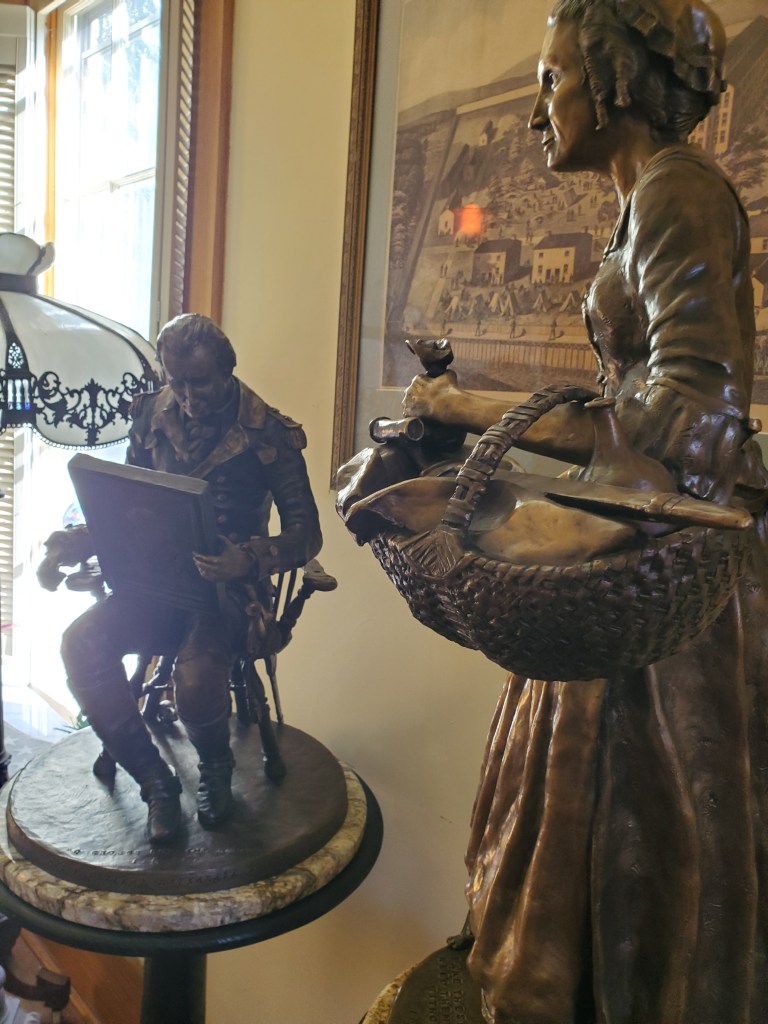
These statues are unique in terms of subjects and realism. There are few statues of colonial women. I had to research female colonial dress to design the Steel statue.
My statue is more realistic than the typical Greene statues in that it represents a quiet moment of frustration. Most Greene statues are romanticized and either depict Greene on horseback or standing heroically.
Where will it be displayed?
My number one priority is to help people understand this fascinating story. I am considering several options. I am consulting with local chapters of the Daughters of the American Revolution and the Sons of the American Revolution. Additional venues may include local historical sites and museums in North Carolina.
Did the Greene/Steel encounter happen?
The encounter between Greene and Steel passed from the oral tradition to the written historical record in the 1840s. Historians continue to cite the vignette. The last two Greene biographers have included the story. However, others are skeptical, as neither Greene nor Steel left a written account of the encounter.
While there is no direct primary-source substantiation, the meeting is plausible and supported by circumstantial evidence. Greene’s correspondence places him in Salisbury in early February, and Steel’s ownership and operation of the tavern is well supported. Her obituary hints at her support of the Continental Army, indicating that she was “distinguished during the war as a friend to her country.”
What is the story’s legacy?
Memorializing the Greene-Steel encounter is important to understand the lives of ordinary citizens and army combatants during the brutal conflict, regardless of whether it is apocryphal or true. General Greene pushed his army and himself to the limit to outfox the British forces. He had many nights of extreme fatigue with little food, as depicted in this story.
Likewise, tavern owners and residents, such as Elizabeth Steel, had to navigate the passage of opposing armies multiple times. It would not be surprising to have a picture of King George III for when the British came through, and to reverse it with a clever saying when encountering Rebel forces. This did not make Steel less patriotic, but able to survive the vicissitudes of war.
Are you working on any other Revolutionary Era projects?
I have three potential sculpting projects. The first is Daniel Boone, who lived as a boy near Salisbury. The statue would depict Boone sitting in front of Boone’s Cave on the Yadkin River.
The second is William Lee Davidson. The militia general died instantly on February 1, 1781, from a chest wound at the Battle of Cowan’s Ford while rallying his militia to protect Greene’s retreating army by delaying Lord Cornwallis’s British forces from crossing the Catawba River.
The third potential subject is Andrew Jackson, who studied law in Salisbury. There is spicy folklore about Jackson organizing a Christmas party, which might make for an interesting subject.
For more information
First entry into the written historical record – Foote, William Henry. Sketches of North Carolina – Historical and Biographical. (New York: R. Carter, 1846), 354-55 https://archive.org/details/sketchesofnorthc00foo/page/354/mode/2up.
King George III Mezzotint – Patriots, “Pirates,” and Portraits” Thyatira Church, AmRevNC Website, https://amrevnc.com/thyatira-church/.
Most Recent Nathanael Greene Biographies
Terry Golway, Washington’s General: Nathanael Greene and the Triumph of the American Revolution, 1st ed (H. Holt, 2005)
Gerald M. Carbone, Nathanael Greene: A Biography of the American Revolution, 1st ed (Palgrave Macmillan, 2008).
Discover more from Researching the American Revolution
Subscribe to get the latest posts sent to your email.

Fascinating history & exceptionally well written! The incredible statues bring the story to life!
LikeLike