Movie Review
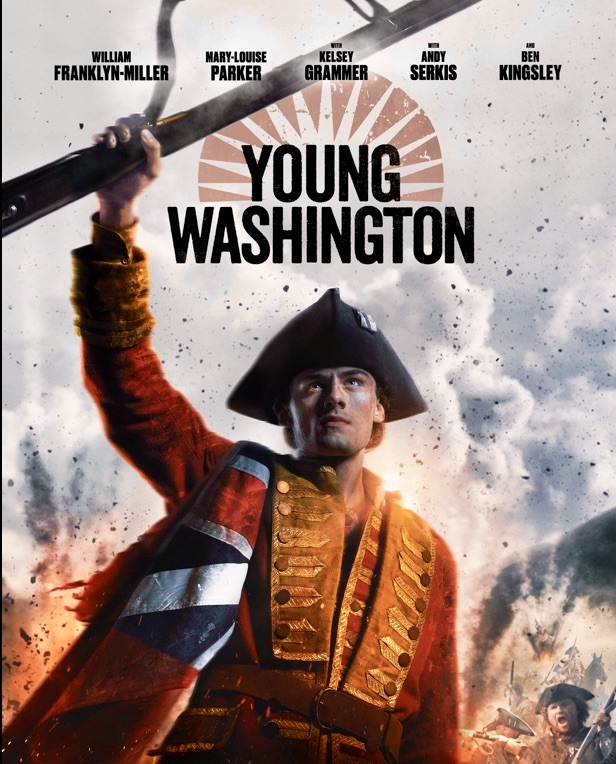
Erwin, Jon, dir. Young Washington. Biographical Drama. Angel Studios, 2026. Digital 2.39:1, 125 minutes. https://www.angel.com/movies/young-washington.
Stories of the American Revolution have not been popular with filmmakers and audiences, and few blockbuster movies have been made. Amid celebrations of America’s 250th anniversary, a new movie, Young Washington, depicts the first 23 years of George Washington’s life. Initial audience reactions are positive, with over 3.0 million tickets sold nationwide. The film’s most important aspects are its portrayal of prominent eighteenth-century themes, including personal ambition, providential westward expansion displacing Native Americans, and rising colonial/British antagonism. As the film generally follows the historical record, I recommend that viewers focus on these themes and key scenes rather than dwelling on the literary-enhancing inaccuracies.
The film’s pivotal moments are two infantry battles, both set in Southwestern Pennsylvania. This heavily forested, mountainous region was fiercely contested among the French, British, and Native Americans. In the first, Washington, then a colonial colonel, launched an ill-advised attack on a French diplomatic mission in 1754. Anticipating retaliation from larger French forces, he retreated to a meadow and built rudimentary but poorly sited fortifications known as Fort Necessity. After being surrounded and attacked by a combined French and Native American force, Washington surrendered his command. It was a devastating defeat and an embarrassing capitulation. A year later, Washington served as a volunteer aide-de-camp to British General Edward Braddock at the disastrous Battle of Monongahela, where French and Indigenous forces decimated a larger British Army. While Washington bears responsibility for the first defeat, in the second he rallied a rear guard to prevent an even greater loss and regained a measure of military reputation.
From a young age, Washington, played by British actor William Franklyn-Miller, was determined to advance his position in society. He was thwarted by being a second son and by a lack of formal education. In one scene, a wealthy planter called Washington a mere tenant farmer. Initially, Washington sought a British military commission to rise above his station. When that proved unattainable, he turned to land surveying and exploring the trans-Appalachian frontier, a potential source of wealth for those who acquired rights to these lands. His first surveying assignment for Lord Fairfax, along with an inheritance after his half-brother Lawrence died, propelled Washington into the Virginia gentry. He could now gain entry to flashy tidewater planter parties through the front door rather than the cellar door, as he had initially. Ambition proved to be one of Washington’s principal motivators throughout his life.
Next, the filmmakers highlight the providential reasoning of eighteenth-century American colonists and Indigenous people. A thrilling scene depicts a vulnerable, though providentially protected Washington in the vanguard of a brutal battle, leaving only bullet holes in his uniform and hat. After the battle, in an apocryphal vignette, opposing Native Americans seek a meeting with the courageous Washington, whom they believe exhibits god-like qualities, evading their musket balls. Next, Washington returns to Virginia’s capital to report the battle results. Seeing Washington’s bullet-torn uniform, the Royal Governor of Virginia (played by Ben Kingsley) expresses similar views to the Native Americans, believing that Washington received divine protection. The inability to kill Washington in battle becomes a metaphor for the widespread colonial-era view that a god-like being placed them on a new continent to exploit the vast richness of its interior.
The film’s third theme is the growing antagonism between British governors and officers and the colonists. Washington and his Virginia soldiers are treated as second-class citizens throughout the movie. Several scenes highlight the denial of equal rank and pay to colonial troops. Different battle tactics also demonstrate a growing disrespect between the British and Virginia forces. British officers denigrate the Virginians for not fighting in the line-and-rank formations used on open European battlefields. Conversely, the Virginians lose respect for the British because the latter fail to adapt their tactics to dense forests and rough terrain. Amid these emerging tensions, the movie teases the impending colonial crisis and the onset of the American Revolution.
I encourage viewers, especially historians, to overlook most of the film’s historical inaccuracies. Overall, Young Washington is more historically truthful than most films about the Revolutionary Era, especially The Patriot, which is grossly inaccurate yet widely popular. However, viewers should be aware of one misleading aspect of the film. The British commander of the advance guard, Lieutenant Colonel Thomas Gage, played by Michael Benz, was not insubordinate for retreating at the Battle of Monongahela, nor did he leave the Virginians to be slaughtered as depicted in the film. His orders that morning permitted him to withdraw if he encountered an overwhelming force. Further, Gage was wounded in battle, and there is no evidence that he acted cowardly.
Later, Thomas Gage, as Commander-in-Chief of British forces in America, would order the lightning-rod march to Lexington and Concord, the opening battle of the Revolutionary War. In a twist of fate, the two officers would lead opposing armies during the 1775 Siege of Boston. A scene late in the movie presages this impending imperial and personal conflict. Washington told Gage they were fighting for their land. Gage disagreed. He was in America as a professional soldier, doing his duty and trying to survive, whereas only Washington was fighting for his homeland.
The film highlights key aspects of Washington’s life: he was driven by ambition, sought land and military commissions to overcome class barriers, and believed in Providence and its influence on his life and opportunities. Many other founding citizens were similarly motivated and acted on those beliefs. I encourage viewers to experience the show without judging it by twenty-first-century mores. The film brings an often-marbled view of Washington to life and depicts the motivations and actions of Revolutionary-Era colonists. The movie offers something for everyone, whether to learn or simply to enjoy. Let’s hope it fosters interest in the nation’s founding and more Revolutionary-Era movies.
Discover more from Researching the American Revolution
Subscribe to get the latest posts sent to your email.
