
Book Review
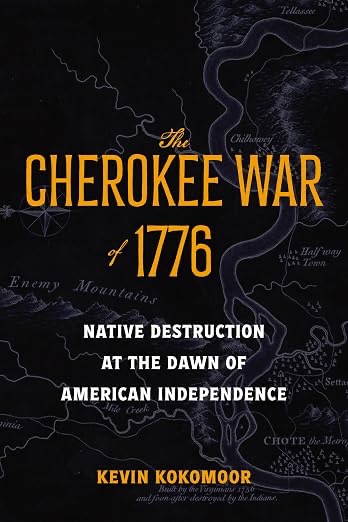
Kokomoor, Kevin. The Cherokee War of 1776. Johns Hopkins University Press, 2026.
Today, few people are aware of the Cherokee War of 1776. Historian Kevin Kokomoor, in his new book, argues that the Cherokee War of 1776 deserves more attention for its scale and impact. He offers two statistics as evidence. First, the history professor believes the Cherokee offensive in the war’s opening phase was the largest Native attack “in the history of Euro-Native warfare, at least since the (1717) Yamasee War” (p. 138). Second, he notes that more Americans fought in it than in the Battle of Bunker Hill, the 1775 invasion of Canada, and the well-known Battle of Cowpens. In fact, fewer American soldiers participated in the devastating Sullivan campaign against the Haudenosaunee Confederacy, which is the best-known campaign against Native Nations during the Revolutionary War (p. 5).
In his third book, the university professor does an excellent job of describing the military campaigns between the Cherokee Nation and militia units from South Carolina, North Carolina, and Virginia. The war began with Cherokee attacks on frontier areas in retaliation for squatting white settlers. The author makes clear that the Cherokee attacks occurred because they were “fed up” with white settlers and were not coordinated with British efforts to suppress the rebellion or with their attack on Charleston (p. 135).
In response to widespread Native attacks, the state militias launched coordinated strikes on Cherokee towns on both sides of the Appalachian Mountains. Native Americans generally retreated without engaging in pitched battles. Although the attacks did not destroy the Cherokees’ combat power, they devastated Indigenous families’ living conditions and economies. The militia burned fields, food stores, and homes, leaving the Cherokees without sustenance and shelter. While destructive, the author concludes that the militia invasion was an “unqualified strategic failure.” The militia did not accomplish the stated objective of “extirpating” the Cherokees, and the Cherokees may have killed more soldiers than the militia did (p. 185).
The historian of the eighteenth-century South argues that the colonialists’ revenge offensive was a cover for a war to control the Cherokee Lands. From a broader perspective, the author argues that the revolution was fought not only for ideological or political reasons but also to dispossess Native peoples of their lands and promote westward expansion by white settlers. In the author’s view, white settlers squatted on cheap land, provoking a Native response. While this assertion is hard to dispute, a more comprehensive inquiry would have included White immigrant voices. For example, many settlers were of Scots-Irish descent and had few alternatives. Describing their motivations and perspectives would better balance the historical record.
Likewise, Kokomoor includes few Native American voices. For example, the author characterizes the 1770 Treaty of Lochaber as “distressing” and “alarming” (p. 51). Whose perspective is the author expressing? The author offers no Cherokee voices to articulate these concerns; only a judgmental twenty-first-century perspective. Another historian cites the reaction of a Cherokee village headman during the treaty negotiations and his attempts to balance the Native Nation’s need to maintain open trade with white settlers while preserving boundary lines.[i] While there are fewer contemporaneous sources, there are accounts of Cherokee reactions written by White authors that, when properly interpreted, can balance the story. Additionally, the author could have included a brief bio when first introducing a Native leader. For example, Dragging Canoe is referenced without any explanation (p. 69).
The narrative presents a dizzying number of Indigenous towns and Native leaders’ names. The book includes eight maps – all detailed, hard-to-read historic maps. It is difficult, and sometimes impossible, to locate towns and geographic features on these eighteenth-century maps. The military campaigns would have been easier to follow with simplified, newly drawn maps. This would be especially helpful, as the war spanned six state lines and included many towns that no longer exist. A simplified map showing the Cherokee Nation’s extent, including its major population centers, would aid readers. Linking Cherokee leaders to the Lower, Middle, and Upper Towns would enhance readers’ understanding of their followership. A map showing their influence would further aid readers’ comprehension.
There are instances in which the author writes from a 21st-century perspective. For example, he characterizes the conflict as “a run-of-the-mill eighteenth-century land grab” (p. 196). Another example is his opinion that “Thank goodness the Virginians did not try to press their Ohio claims too hard …” during the negotiations over the Lochaber Treaty (p. 65). In other instances, Kokomoor uses emotive language to describe one side’s actions when it could apply to all participants. For example, he asserts “Native predatory violence” and “loyalist treachery” (p. 250).
At other times, the author is somewhat informal in describing British leaders and misidentifies them. He does not provide ranks when referring to British Army officers, relying on readers to know they were generals. Kokomoor misspells the name of British General James Paterson (p. 245). He adds the title “Sir” to Henry Clinton’s name before the King knighted him. Contrary to many historians’ views, the author characterizes Continental Army Major General Charles Lee as a “legendary hothead.”[ii] The book lacks a citation to support this assertion (p. 143). Further, he misrepresents British changes in command. Henry Clinton did not assume command of British forces in America from General Thomas Gage (p. 80), and General William Howe did not replace Henry Clinton as British Commander in Chief (p. 212).
From a broader perspective, the author offers provocative observations on the British strategy to subdue the Southern states in 1780-1. Initially, the British captured Charleston and most of South Carolina. However, the Southern commander in chief, General Charles Cornwallis, ordered the Cherokee Nation to refrain from fighting (p. 271). This was typical of both American and British commanders, who sought to defeat their opponents’ conventional armies in large battles, leaving Western frontier residents to fight among themselves. Kokomoor posits that if Lord Cornwallis had integrated Cherokee forces into his campaign strategy, the British might have retained control of the South Carolina backcountry. The author contends that improved Cherokee-British cooperation would have prevented the Loyalist militia’s catastrophic defeat at the Battle of Kings Mountain. While this may have been possible, Native American cooperation with British main armies, even when planned, such as the 1777 invasion from Canada, proved militarily ineffective. From a Cherokee perspective, they were first and foremost fighting for their existence. They participated in American or British operations only when they perceived benefits.
The author concludes that the War of 1776 was the “largest and most transformative reordering” of the Cherokee Nation since their “formation as a people. (p. 13). While the Americans and the British made peace, the Cherokee-White settler conflict continued for another decade after the 1783 Treaty of Paris. The author pronounces the conflict between the Americans and the Cherokee as the “longest, deepest-simmering Native conflicts in the history of pre-Removal America” (p. 13).
In the late 1790s, there was a period of peaceful coexistence. The author concludes that this peace ushered in a twenty-year renaissance in the Cherokee Nation. However, that prosperity ended with the Trail of Tears and the White dispossession of their territory. Despite a few foibles, Kokomoor makes a solid case that the 1776 Cherokee/Southern state militia war is an underappreciated conflict that warrants attention for a better understanding of the Revolutionary Era.
[i] Colin G. Calloway, The American Revolution in Indian Country: Crisis and Diversity in Native American Communities, Cambridge Studies in North American Indian History (Cambridge University Press, 1995), 189.
[ii] For an overview of Charles Lee’s character, see his latest biographer’s assessment Phillip Papas, Renegade Revolutionary: The Life of General Charles Lee (New York University Press, 2014), 12–13.
Discover more from Researching the American Revolution
Subscribe to get the latest posts sent to your email.

Nicely done review, Gene. I’ve conducted considerable research into the post-war move into the Old Northwest and might have to pick up this book just for comparative thoughts.
LikeLike
Mike, I will be interested in your Old Northwest work when available. Gene
LikeLike
I’m looking primarily at St. Clair’s Defeat on Nov. 4, 1791, and the impact it had on the brandy-new U.S. military and government. As usual, I take on too many projects and others, like that one, get set aside. I’m planning to get back on it for submission to the “Journal of the American Revolution.”
LikeLike