Book Review
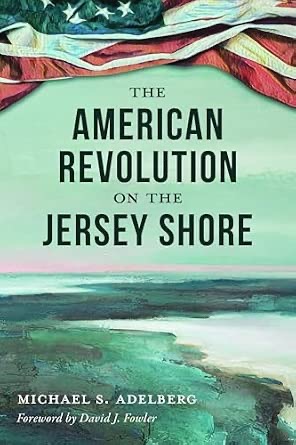
Adelberg, Michael S. The American Revolution on the Jersey Shore. The History Press, 2026. Paperback. https://www.arcadiapublishing.com/products/the-american-revolution-on-the-jersey-shore-9781467170604/.
Envision an impoverished, sparsely populated region prone to lawlessness, engulfed in a brutal partisan war that fuels war profiteering and trading with the enemy. That is how Michael S. Adelberg depicts the American Revolution along the Jersey seacoast. Drawing on more than thirty years of research on the Revolution in Southern New Jersey, he focuses his third History Press book on the 70 miles of coastline between Sandy Hook and Cape May.[i] Adelberg organizes his work thematically rather than chronologically, which aids understanding of complex, captivating events.
The first topic concerns salt production. While this might sound odd, salt was vital to the colonists’ diets because it was the only way to preserve meat. Amazingly, curing five pounds of pork required an equal weight of salt. Because Americans imported most of their salt, they sought domestic alternatives when the war interrupted trade. New Jersey marshlands offered an opportunity to distill seawater into salt. Jersey Shore residents built at least eighteen salt works. However, British raids, weather, and a lack of labor hindered production. At their peak, the Jersey saltworks produced two thousand bushels of salt per month, still not enough to meet demand (p. 40). By 1778, Americans resumed importing salt from non-British locations, and salt making on the Jersey Shore waned.
Next, Jersey Shore residents turned to privateering (legalized piracy) to support the rebellion and earn money. Although the Jersey Shore had only a few small natural harbors, small raiding privateers ventured from the coast to capture unarmed British merchant ships. Although hazardous, privateering proved profitable, injecting wealth into the depressed local economy. British commanders fought back, raiding and razing towns harboring privateers. Adelberg questions whether privateers were true Patriots or mere opportunists. Some privateers also traded with New York Loyalists.
The third topic is the London Trade, or trading by Jerseyans with the enemy. Because New York City was a short sail from South Jersey, ships could easily carry food and goods produced in New Jersey to the Loyalists and the British. Rebel leaders tried to stop the trade by legally impounding goods, making arrests, and conducting vigilante confiscations. Despite these efforts, the London Trade persisted, fueling lawlessness and providing resources to those opposed to the rebellion (p. 124).
The last topic is the exploits of the Pine Robbers. Enmeshed in myth and truth, the Pine Robbers were outlaw groups with Loyalist, questionable, or no allegiances. They robbed people to survive and melted into the pine barrens in the interior of South Jersey. Some robbers participated in the London Trade; others stole goods and money from illegal traders. A few Pine Robbers continued to prey on residents after the war, while most melted back into society. This is a good example that local civil wars end slowly (p. 165). While the Pine Robbers largely ended their thefts and arson after the British recognized American independence, myth-making continued. Several nineteenth-century accounts embellished their actions, keeping those memories alive today.
Two individuals play prominent roles in these four events – one Rebel and the other Loyalist. Both men skirted the law, led vigilante groups, and pursued victory for their side with relentless, brutal force. Vengeance and retaliation were common motivators.
On the Patriot side, the author judges David Forman “among the most important men in New Jersey in 1777” (p. 25). Forman served as a colonel in the Continental Army and as a Brig. Gen. of the New Jersey militia. While stationed on the Jersey coast, Forman was accused of self-dealing by using his Continental soldiers as laborers in his salt works. Later in the war, he resigned from the Continental Army, retained his state militia commission, and served as a judge in the Monmouth County courts. He also led a vigilante group known as the Retaliators. In this capacity, Forman may have arranged for his friends to buy livestock and goods impounded while on militia duty at below-market prices. However, the general counted New Jersey Governor William Livingston as a friend, and nothing came of the self-dealing charges.
For the first several years of the conflict, John Bacon supported the Rebel side at least through 1779, when he claimed a privateering prize for capturing a British ship. Shortly thereafter, Bacon wounded a Patriot soldier while defending his cargo bound for the London Trade. Next, he killed an arresting officer, marking him as an outlaw and firmly on the Loyalist side (p. 154). Bacon became the leading Pine Robber, plundering the homes of Rebel supporters and conducting armed attacks on county militia. Most notably, he led an attack on an unsuspecting militia camp known as the Long Beach Massacre. The nighttime assault killed or wounded twenty-one sleeping militia members (p. 156). New Jersey authorities had had enough and placed a bounty on his head. In March 1783, Bacon’s luck ran out, and Burlington militia members killed him at Egg Harbor.
The stories of these two individuals are fascinating and could have been introduced up front and used as threads to tie the four events together. Their stories also raise open questions. Why did George Washington and William Livingston hold Forman in high regard despite his self-dealing and vigilante methods? On the other hand, why did Bacon switch sides relatively late in the war and do so with great vengeance? Additionally, readers would benefit from a brief sketch of Forman’s life after the war.
On the other hand, Adelberg’s work offers several strengths. He cites prior scholarship throughout the book and acknowledges the expertise of historian David J. Fowler. This credibility-enhancing approach helps separate fact from myth, which is especially challenging in Revolutionary-era Jersey Shore. To buttress his arguments, Adelberg presents detailed data and charts. The author demonstrates that residents still suffered the war’s brutal effects even in areas that did not see major battles between conventional armies. The Jersey Shore communities faced violent lawlessness alongside a bitter civil war. I recommend The American Revolution on the Jersey Shore to readers seeking to understand the complex and deadly environment faced by ordinary Revolutionary-era Americans.
[i] Rumson Neck to Great Egg Harbor
Discover more from Researching the American Revolution
Subscribe to get the latest posts sent to your email.
