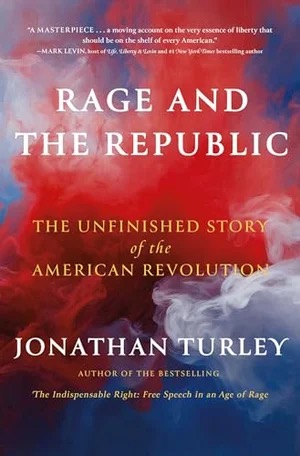
Turley, Jonathan. Rage and the Republic: The Unfinished Story of the American Revolution. New York, NY: Simon & Schuster, 2026.
A Scholarship Review
John Adams famously defended the British soldiers accused in the Boston Massacre, asserting that “facts are stubborn things.” The George Washington University law professor’s new book illustrates a growing challenge to Adams’s maxim and to the misuse of history to advance political advocacy. The popular TV commentator’s book is a commercial success. It ranks among the top ten on Amazon’s list of constitutional and democratic topics, and readers give it exceptional marks on book review sites. Few books on the American Revolution achieve this level of readership.
At a high level, the author’s thesis is that the political rights articulated in the Declaration of Independence and the US Constitution are vital to the nation’s ongoing journey toward living up to the nation’s founding ideals. The popular pundit sees storm clouds on the horizon today as popular rage, particularly from one faction, overtakes reason (p. xvi). Turley decries the growing abandonment of democratic safeguards and constitutional protections in the pursuit of immediate political objectives. It is hard to argue with this assertion, as one group is likely to apply it to others, which likely explains why the author’s book is so well received.
Upon closer examination, the author’s narrative featuring Thomas Paine’s role in the American and French Revolutions contains scholarly missteps and weaknesses. Unfortunately, readers without backgrounds in the late eighteenth-century revolutions are likely to be misled. Typically, a book review evaluates an author’s thesis and supporting arguments. However, in this case, the underlying historical analysis is the key takeaway for readers. Therefore, rather than a book review, this is a review of the scholarship that underpins the author’s historical arguments.
The best place to start when reading a book is to determine how it relates to established scholarship. How does the author build on previous studies? Turley relies extensively on secondary sources from a narrow subset of Thomas Paine biographies. He selects mainly self-published books, works by amateurs, or those that appear politically biased. Unfortunately, he does not consult some of the most authoritative biographies of Thomas Paine, such as John Keane’s Tom Paine: A Political Life, and omits major volumes published by academic presses, such as Eric Foner’s Tom Paine and Revolutionary America. The best practice is to use a wide range of scholarly sources, summarize their theses, and explain how your thesis and arguments differ. Readers want to know what is distinctive.
Next, readers should examine a historian’s tradecraft. The seven key elements of a historian’s methods include using primary sources, applying appropriate analytical depth, maintaining healthy skepticism, practicing objectivity, establishing context, avoiding anachronistic references and comparisons, and getting the facts right. Each is discussed below with examples from Rage and the Republic.
Primary sources provide direct, firsthand accounts created at the time under study. They are foundational, offering the best available evidence. Secondary sources, while often useful for evaluating different interpretations of events and people, can introduce errors into the author’s account. Unfortunately, Professor Turley relies mostly on secondary sources, particularly from previous Paine biographies, which, in several cases discussed below, lead to unintended errors. The author’s reliance on secondary sources for readily accessible primary source information is curious, as many primary sources are readily available online, such as Founders Online and the Benjamin Franklin Papers.
Contrary to best practices, Turley asserts monocausal explanations for complex events. For example, he cites, “At the time, there was no debate as to who was the “father of the American Revolution.’”[i] The law professor provides no contemporaneous evidence to support this assertion. He cites John Adams fuming about Paine 43 years later in a letter to Thomas Jefferson and George Washington recruiting Paine to address his soldiers, which he never did (p. xxi). In another case, Turley characterizes Paine as “The most influential voice of the American Revolution…” (p. xx). Certainly, Paine was one of the most influential voices, but it is hard to place him above Thomas Jefferson and the Declaration of Independence. Others such as John and Samuel Adams and John Dickinson could also make strong cases. It required a collective effort to make the case for and achieve independence.
In another example, Turley argues for a single cause of the American Rebellion. He asserts that Common Sense was the “missing reason for the revolution” (p. 23). While there is no doubt that Paine’s pamphlet advanced the Rebel cause, other factors included taxes, trade policies, abrogated rights, and oppressive British military rule. Turley appears to fall into the trap of “falling in love” with their protagonist. This tendency ensnares many writers, leading them to overestimate their subjects’ impact on people and events.
Oversimplification can also lead to reader doubt, confusion, and misunderstanding. Turley writes that General John Cadwalader was a hero at the Battle of Trenton (p. 68-69). Many readers will recall that his command failed to cross the Delaware River because of ice flows on Christmas night 1776 and that he did not participate in the famous attack on the Hessians. A few days later, he played a major role in holding the line against a determined British attack at the battle most often called Assunpink Creek, though sometimes known as the Second Battle of Trenton. Noting that Cadwalader was a hero at the Second Battle of Trenton would be accurate and avoid misleading readers.
Historians should use healthy skepticism before recounting as fact information provided in secondary sources or not supported by any source. Turley estimates that half a million copies of Common Sense were sold, one for every five people (free and enslaved) (p. 25). For this to be true, every free household would have to purchase a copy, even those who were illiterate or could not afford the 2 to 3 shilling purchase price. Historian Ray Raphael investigated this claim thirteen years ago and concluded that it was vastly overstated. On the low end, the Mount Vernon Library estimates that twenty-five presses printed approximately 50,000 copies. The most recent estimate by a professional historian is 120-150,000 copies.[ii] Certainly, Common Sense was widely read; there is no reason for the author to provide an obviously inflated number of copies sold.
Like sales of Common Sense, Turley estimates that Paine’s first edition of the Rights of Man sold one million copies (p. 94). While exact historical sales figures are notoriously difficult to pin down, historians generally estimate that publishers sold a few hundreds of thousands of copies. Overstating sales is not necessary for the reader to know that Paine’s Rights of Man was widely popular.
Another proper skepticism practice is to avoid citing apocryphal stories as fact. The author asserts that George Washington believed Paine was “the only writer who could reinvigorate his troops” (p. 24). The author references an account in an early biography of Paine by James Cheetham, which claims that Washington had Paine’s American Crisis No. 1 read to the troops before crossing the Delaware to attack the Hessian garrison the day after Christmas Day 1776. There are no contemporary accounts to corroborate this assertion, and Cheetham was not present and did not provide a source. A historian investigating the account concluded that he was “unable to find anything that supports Cheetham’s assertion about Washington’s orders and Crisis No. 1. Perhaps the story is true, but in this case saying so apparently makes it so.” While this story is widely recounted, it is not evidence that Paine’s writings were used by Washington to inspire the Continental Army.
Historians should also be skeptical of citing unverified information from a secondary source as fact. Drawing on a secondary source, Turley asserts “…when Common Sense came out, the Continental Army had reached one of its lowest points in morale and had been reduced to half of its size from just a year earlier” (p. 22). Thomas Paine published Common Sense in January 1776. A year earlier, the Continental Army did not exist. In the winter of 1776, a large Continental Army trapped the British inside Boston and enjoyed good morale. Turley likely mistook Common Sense for Paine’s American Crisis, which came out in December 1776, a low point for the American rebels.
Historians should present both sides of issues when there is a historiographic controversy. For example, Turley asserts that Paine’s initials, T.P., are on the 2018 discovery of Roger Sherman’s copy of a draft of the Declaration of Independence. The Thomas Paine Historical Society believes the T.P. most likely indicates Paine’s involvement in drafting the Declaration of Independence. Other historians are not convinced and offer divided interpretations. Readers would have been better served with a description of the controversy rather than presenting it as fact.
It is especially misleading not to present both sides of a controversy when the facts are murky, and evidence is scarce. The author presents Paine’s leak of confidential information about America’s diplomat in Paris, Silas Deane, as a common-man-versus-aristocracy dispute. Turley characterizes Deane’s actions as a Beltway leak today. He also quotes a Paine biographer who called Deane a scoundrel (p. 65). The matter was far more complicated than a dispute between a common man and an aristocrat over a leak. In fact, Deane’s main opponent was Arthur Lee, a wealthy son of a tidewater planter. The most recent Silas Deane biographer asserts that the former member of Congress did not personally profit from his diplomatic post.[iii]
However, even if Deane was double-dipping, Paine created a diplomatic firestorm. He jeopardized the Franco-American alliance. Paine’s actions were rash and hurtful to the American cause. Dealing with Deane’s purported malfeasance, if necessary, could have been done behind closed doors. Paine seemed to know better than the Congress. Whether Deane was a scoundrel or not, going after him publicly was not prudent when it jeopardized the French alliance. The author’s arguments would have been more persuasive if he had addressed the more balanced view of the Deane affair found in another Paine biographer’s work.[iv]
Clarity and context are critical to a historian’s work. Turley provides an example of why this is true. He provides a quote citing Adams, just the last name, from a secondary source. “Hereditary succession was attended with fewer evils than frequent elections.” (p.87). In the previous paragraph, the author referenced Sam Adams, leading to confusion over the quote’s authorship. However, John Adams wrote the passage in the 32nd and final essay of his Discourses on Davila (published in April 1791):
“All the nations of the world… had tried all possible experiments of elections of governors and senates… but they had almost unanimously been convinced that hereditary succession was attended with fewer evils than frequent elections.”
John Adams was not advocating for the U.S. to immediately institute a king or a hereditary nobility. Rather, he was analyzing human nature and political history. He argued that humans are driven by a desperate “passion for distinction” and power. In a pure republic, he warned, frequent popular elections for the top executive role would inevitably cause wealthy, ambitious factions to bribe, divide, and destabilize the nation. Historically, he claimed, ancient nations eventually chose hereditary succession not because it was perfect, but as a “lesser of two evils” to stop civil wars caused by disputed elections.
Historians avoid uncited, partial quotations. Readers should be able to verify that the context is appropriate. For example, Turley offers this John Adams quote without a citation, “Liberty, under every conceivable Form of Government, is always in Danger” (p. 44). He omits the crux of Adams’s argument from his 1773 Braintree Address. “There is Danger from all Men. The only Maxim of a free Government, ought to be to trust no Man living, with Power to endanger the public Liberty.” The omitted passages are required for readers to understand that Adams was concerned with the concentration of power in an individual, not the inherent dangers of government.
Historians should also be careful when comparing different time periods. The author offers an instructive example. He draws a comparison between competing factions in the French Revolution and the US Constitutional Convention. “The sans-culottes and the bourgeoisie are analogous to the division between the Constitutionalists and the Republicans” at the 1787 Philadelphia Constitutional Convention (p. 125). This is not a good comparison. While it makes an intuitive leap regarding “radicals vs. elites,” the historical realities, class dynamics, and political ideologies of the two groups are far too different for the analogy to hold. In the French Revolution, the sans-culottes versus the bourgeoisie was an explicit class conflict. There were no sans-culottes at the Philadelphia Convention. Every one of the 55 delegates was an elite, wealthy, property-owning gentleman—merchants, plantation owners, lawyers, and political elites. Additionally, the Constitutionalists were those supporting the 1776 Pennsylvania Constitution. Almost none of these men attended the national convention in Philadelphia. Comparing them collapses two entirely different historical contexts, misrepresenting both the French Revolution and the 1787 Philadelphia Convention.
All books have typos and errors, including the ones I have written. While some fact errors are benign, others mislead readers on important issues, especially those that detract from the author’s argument. For example, Turley quotes a Paine biographer who asserted that Paine sent a letter to John Adams in mid-1793. “I saw many of my most intimate friends destroyed” (p. 160). Paine did not write any letters to John Adams in 1793. The quote is from the preface of Paine’s Age of Reason, Part Two, published in 1795.[v] Turley’s objective was to show Paine’s growing realization that Paris was not a safe place for him. By 1795, he was safe living with American Ambassador James Monroe.
Other important fact errors include those that shed different light on events and people. Turley writes that Washington secured Paine’s position as a Secretary to the Committee on Foreign Affairs. This is not true. John Adams recommended Paine for the clerical position.[vi] This undercuts Turley’s assertion that Adams was widely jealous of Paine’s popularity. Additionally, a more skeptical historian would recognize that Washington stayed out of congressional affairs.
Another fact error gives the wrong impression. The author asserts that Congressional Delegate John Dickinson, who shared Paine’s views on natural rights, was one of two members to serve in the Continental Army (p. 37). Dickinson served in the Pennsylvania and Delaware militias, not in the Continental Army. While dozens of delegates to the Second Continental Congress held commissions in state militias, at least fifteen members served directly in the Continental Army.
Some fact errors can be caught and corrected by the reader, while others may mislead readers. For example, Turley states, “When the framers finally worked out the details of the Constitution on September 17, 1781, the draft was sent to the states for ratification” (p. 88-89). Informed readers will understand that the correct year for the US Constitution Convention is 1787, not 1781. However, on September 17,1787, the Constitutional Convention transmitted the newly drafted Constitution to the Confederation Congress, not the states. After consideration, the Confederation Congress sent it to the states for ratification on September 28th.
Rage and the Republic reflects an admirable objective of enhancing America’s ongoing efforts to achieve the ideals of the revolution. Additional attention to the historians’ tradecraft would aid this important objective. Additionally, all authors without extensive backgrounds in the American Revolution, by following historians’ best practices, can better assert their theses.
[i] Turley quotes “father of the revolution” from Joseph M. Hentz, The Real Thomas Paine (iUniverse Books, 2010), 218. Hentz, a history enthusiast in a self-published book, does not provide contemporary evidence. He offers his opinion that Paine’s accomplishments earn him the title of the father of the revolution.
[ii] Danielle Allen, Radical Duke: How One Aristocrat – and the American Revolution – Transformed Britain (Liveright Publishing Corporation, 2026), xxi.
[iii] Milton C. Van Vlack, Silas Deane: Revolutionary War Diplomat and Politician (McFarland & Company, Inc., 2013), 9.
[iv] John Keane, Tom Paine: A Political Life, 1st ed (Little, Brown, 1995).
[v] Thomas Paine, Collected Writings, The Library of America 76 (Library of America, 1995), 731.
[vi] Confirmed by Paine’s most authoritative biographer. Keane, Tom Paine, 154–55.
Discover more from Researching the American Revolution
Subscribe to get the latest posts sent to your email.

An excellent critical review of the book. Based in this I can’t seem myself investing in the volume.
LikeLike