Book Review
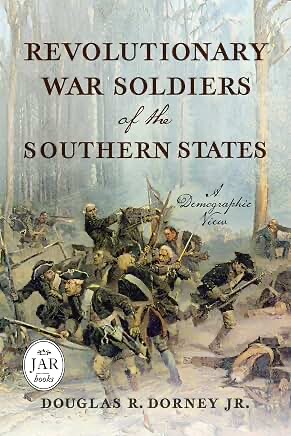
Dorney, Jr., Douglas R. Revolutionary War Soldiers of the Southern States: A Demographic View. Westholme Publishing, 2026.
Countless biographies document the lives and contributions of Revolutionary War generals and senior field officers. However, far less is known about the common soldiers who served in the Continental Line, state armies, and militias.Typically, accounts of Revolutionary War battles and campaigns portray combatants as nameless, faceless people whom generals move around the battlefield like chess pieces. Douglas R. Dorney, Jr., a dedicated Revolutionary War researcher, helps us better understand their backgrounds and contributions by examining Federal pension applications.
Dorney, a licensed architect, designed and built an electronic database of pension records for 8579 veterans from the four southernmost of the thirteen colonies. Over a period of four years, he included all known pension applications from Georgia (338), North Carolina (4616), and South Carolina (1375). Due to the large volume of Virginia pension applications, he included a fifth to a quarter (2250) of the total, which he believes is a representative sample. The pension records contain 130,000 items of information (p. x).
Soldiers and sailors primarily received pension benefits under three legislative acts. Beginning in August 1776, disabled soldiers and sailors could receive a pension from the Continental Congress for as long as they remained disabled. The US Congress enacted a second pension benefit in 1818 for veterans facing economic hardship. To be eligible, men had to serve at least nine months in the Continental Army or Navy. An 1828 modification extended full pay to enlisted men and officers who served until the war’s end. A major expansion of pension benefits occurred in 1832. All soldiers who served in any branch for six months, along with their wives and descendants, were eligible for a pension, regardless of economic need (p. xiii).
Despite the passage of years, the 1818/1832 acts yielded 53,910 pensions out of 57,623 awarded (p. xiv). The author estimates that ten to twenty percent of soldiers filed pension applications (p. xiv). The pension applications generally contain about a dozen data points (xv). Applications under the 1818 act are generally less detailed than those filed under the 1832 act.
The book is chronologically arranged over the course of a soldier’s life. There are eight chapters depicting birth years, residence, military units, lengths of service and number of enlistments, years enlisted and ages, battles and skirmishes, prisoners, soldiers’ possessions, occupations, literacy, naming patterns and heights, and the location of pension applications. A ninth chapter focuses on minorities including enslaved and free African-Americans, people of non-Christian and Catholic faiths.
Each chapter features clear, easy-to-read charts summarizing the author’s analysis. In addition to the data tables, Dorney includes compelling stories from individuals. For example, Sarah Tyry filed a widow’s application in 1837. She included a letter to her soldier husband, a Virginia militiaman, describing the terrible burden his absence was causing the family. Touchingly, she hoped he would continue as a wagoner to avoid combat. Her husband did return home and lived until 1833. Four years later, Sarah filed a pension application from Smith County, Tennessee. These stories are among the book’s highlights. They demonstrate the range of experiences and show that there is no such thing as a typical soldier (p. 237).
While there are variations, a summary analysis posits a broad set of interesting conclusions for the four southern states. Most pension-seeking soldiers and sailors were born between 1755 and 1764. For all states, Virginia was the most likely birthplace. Pensioners averaged five feet seven inches. They appear to have been among the least wealthy citizens, likely encouraging them to complete the paperwork required to substantiate their service and demonstrate their lack of financial resources.
The soldiers and sailors were more racially diverse than commonly portrayed. At least 900 free and enslaved Black men served in military units. Men of color predominantly served in the Continental Line and applied for pensions at higher rates than white soldiers (p. 125). While pensioners were overwhelmingly white Protestants, a few were Native Americans, Jewish, or Catholic men.
In the Southern states, militia service was most common, with 70% of the pensioners serving only in the militia and 20% only in the Continental Army. The remainder served in both types of military units. The Continental Army soldiers most likely served one enlistment; militia most likely two to four enlistments.
A significant number were in at least one battle, ranging from 58 percent to 86 percent depending upon state. While many fought in multiple battles, the most prevalent battle varied by state: Virginia and North Carolina (1781 Guilford Courthouse), South Carolina (1781 Eutaw Springs), and Georgia (1781 Siege of Augusta). Additionally, many pensioners cite undefined or Native American skirmishes. There were a high number of prisoners of war, a decreasing percentage from south to north: Georgia (25%), South Carolina (22%), North Carolina (15%), and Virginia (8%).
After the war, the veterans were exceptionally mobile. At least 60 percent relocated to other states. Many migrated over the Appalachian Mountains to new homes in the west or southwest. Few went to Florida or settled west of the Mississippi River. Less than half filed pension applications from the state where they served, with the migration percentage increasing from north to south (p. 227-8).
The author highlights several lessons learned that will inform his further research and encourage others to investigate the pensioners. During his work, the author believed that capturing the monetary value of soldiers’ assets, marital status, and battle wounds would have yielded valuable insights (p. xix). Additionally, to his credit, the author experimented with artificial intelligence but found it distorting and unhelpful (p. 242). Instead, he used traditional spreadsheet technology.
Despite AI’s current limitations, I encourage the author and other researchers to continue experimenting with the new technology. The pace of advancement is stunning. For example, just a couple of years ago, handwriting transcription tools provided little value; today they greatly accelerate the interpretation of eighteenth-century cursive documents. In the end, there will always be data gaps and anomalies, but emerging technology will better guide researchers in understanding them and correcting their interpretations. The new technologies will correct transcription and other errors that the author correctly notes are unavoidable in hand transcription (p. xxii).
The author concludes with provocative questions still to be answered and ideas for extending research on pension records. For example, a soldier’s rank might shed light on differences in wartime and postwar experiences between officers and enlisted men. Additionally, a similar study of northern pensioners could yield interesting insights into regional differences.
The demographic view of Revolutionary War soldiers from the Southern states helps humanize them and deepens understanding of their lives. Data junkies will be fascinated by the tables and statistics. Readers captivated by individual soldiers’ stories will enjoy the snippets from the pension applications. All those interested in the Revolutionary War will benefit from insights into the variation in experiences by state and type of military service. Hopefully, the author and other historians will extend research into new states and additional data types.
Discover more from Researching the American Revolution
Subscribe to get the latest posts sent to your email.

Thank you Gene! I am currently researching the “middle” states of Maryland and Delaware. Even at this early stage I can tell there are many demographic differences compared to southern pension appllicants.
LikeLike