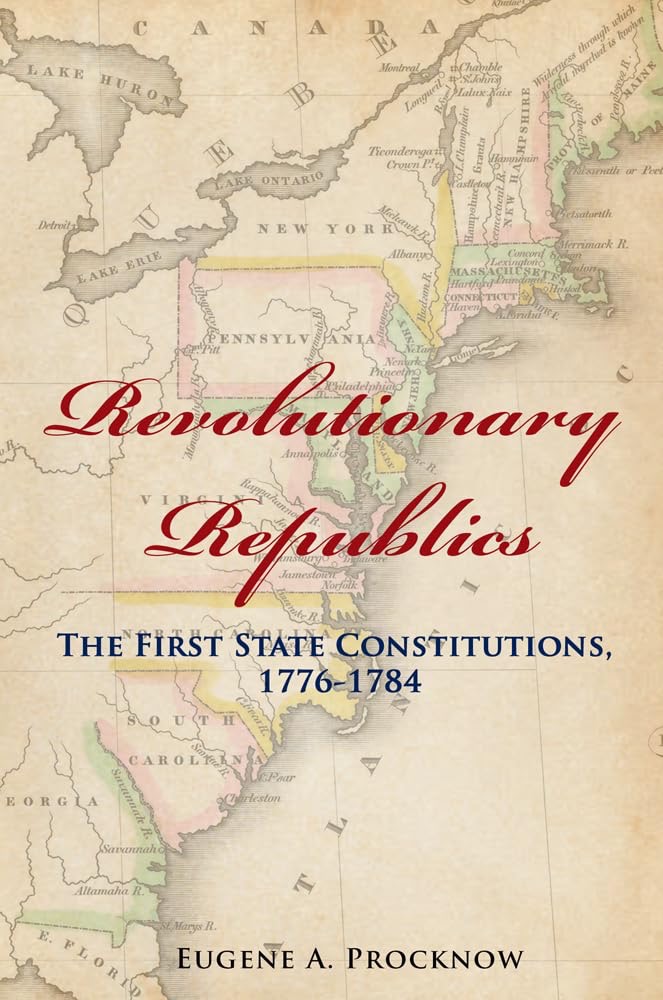
… the publication of “Revolutionary Republics: The First State Constitutions, 1776–1784” by Eugene A. Procknow, published by Oxford Southern, the academic imprint of Sunbury Press.
John Adams believed that establishing new governments was far more dangerous than confronting the British on the battlefield. Procknow examines the hazardous breakdown of royal authority between 1775 and 1784, prompting an unprecedented wave of constitution-making. The new state constitutions fundamentally transferred legal sovereignty from the British Crown directly to the individual states. This monograph addresses a half-century gap in dedicated scholarship regarding the first thirteen state constitutions enacted during the American Revolution.
Historiographical Focus & Key Monograph Themes
- The Allocation of Sovereignty: Following the Continental Congress’s resolution of May 15, 1776, individual states assumed full sovereign authority—including taxation, lawmaking, and public safety—while delegating only military defense and international diplomacy to the Continental Congress.
- Three Waves of Constitutional Innovation: The study traces the chronological evolution across three distinct waves of drafting, from early emergency frameworks in New Hampshire and South Carolina to permanent republican structures in Virginia, Pennsylvania, Maryland, and the 1780 Massachusetts Constitution.
- Declarations of Rights: Seven states and the Republic of Vermont codified enumerated Declarations of Rights that served as a superset of the liberties later embodied in the U.S. Bill of Rights.
- Suffrage Expansion vs. Officeholding Restrictions: The volume details how states broadened the voting electorate by lowering property requirements or adopting taxpayer-based suffrage, while paradoxically elevating financial and property thresholds for higher legislative and executive offices.
- Institutional Restraints on Power: Reacting against royal executive overreach, early framers constructed institutional safeguards including weak gubernatorial powers, annual legislative elections, strict term limits and rotation in office, multi-officeholding prohibitions, and explicit civilian subordination of the military.
- Unfinished Constitutional Business: Procknow critically analyzes how early state constitutions confronted—or evaded—the crucial issues of race, slavery, and indigenous sovereignty, highlighting early anti-slavery provisions in Vermont, judicial freedom suits in Massachusetts, and Delaware’s ban on the slave trade alongside persistent racial exclusions.
Advance Praise & Scholarly Testimonials
“With [this work], Eugene Procknow provides a vital addition to the history of the American Revolution. This superbly researched book is a must-read for anyone interested in representative government in the United States. If you have ever asked yourself, ‘How did we get here?’ then this is the book for you!” — Dr. Marianne Holdzkom, Author of Remembering John Adams: The Second President in History, Memory and Popular Culture
“Eugene Procknow’s book is essential reading for Americans who want to understand why our government works the way it does. The U.S. Constitution was the culmination of a century of experimentation and debate that, in many respects, began with Britain’s Glorious Revolution. The defining moment of that era was the remarkable decade of constitution-making that accompanied the American War for Independence… What sets the American Founding apart is what these former colonies did with theirs. That is the story Mr. Procknow tells in this important book.” — Gabriel Neville, Author of The Last Men Standing: The 8th Virginia Regiment in the American Revolution
“Eugene Procknow reveals that the American Revolution was a complex movement of competing ideologies, agendas, and goals. This book is required reading for the 250th Anniversary and beyond.” — Brady J. Crytzer, Author of The National Road: George Washington and America’s First Highway West
About the Author
Eugene A. Procknow is an independent researcher focusing on the American Revolutionary Era constitutionalism and military history. He holds master’s degrees in history and business from Norwich University and the University of Michigan. His first book, William Hunter – Finding Free Speech – A British Soldier’s Son Who Became an Early American, was published in 2022. Procknow’s scholarship has appeared in peer-reviewed journals including the Journal of Military History, the British Journal of Military History, and the Journal of the American Revolution.
For more information, click on the link below for my author website
https://www.eugeneaprocknow.com
To purchase the book from Amazon.
Discover more from Researching the American Revolution
Subscribe to get the latest posts sent to your email.
